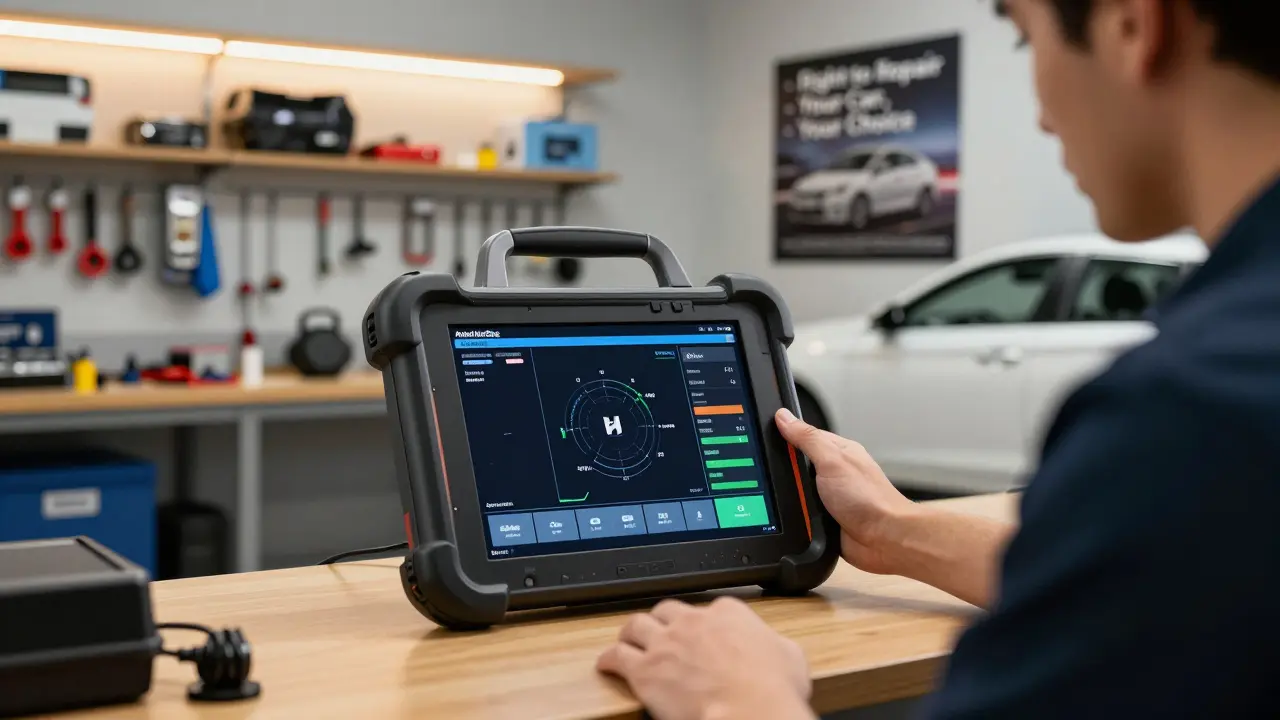
For decades, car manufacturers made it nearly impossible for anyone but their own dealerships to fix your vehicle. If your check engine light came on, you had two choices: pay the dealership’s steep labor rates or risk voiding your warranty by taking it somewhere else. That’s changing - and fast. Right to repair laws are now rolling out across the U.S. and Europe, forcing automakers to open up access to tools, software, and data that mechanics need to fix modern cars. This isn’t just about saving money. It’s about shifting power back to consumers and independent repair shops.
What Right to Repair Actually Means for Cars
Right to repair isn’t a buzzword. It’s a legal requirement. In 2024, Massachusetts passed a sweeping law that forced all carmakers selling vehicles there to provide standardized diagnostic access. By 2025, the U.S. federal government followed suit with a rule from the National Highway Traffic Safety Administration (NHTSA) that requires manufacturers to offer repair information, tools, and software to independent shops on fair and reasonable terms. The same rule applies in the EU under the 2023 Right to Repair Directive.
Before these laws, manufacturers locked diagnostic systems behind proprietary software. Even basic code readers couldn’t pull data from newer vehicles without a factory-licensed tool. That meant independent shops couldn’t diagnose issues like transmission glitches, battery drain, or software glitches in infotainment systems. If you needed a simple reset after replacing a sensor, you had to go to the dealer - and pay $120 for a 15-minute job.
How Modern Cars Made Repairing Harder
Modern cars aren’t just metal and engines anymore. They’re rolling computers. A 2025 Toyota Camry has over 100 electronic control units (ECUs) managing everything from adaptive cruise control to climate settings. Each ECU talks to the others through a network called CAN bus. To fix something, a mechanic needs to communicate with each one - and that requires access to the same software the factory uses.
Manufacturers claimed this was about safety. They argued that letting third parties access software could lead to hacking or unsafe modifications. But that excuse didn’t hold up. In 2023, the U.S. Government Accountability Office found no verified cases of a vehicle being compromised because of independent repairs. Meanwhile, the average repair cost for a software-related issue at a dealership was $437. At an independent shop with proper access, it was $122.
The Impact on Independent Repair Shops
Before 2024, independent repair shops were already struggling. A 2022 survey by the Automotive Service Association (ASA) showed that 68% of small shops couldn’t service vehicles made after 2018 because they lacked diagnostic access. Now, that’s changing.
With mandated access, independent shops are finally able to compete. Tools like the Autel MaxiSys MS908 and Launch X431 V+ now work with 95% of 2020+ vehicles. These tools cost under $5,000 - far less than the $25,000 factory scanners dealerships use. And because independent shops aren’t tied to OEM profit margins, they can offer repairs at 30-50% lower prices.
Shop owners report a 40% increase in customer traffic since 2024. One shop in Ohio went from servicing 12 cars a week to 47. They now hire two additional technicians and have expanded their bay space. This isn’t an exception - it’s the new norm.
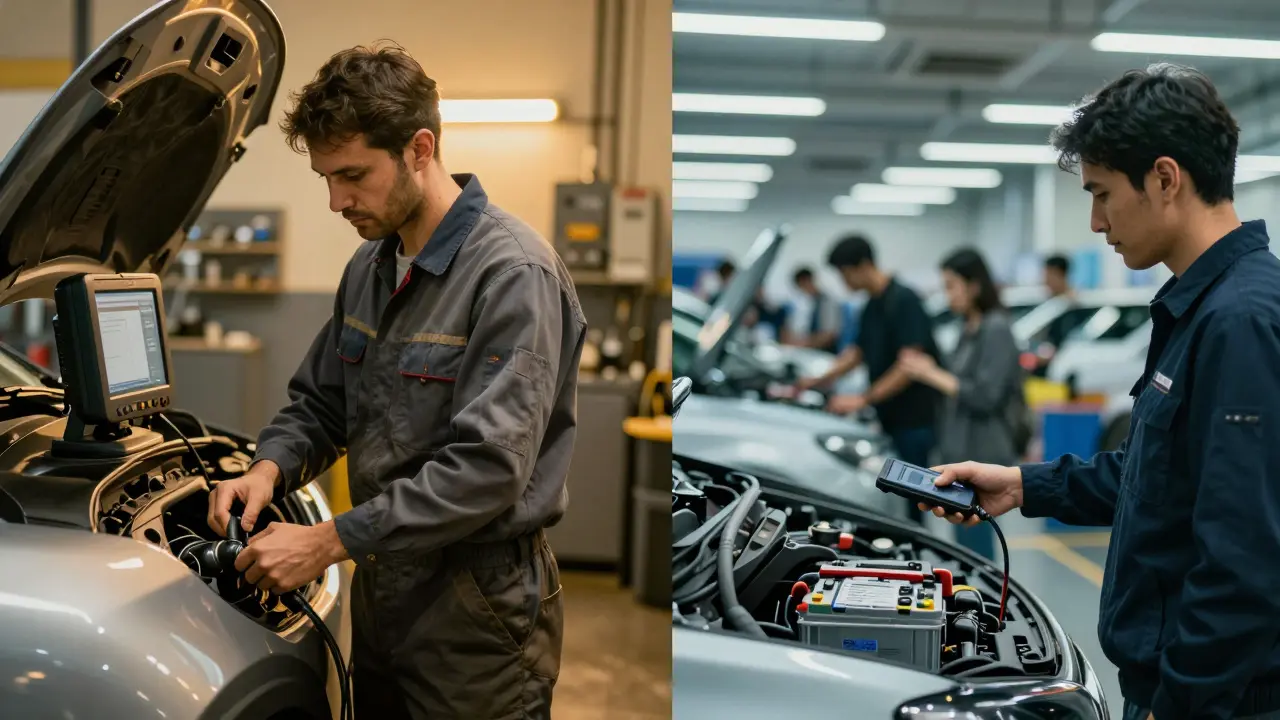
What About Warranty and Safety?
Manufacturers still warn that independent repairs could void warranties. But federal law now says otherwise. Under the Magnuson-Moss Warranty Act, automakers can’t void a warranty just because you used an independent shop - unless they can prove the repair caused the failure. That’s huge. It means if your transmission fails and you last had your brakes done at a local shop, they can’t blame it on you.
As for safety, the NHTSA now requires all diagnostic tools sold under right to repair laws to include security checks. These tools can’t be used to alter safety systems like airbag calibration or brake torque settings. They can only read and reset codes. That keeps safety intact while opening access.
How This Affects You as a Driver
Here’s what this means for your wallet and your choices:
- You can now take your car to any qualified shop - not just the dealership.
- Repairs for software issues, sensor replacements, and ECU resets cost 30-60% less.
- You’re no longer stuck waiting weeks for a dealership to get a software update from the manufacturer.
- Used car values are rising because buyers know repairs are easier and cheaper.
- Repair shops can now offer transparent pricing - no more surprise fees for "dealer-only" diagnostics.
One driver in Florida saved $1,100 on a battery replacement and software recalibration that would’ve cost $1,750 at the dealer. She took her 2023 Honda Accord to a local shop that had just bought a $4,200 diagnostic tool. The job took two hours. The dealer quoted her a week-long wait.
What’s Still Holding Back Repair Access
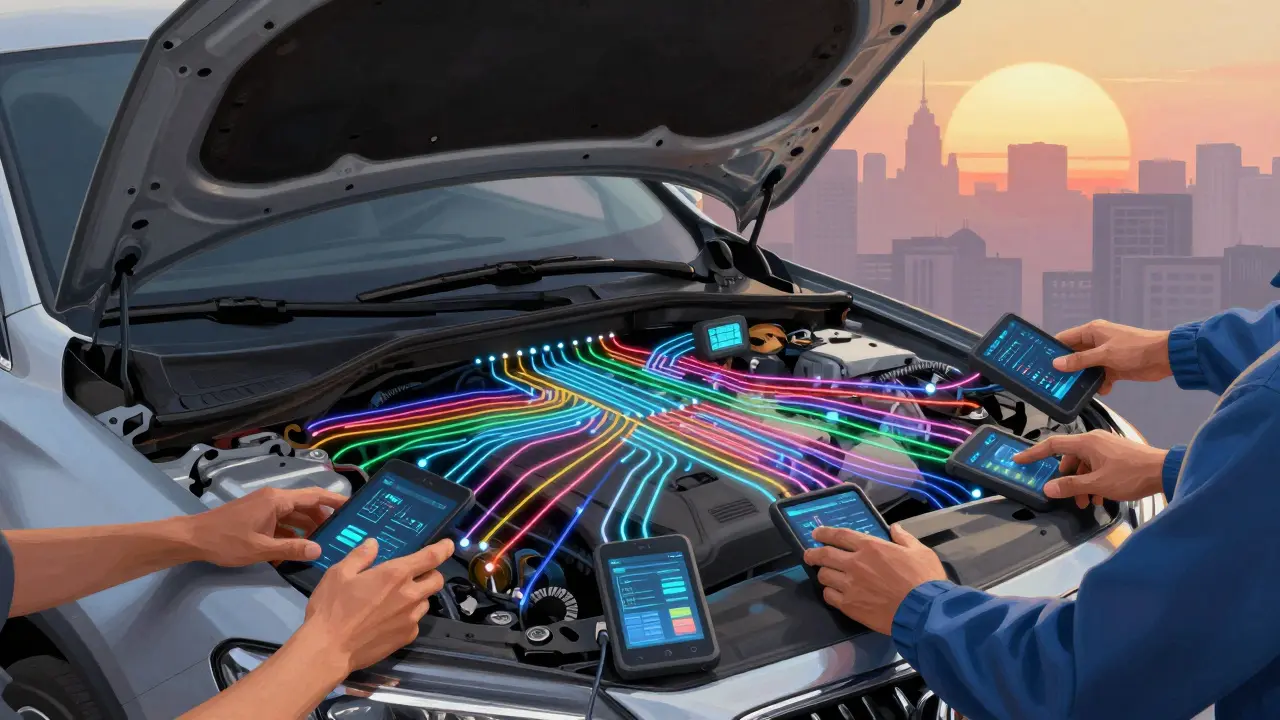
Not everything is fixed. Some manufacturers still use loopholes. A few brands require you to log into a portal with a VIN and account - which sounds fine until you realize you need a factory login to get the software update file. Others embed repair data into encrypted cloud systems that only work with their own apps.
The 2025 federal rule requires data to be accessible via open API, but enforcement is still patchy. The ASA is pushing for mandatory public API documentation by 2027. Until then, some shops still struggle.
Another issue: training. Many independent shops don’t have the budget to train staff on new software. That’s why organizations like the National Institute for Automotive Service Excellence (ASE) are now offering free certification courses on modern vehicle diagnostics - funded by federal grants.
The Bigger Picture: Repair as a Movement
This isn’t just about cars. Right to repair is part of a global shift. From smartphones to tractors to medical devices, people are demanding the right to fix what they own. The auto industry is just the latest battleground.
When you buy a car, you own it - not the company that made it. Right to repair laws are finally recognizing that. They’re reducing waste, cutting repair costs, and giving power back to the people who actually drive the vehicles.
By 2027, experts predict that over 70% of vehicle repairs in the U.S. will happen outside dealerships. That’s not just a trend - it’s a revolution.
Can I still take my car to the dealership after right to repair laws pass?
Yes, you can still go to the dealership. Right to repair laws don’t eliminate dealerships - they just give you more options. Dealerships still offer factory-trained technicians, genuine parts, and extended warranties. But now, you’re not forced to go there. You can choose based on price, convenience, or trust.
Do right to repair laws apply to electric vehicles (EVs)?
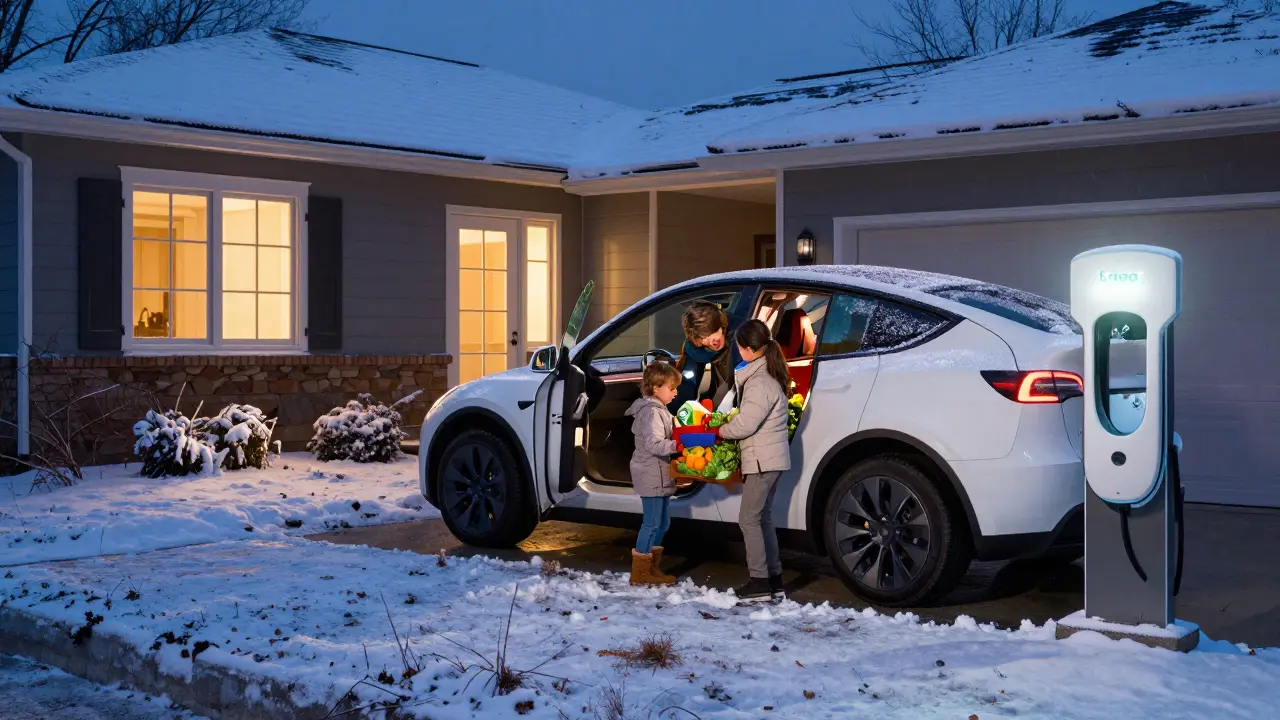
Yes, and EVs are actually one of the biggest drivers of these laws. Electric vehicles have more software, more sensors, and more complex diagnostics than gas cars. Tesla, Ford, and Rivian all had to open up their diagnostic systems by 2025 to comply with federal rules. Independent shops can now read battery health, motor performance, and charging system logs - something they couldn’t do before.
Will my car’s warranty be voided if I use an independent shop?
No, not unless the independent repair directly caused the problem. Federal law under the Magnuson-Moss Warranty Act protects you. The manufacturer must prove that the repair - not normal wear, a manufacturing defect, or unrelated issue - caused the failure. Most of the time, they can’t. This gives you real freedom to choose where you get your car fixed.
Are there any downsides to right to repair in the auto industry?
The biggest challenge is the learning curve. Many independent shops still lack the training or tools to handle modern systems. Some manufacturers still delay releasing diagnostic data, and not all tools are equally reliable. But these are growing pains - not reasons to block access. Over time, as more shops adopt the tools and training becomes widespread, these issues will fade.
How do I know if a shop can repair my car under right to repair laws?
Ask if they use a diagnostic tool that supports your vehicle’s make and model year. Most shops will say they’re "right to repair compliant" if they have tools from Autel, Launch, or Snap-on that support 2020+ vehicles. You can also check the shop’s website - many now list which vehicle brands and years they can service. If they can’t, they’ll likely tell you why - and may even refer you to someone who can.


pk Pk
March 2, 2026 AT 11:53Finally, some justice for regular folks. I used to get ripped off every time my Honda needed a simple reset. Now my local shop fixes it for a third of the price. No more dealership drama.
And yeah, I know some folks still cling to dealerships like they’re sacred temples-but let’s be real, they’re just profit machines in nice uniforms.
sumraa hussain
March 2, 2026 AT 23:07So… we’re saying cars are just computers on wheels now? I mean… wow. I’ve been driving since 2005 and I never thought I’d need a software license to fix a sensor. This feels like the future… but also like a trap. Who’s gonna teach grandpa how to plug in a scanner? And why does it feel like we’re being sold a revolution that still needs a user manual?
Raji viji
March 3, 2026 AT 06:51LMAO the manufacturers crying about 'security risks' while charging $400 to reset a tire pressure light. That’s not safety-that’s corporate extortion. They’ve been holding your car hostage for a decade. And now they’re whining because someone finally took the keys away?
Meanwhile, independent shops are making bank on $5k tools while dealerships are stuck selling $25k scanners like they’re holy relics. The real scam? You paying for their monopoly rent. Time to burn the whole system down.
Rajashree Iyer
March 4, 2026 AT 23:43Isn’t it beautiful? We’ve been conditioned to believe that ownership is a myth-that once you buy something, it belongs to the corporation that made it. But now, with every diagnostic port cracked open, we’re reclaiming not just our vehicles, but our autonomy. This isn’t about cars. It’s about sovereignty. The moment you can reset your own ECU, you stop being a consumer… and become a person again.
Tarun nahata
March 6, 2026 AT 12:44THIS IS THE BEST THING TO HAPPEN TO DRIVERS SINCE THE INVENTION OF THE GEARSHIFT. I took my 2022 Hyundai to a garage in Bangalore and paid $90 for a battery recalibration that would’ve cost me $1,400 at the dealer. They even gave me a coffee and a high-five.
Independent shops are the unsung heroes of modern mobility. Let’s fund them, shout their names, and never go back to dealership hell again.
Aryan Jain
March 8, 2026 AT 11:35Wait. So now anyone can hack into your car? What’s next? Someone resets your airbag and you die in a crash? They say 'no safety risk' but what about the ones they don’t report? I’ve seen documentaries. Hackers are already out there. This is just the beginning. They’re gonna turn every car into a remote-controlled drone. You think you own your car? You’re just a data point now.
Nalini Venugopal
March 10, 2026 AT 05:41Just a quick note: 'ECUs' should be capitalized as 'ECUs' throughout, and 'CAN bus' should always be capitalized. Also, 'right to repair' is a proper noun in this context, so it deserves the capitalization. Small things, but they matter. And hey-this is amazing news. Finally, someone’s listening!
Pramod Usdadiya
March 10, 2026 AT 10:41im so happy this is happening!! my uncle runs a small shop in delhi and he just bought a launch x431 last month. now he can fix my cousins tesla and my ford. before this he was like 'i cant do anything after 2018'... now hes hiring two more guys. i love this. also sorry for typos im typing on my phone and my thumbs are tired lol
Aditya Singh Bisht
March 10, 2026 AT 18:50This is more than a law-it’s a movement. Every time you choose a local mechanic over the dealership, you’re voting with your wallet for fairness, for sustainability, for dignity.
Imagine a world where your car doesn’t own you. Where repairs aren’t a ransom. Where knowledge isn’t locked behind corporate paywalls.
That world is here. And it’s not just possible-it’s already happening. So go find your local shop. Support them. Tell your friends. And don’t let anyone tell you this isn’t revolutionary. It is. We’re living it.