Modern cars aren’t just faster or more fuel-efficient-they’re smarter. Features like automatic emergency braking, lane-keeping assist, and blind-spot monitoring aren’t luxury add-ons anymore. They’re standard. And here’s the thing: your insurance company notices. If your car has these systems, you could be paying hundreds less each year. Not because you’re a better driver, but because the car itself is helping prevent crashes before they happen.
What counts as an advanced vehicle safety system?
Not every driver assistance feature qualifies for a discount. Insurance companies aren’t just looking for fancy gadgets-they want proof it reduces claims. The systems that consistently lower accident rates get the most attention. Here’s what actually matters:
- Automatic Emergency Braking (AEB): Detects vehicles, pedestrians, or cyclists ahead and applies brakes if you don’t react in time. This alone can cut front-end collision claims by up to 50%, according to the Insurance Institute for Highway Safety (IIHS).
- Lane Departure Warning (LDW) and Lane Keeping Assist (LKA): Alerts you if you drift out of your lane, and some systems gently steer you back. These reduce single-vehicle run-off-road crashes by nearly 30%.
- Blind Spot Detection (BSD): Warns you when a vehicle is in your blind spot. Studies show it cuts lane-change crashes by 14%.
- Adaptive Cruise Control (ACC): Maintains a set distance from the car ahead. Reduces rear-end collisions, especially on highways.
- Reverse Automatic Braking: Stops your car when backing up and detects objects or people behind you. Prevents low-speed parking lot accidents-common and costly.
- Driver Attention Monitoring: Watches for signs of drowsiness or distraction and alerts you. Less common, but gaining traction with insurers.
These aren’t just features on a brochure. They’re data points insurers use to calculate risk. If your car has three or more of these, you’re likely eligible for a discount.
How much can you actually save?
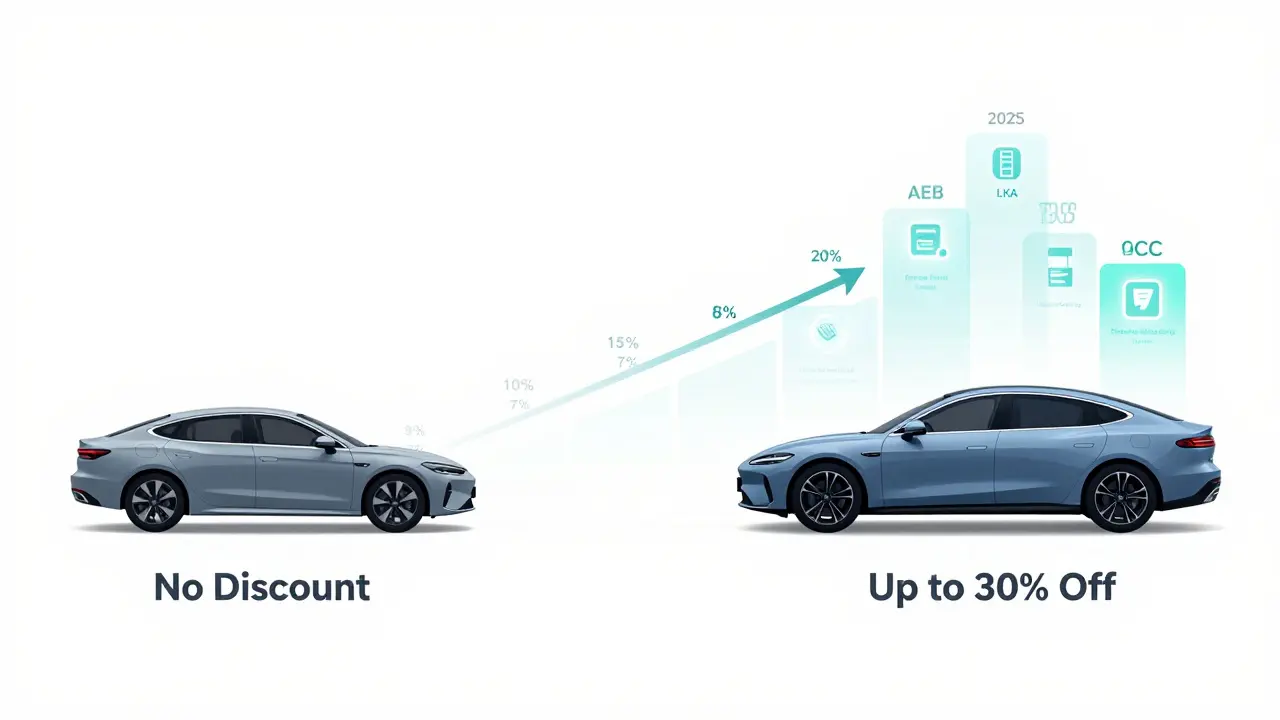
Discounts vary by insurer, state, and vehicle model-but the numbers are real. In 2025, the average discount for vehicles with advanced safety systems was around 15%. Some drivers saw as much as 30% off their collision and comprehensive premiums. That’s $450 to $900 a year on a typical $3,000 policy.
For example, a 2024 Honda Accord with standard AEB, LKA, and BSD gets a 22% discount from State Farm. A 2025 Toyota Camry with the same setup saves 25% with Geico. Even older models (2020 and newer) with factory-installed systems qualify. Aftermarket upgrades? Usually don’t count. Insurers want factory-integrated systems that were tested and certified.
Some companies even offer tiered discounts. If your car has five or more systems, you might get an extra 5% on top of your base discount. It’s not a flat rate-it’s a sliding scale based on how much your car can do to prevent accidents.
Why do insurers care so much?
Because accidents cost money. And advanced safety systems reduce those costs. In 2024, IIHS reported that vehicles with AEB had 47% fewer insurance claims for property damage and 53% fewer claims for bodily injury compared to vehicles without them. That’s not a small difference-it’s a game-changer for insurers.
Think of it this way: if your car can stop itself before hitting a stopped vehicle on the highway, the insurer doesn’t have to pay for repairs, rental cars, medical bills, or legal fees. That’s money saved. And they pass some of that savings to you.
It’s not charity. It’s smart risk management. And it’s why insurers are now pushing drivers to upgrade. Some even offer apps that sync with your car’s safety systems to track how often features are activated. More usage? More savings.
How to get the discount
It’s not automatic. You have to ask. And you need proof.
- Check your policy: Log into your insurer’s website or app. Look for a section called "Safety Features" or "Vehicle Discounts." Some list qualifying systems by make and model.
- Find your car’s safety specs: Go to the manufacturer’s website or your owner’s manual. Write down every safety system your car has. Don’t guess-be specific.
- Call your agent: Say: "My car has [list systems]. Do I qualify for a discount?" Agents have access to internal discount tables that aren’t always online.
- Ask for documentation: If they say yes, ask for a written confirmation. Sometimes discounts are applied retroactively if you prove you’ve had the car for a while.
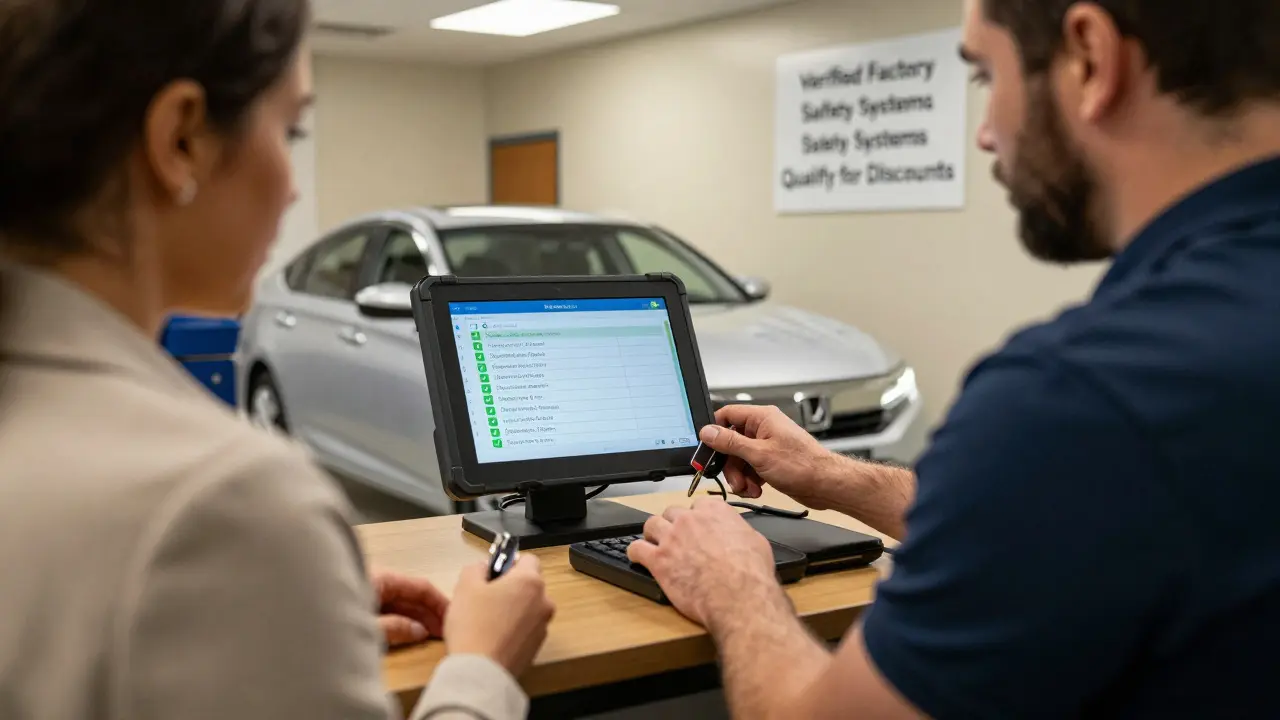
Pro tip: If you bought your car used, make sure the safety systems are still active. Some features (like automatic braking) can be disabled during repairs or software updates. Insurers may require a diagnostic report from a dealership to verify everything’s working.
What if your car doesn’t have these systems?
You’re not out of luck. You can still lower your premium-but not through discounts. Consider:
- Upgrading your car: If you’re due for a new vehicle, prioritize models with standard safety tech. Even mid-range cars like the Hyundai Elantra or Kia Forte now come with full safety suites.
- Telematics programs: Many insurers offer usage-based programs (like Progressive’s Snapshot or Allstate’s Drivewise). They track your driving habits via a plug-in device or app. Safe driving can save you 10-30%-even without advanced systems.
- Driver training: Completing a defensive driving course often gets you a 5-10% discount. Some insurers offer online courses for under $20.
But if you’re serious about cutting costs, the smartest move is to drive a car that helps prevent accidents before they happen. That’s where the biggest savings are.
Top insurers offering the best discounts in 2026
Not all companies treat safety tech the same. Here’s who’s leading the pack:
| Insurer | Average Discount | Best For | Notes |
|---|---|---|---|
| State Farm | 20-25% | Family sedans | Offers up to 30% with 5+ systems; no device required |
| Geico | 18-28% | Hybrids and EVs | Applies discount automatically if system is listed in their database |
| Progressive | 15-22% | Young drivers | Combines safety discount with telematics for extra savings |
| USAA | 25-30% | Military members | Requires factory-installed systems; no aftermarket |
| Allstate | 12-20% | Urban drivers | Offers bonus discount if you use their app to track safety system usage |
USAA consistently tops the list, especially for drivers with full safety suites. But if you’re not eligible for USAA, State Farm and Geico are your best bets. Progressive is great if you’re already using telematics.
What to watch out for
Discounts aren’t guaranteed. Here are the common pitfalls:
- Aftermarket systems don’t count: Adding a $200 camera or radar module won’t help. Insurers only recognize factory-installed systems that meet federal safety standards.
- Used cars need verification: If you bought a used car with safety tech, you may need a dealership diagnostic report to prove the systems are active.
- Discounts aren’t permanent: If you switch insurers, you’ll need to re-qualify. Don’t assume your new provider knows your car’s features.
- Some states limit discounts: California and New York restrict how much insurers can discount based on safety tech. Always check local rules.
And remember: a discount isn’t a reason to drive recklessly. These systems help, but they don’t replace attention. Always stay alert.
What’s next for safety tech and insurance?
By 2027, the NHTSA will require AEB on all new passenger vehicles. That means almost every car on the road will have it. Insurers are already preparing for that. Expect discounts to become standard-not optional.
Some companies are testing real-time discounts based on system usage. If your car’s automatic braking activates 10 times in a month, you might get a bonus. If it never activates? You’re driving safely. You still get the discount.
Eventually, safety tech might replace traditional driver scoring. Your car’s behavior could matter more than your driving record. That’s the future-and it’s already here for those who drive smart cars.
Do all insurance companies offer discounts for advanced safety systems?
Most major insurers do, but not all. Smaller regional companies may not track or reward safety tech yet. Always ask your agent. If they say no, ask if they plan to add it. The trend is moving toward universal adoption, especially as federal safety standards tighten.
Can I get a discount if I install safety systems after buying the car?
Almost never. Insurers require factory-installed systems that were tested and certified as part of the vehicle’s original design. Aftermarket devices-like aftermarket cameras, radar, or braking modules-aren’t recognized. Even if they work, insurers can’t verify their reliability or integration with the car’s sensors.
What if my car has a safety system but it’s turned off?
Some systems can be manually disabled. But insurers usually require proof that the system is active and functional. If you’ve turned off automatic braking, for example, you may not qualify for the discount. Dealerships can run diagnostics to confirm the system is enabled and working.
Do electric vehicles get bigger discounts because of their safety tech?
Not because they’re electric, but because most EVs come with more advanced safety systems than gas-powered cars. Tesla, Rivian, and Hyundai EVs often include 6-8 safety features as standard. So yes, EV owners often get bigger discounts-but it’s because of the tech, not the battery.
Can I get a discount on my motorcycle for safety systems?
Currently, no. Motorcycle safety tech like automatic braking or lane detection is still rare and not standardized. Insurers don’t offer discounts for it yet. Some companies are testing it, but it’s not widely available. Focus on rider training and gear for now.
Gabby Love
February 11, 2026 AT 01:02Had no idea my 2023 Honda Civic’s AEB and blind spot detection were worth a 22% discount. Called my agent yesterday and they applied it retroactively. Saved me $380. Just goes to show you should always ask - insurers won’t volunteer this stuff.
Also, my neighbor tried installing a $150 aftermarket camera and thought it’d count. Got laughed at. Factory-only, folks.
Jen Kay
February 11, 2026 AT 03:11It’s funny how insurers treat safety tech like a reward system instead of just… doing their job. If a car can prevent crashes, shouldn’t that be the baseline? Not a perk.
But hey, I’ll take the $500 off my premium. Just don’t call it generosity.
Abert Canada
February 11, 2026 AT 08:50As someone who drives a 2021 Hyundai Kona in Canada, I can confirm - Geico and Allstate both gave me 24% off. But here’s the kicker: my dealer had to send a diagnostic report to prove the AEB wasn’t disabled after a battery replacement. Took three weeks.
Also, no one in Canada talks about this. You’d think it’d be common knowledge. It’s not. Most people think it’s just a sales pitch. It’s not.
Xavier Lévesque
February 13, 2026 AT 00:06My 2024 Prius Prime got me 28% off with Geico. But let’s be real - if I didn’t have the tech, I’d be paying $400 more a year. So… thanks, Toyota. And thanks, insurance company, for finally catching up.
Also, I turned off lane assist once because I was tired of it nudging me on a winding road. Got a letter from Geico asking if I wanted to re-enable it. I didn’t know they tracked that. Creepy? Maybe. Worth it? Absolutely.
Sandi Johnson
February 13, 2026 AT 21:12USAA’s 30% discount sounds insane until you realize they only give it to people who drive like robots. My cousin got it on his 2023 Tesla. He never uses cruise control. Never. But the car still has the sensors. So he gets the discount. I drive like a maniac and have the same car. No discount. Irony?
Eva Monhaut
February 15, 2026 AT 13:51Let’s talk about the real win here: these systems are saving lives. I saw a video of a Tesla with AEB stopping for a kid who ran into the street. No one was hurt. No insurance claim. No hospital bill. That’s not a discount - that’s a public service.
And yes, I’m still mad my 2018 Camry doesn’t qualify. But I’m upgrading next year. No question.
mark nine
February 17, 2026 AT 02:03My 2022 Ford Escape got 20% off. Called my agent. Said yes. Done. No paperwork. No drama. Just a better car and lower bills. The system works. Use it.
Tony Smith
February 18, 2026 AT 07:39It is, without a doubt, a remarkable development in the realm of automotive risk mitigation that insurers have begun to formally recognize the efficacy of factory-integrated safety systems. One might argue, however, that such recognition is not merely commendable - it is overdue.
That said, the disparity in implementation across regional providers remains a source of considerable frustration. For example, while State Farm offers tiered incentives, certain mid-tier insurers still treat these features as optional novelties. This is, frankly, irresponsible.
Rakesh Kumar
February 19, 2026 AT 20:32Bro, I live in India and my car has zero safety tech. But I read this and I’m jealous. Here, even airbags are optional. I had to pay extra for ABS. No one talks about automatic braking. No one even knows what it is.
Just got my first insurance renewal. $900. No discount. No chance. I’m saving up for a Hyundai Kona. Even if I have to move to the US to drive it.
Bill Castanier
February 20, 2026 AT 04:48Factory systems only. No exceptions.
Ask your agent. Don’t assume.
Used car? Get the diagnostic.
Discounts are real. But you have to prove it.
Ronnie Kaye
February 21, 2026 AT 21:10So let me get this straight - if I drive like a maniac but my car has 6 safety systems, I get 25% off? But if I’m a careful driver in a 2015 Corolla? Pay full price.
That’s not risk-based pricing. That’s tech-based privilege. I love it. But also… yikes.
Priyank Panchal
February 23, 2026 AT 17:45Insurers are not your friends. They are not giving you discounts because they care. They are doing it because their actuaries ran the numbers and found that cars with AEB reduce claims by 50%. That’s math. Not mercy.
Stop romanticizing this. It’s business. You’re a data point. Your car is a risk model. You’re lucky they’re paying you back at all.