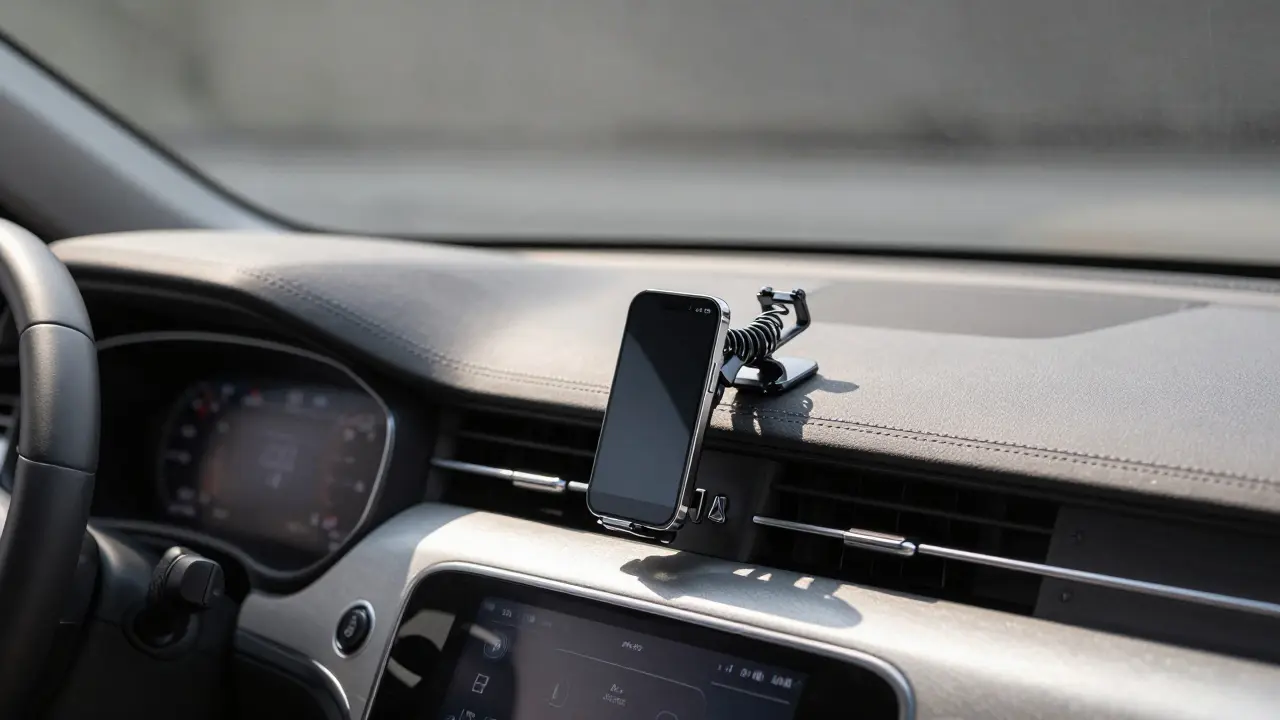
If you’ve ever tried to navigate with your phone balanced on your knee or stuck between the seat and center console, you know how dangerous and frustrating it is. A good phone mount isn’t just convenient-it’s a safety must-have. But with so many types out there-dashboard, windshield, and vent mounts-how do you pick the right one? Let’s cut through the noise and show you exactly what works, what doesn’t, and which one fits your real-life driving habits.
Dashboard Mounts: Stable but Risky
Dashboard mounts stick directly to your car’s dash using adhesive pads or suction cups. They’re popular because they give you a clear, unobstructed view of your phone, and they usually hold it flat like a mini dashboard display. Brands like iOttie and Scosche make solid ones that grip tightly, even on bumpy roads.
But here’s the catch: many states ban adhesive mounts on the dashboard because they block airbag deployment zones. In Michigan, where I live, police have started citing drivers for this during routine traffic stops. Even if your state doesn’t have a law yet, your insurance company might deny a claim if they find your mount interfered with safety systems during a crash.
Pro tip: If you go with a dashboard mount, look for ones that attach to the lower edge of the dash, near the glovebox. That’s usually outside the airbag’s blast radius. Also, avoid glossy or plastic dash surfaces-they’re slippery. Silicone pads or rubberized grips work way better than sticky foam.
Windshield Mounts: The Classic Choice
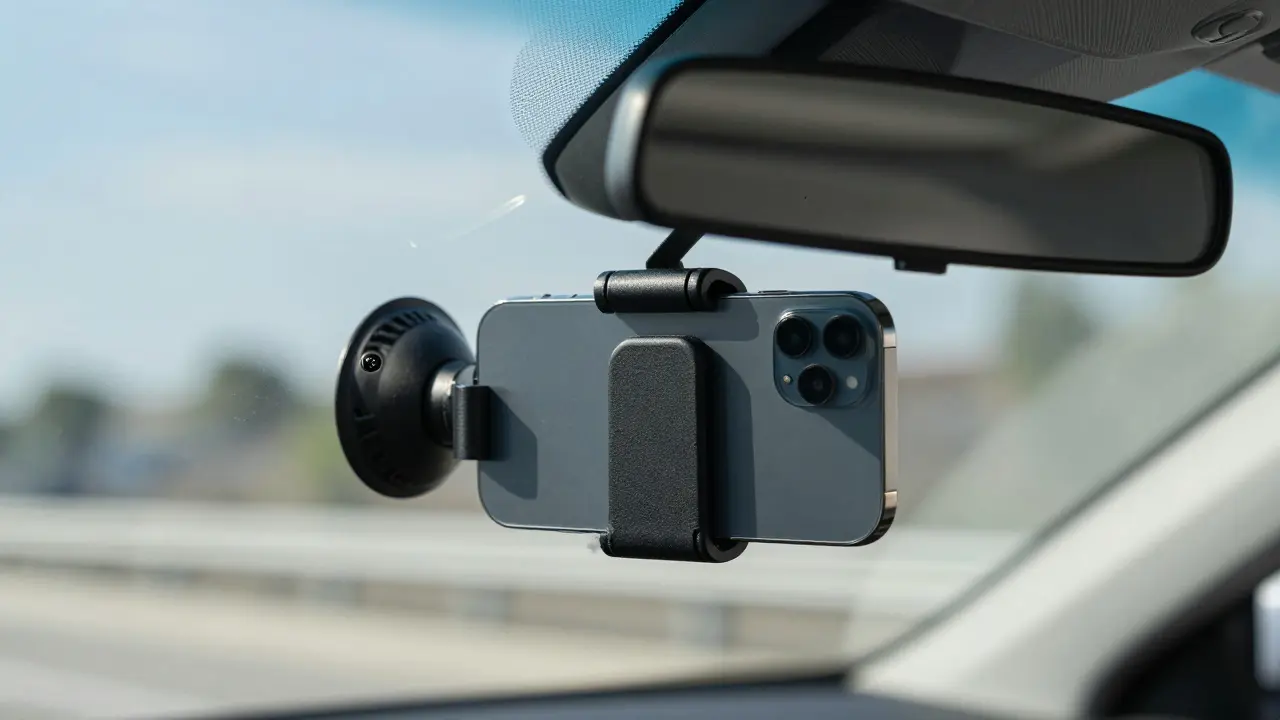
Windshield mounts use suction cups to stick to the glass. They’ve been around forever, and for good reason. They keep your phone at eye level, reduce neck strain, and give you the best line of sight to the road. Most GPS apps and navigation systems are designed with this setup in mind.
But suction cups have their weaknesses. Heat and cold mess with them. In Detroit winters, that suction cup can lose grip when it’s -10°F. In summer, the sun bakes the windshield, and the mount slides down like it’s on roller skates. I’ve seen more than one phone crash onto the floor after a 30-minute drive on a hot day.
Upgrade your game by choosing a mount with a double-suction cup or a silicone ring seal. These create a tighter vacuum. Look for models with a swivel ball joint so you can flip from portrait to landscape without pulling the mount off. And always clean the windshield with isopropyl alcohol before installing-it removes oils and dust that cause slippage.
Vent Mounts: The Smart Compromise
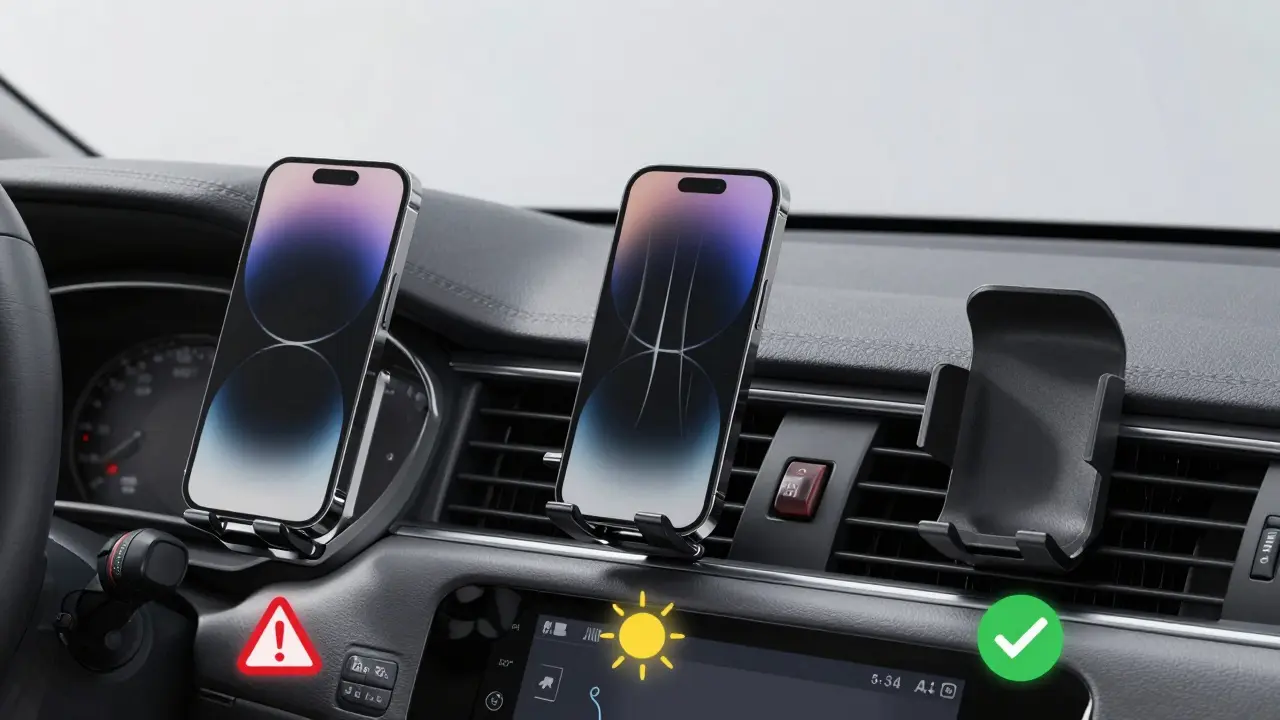
Vent mounts clip onto your car’s air conditioning vents. They’re the most popular choice for a reason: they don’t touch your dashboard or windshield, so they avoid legal and safety issues entirely. Plus, they’re easy to install, remove, and switch between cars.
Not all vent mounts are equal, though. Some are flimsy and wobble when you hit a pothole. Others are too bulky and block airflow, making your AC work harder. The best ones use a spring-loaded clip that grips the vent slats firmly without bending them. Brands like Kenu and Ugreen make ones that fit most modern vents-even the narrow ones in Teslas and Hondas.
Here’s something most people don’t think about: airflow. If your vent mount blocks the cold air from hitting your face, you’ll end up cranking the AC harder, which drains your battery faster (especially in EVs). Choose a mount that attaches to the vertical slats, not the horizontal ones. That way, air still flows around the phone instead of into it.
What You Really Need to Consider
It’s not just about where you stick it-it’s about how your phone behaves once it’s mounted.
- Weight and size: If you use a big phone like an iPhone Pro Max or Samsung Galaxy Ultra, you need a mount with strong clamps. A weak grip = a $1,000 repair job.
- Wireless charging: Some mounts have built-in Qi charging. That’s great if you hate plugging in. But make sure it’s compatible with your phone’s case. Thick cases or metal-backed ones often block the charge.
- One-handed use: Can you reach your phone while driving? A mount that’s too high or too far back forces you to take your eyes off the road. Test it before you buy.
- Removal: If you drive multiple cars, or rent vehicles, you’ll want something that leaves no residue. Vent mounts win here.
Real-World Trade-Offs
Here’s what you’re really choosing between:
| Feature | Dashboard Mount | Windshield Mount | Vent Mount |
|---|---|---|---|
| Visibility | Good | Excellent | Good |
| Stability | High (if surface is right) | Medium (heat/cold affects grip) | Medium (depends on vent design) |
| Legal Risk | High in many states | Low | None |
| Installation | Medium (cleaning required) | Medium (cleaning required) | Easy |
| Portability | Low (adhesive residue) | Low (suction leaves marks) | High (clip-on, no residue) |
| Best For | Short commutes, static dash surfaces | Long drives, consistent climate | Multi-car drivers, EV owners |
Most people I talk to in Detroit end up choosing the vent mount. Why? Because they drive year-round, switch between a daily driver and a winter car, and don’t want to risk fines or cracked windshields. If you’re a ride-share driver, delivery person, or just someone who hates fumbling with cords, the vent mount is the quiet winner.
What to Avoid
Here are three mistakes I see way too often:
- Using a phone case with metal plates: These interfere with magnetic mounts and wireless charging. Stick to silicone or plastic cases.
- Buying cheap no-name mounts: A $5 mount might hold your phone for a week, then snap in traffic. Spend $15-$25. It’s cheaper than replacing a cracked screen.
- Mounting behind the steering wheel: That’s not just dangerous-it’s illegal in most places. Your phone should be visible in the lower third of the windshield, not blocking your view of the road.
Final Tip: Test Before You Commit
Before you buy, take your phone and your car to the store. Clip it onto a vent mount, stick it to a sample windshield, and see how it feels while you’re sitting in the driver’s seat. Can you reach it without leaning? Does it block your mirrors? Does it rattle when you hit a bump? If the answer is yes to any of those, keep looking.
The best mount isn’t the flashiest. It’s the one you forget about-because it just works, every time.
Are windshield mounts legal in all states?
No. While windshield mounts themselves aren’t banned everywhere, many states restrict where you can place them. In California, New York, and Michigan, the mount must be in a 5-inch square area in the lower corner of the windshield, away from the driver’s line of sight. Some states ban any device that obstructs vision, regardless of placement. Always check your state’s vehicle code before installing.
Can I use a magnetic mount on my dashboard?
Yes, but only if your dashboard is metal or has a metal plate installed underneath. Most dashboards are plastic, so a magnetic mount won’t stick unless you glue a steel plate to it first. That’s messy and risky. It’s better to use a non-magnetic mount designed for plastic surfaces, like those with silicone grips or friction pads.
Do vent mounts damage air vents?
Not if you choose a well-designed one. Cheap vent mounts have sharp clips that bend or crack plastic vent slats. Look for models with padded or flexible clips that spread pressure evenly. Brands like Kenu and Ugreen test their mounts on over 50 different car models to ensure they don’t damage vents. If your vent feels loose after installing the mount, it’s too tight-replace it.
Is wireless charging worth it in a car mount?
It depends. If you drive long distances daily and hate plugging in, yes. But wireless charging is slower than wired, and it generates heat-especially in summer. That heat can shorten your phone’s battery life over time. If you use a mount with wireless charging, make sure it has a cooling pad or airflow design. Otherwise, stick with a wired mount and keep your charging cable plugged in.
Which mount is best for electric vehicles?
Vent mounts are the top choice for EVs. They don’t block airflow, which helps your cabin cooling system work efficiently. Plus, EVs often have minimalist dashboards with no flat surface for suction cups. Many EVs also have sensitive sensors near the windshield, so a dashboard or windshield mount could interfere with automatic braking or lane-keeping systems. A vent mount keeps your phone out of those zones.
Kirk Doherty
February 11, 2026 AT 10:02Dmitriy Fedoseff
February 12, 2026 AT 20:55Also, suction cups work fine if you clean the glass properly. Isopropyl alcohol? Please. A damp microfiber cloth and 5 seconds of pressure does the job. This is why Americans overcomplicate everything.
Meghan O'Connor
February 13, 2026 AT 17:37Morgan ODonnell
February 13, 2026 AT 17:38Liam Hesmondhalgh
February 13, 2026 AT 21:58Also, wireless charging in cars? Please. It's slower than dial-up and hotter than a sauna. Just plug it in. Your phone will thank you.
Patrick Tiernan
February 15, 2026 AT 09:14Patrick Bass
February 15, 2026 AT 18:08Tyler Springall
February 16, 2026 AT 15:03Also, wireless charging? That's not innovation. That's a marketing ploy. Your phone doesn't need to be warm while you're driving.
Colby Havard
February 18, 2026 AT 07:55Mongezi Mkhwanazi
February 19, 2026 AT 06:36Teja kumar Baliga
February 20, 2026 AT 17:56Denise Young
February 22, 2026 AT 09:12