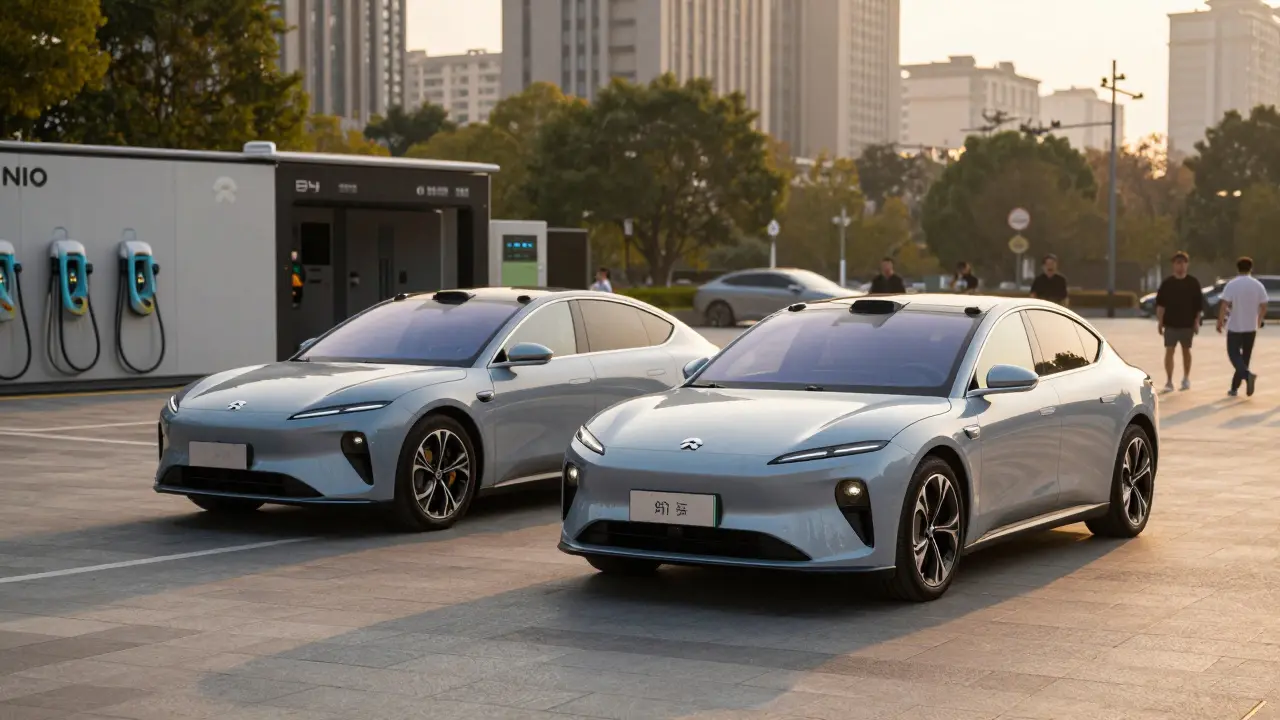
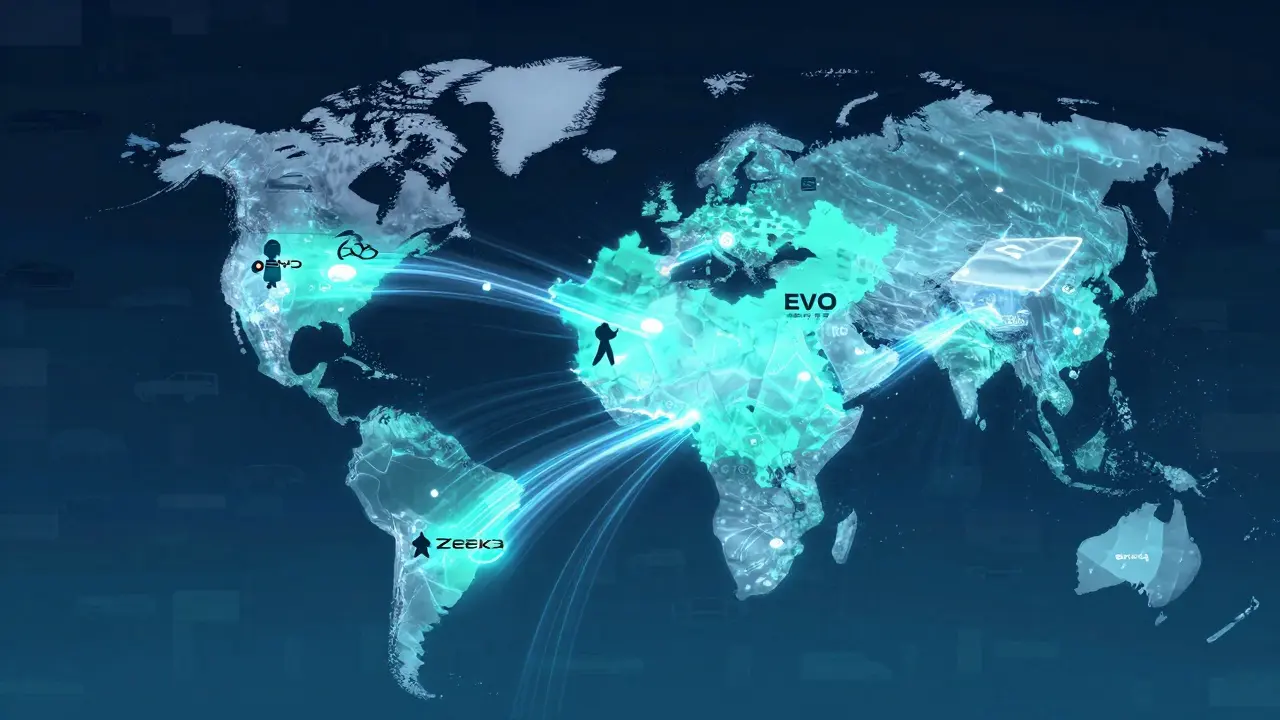
By 2025, Chinese electric vehicle brands aren’t just entering global markets-they’re reshaping them. In 2024 alone, Chinese EV makers shipped over 5.2 million vehicles outside China, up 67% from the year before. That’s more than the entire U.S. EV market. And it’s not just about volume. These brands are undercutting prices, outpacing software updates, and winning over buyers who once thought only Tesla or German luxury cars could deliver on quality and innovation.
Why Chinese EVs Are Winning Abroad
It starts with scale. China produces nearly 70% of the world’s EV batteries. That gives brands like BYD, NIO, and XPeng access to cheaper, more advanced cells than most Western competitors can get. BYD’s Blade Battery, for example, uses lithium iron phosphate chemistry-safer, longer-lasting, and cheaper than the nickel-based cells used in many Teslas. It’s not a gimmick. It’s a cost advantage built into the supply chain.
Then there’s speed. Chinese automakers move faster because they’re used to competing in the world’s most crowded EV market. When NIO launched its battery swap stations in Europe in early 2024, Tesla still hadn’t rolled out a single one outside China. NIO didn’t wait for regulators to catch up-they built the infrastructure themselves, then offered free swaps to subscribers. In Norway, where charging stations are scarce, that made all the difference.
Software is another battleground. XPeng’s XNGP autonomous driving system now works on 90% of China’s highways and urban roads. In Europe, it’s being rolled out in Germany and the Netherlands with over-the-air updates every two weeks. Compare that to Ford or Volkswagen, whose software updates still require dealership visits for major features.
Key Players and Their Strategies
Not all Chinese EV brands play the same way. Their strategies vary by region, price point, and target customer.
- BYD targets volume. Its Dolphin and Seal models sell for under €25,000 in Europe-€5,000 cheaper than a comparable Volkswagen ID.4. BYD doesn’t rely on subsidies. It cuts costs by making its own chips, batteries, and motors. In 2024, it outsold Tesla in Europe by 18%.
- NIO goes premium. Its ET5 and ET7 compete with BMW i4 and Mercedes EQE. But NIO adds services: battery swaps, home charging installation, and 24/7 concierge support. In Germany, NIO’s customer satisfaction score is 8.9 out of 10-higher than Tesla’s 7.6.
- XPeng bets on tech. Its G9 model comes with lidar, 8 cameras, and 12 ultrasonic sensors. It’s not just a car-it’s a rolling data hub. XPeng’s AI driver, XNGP, learns from every mile driven in China and pushes updates to global users. In Sweden, XPeng’s software update frequency is now faster than any U.S.-based automaker.
- Geely (Zeekr) leverages its Volvo connection. Zeekr 001 uses the same platform as the Polestar 2 but with better software and lower pricing. Geely’s ownership of Volvo gives it access to European safety certifications and supply chains, making market entry smoother.
How Western Brands Are Responding
European and American automakers didn’t see this coming. In 2020, most thought Chinese EVs were cheap imitations. Now, they’re scrambling.
Volkswagen slashed its ID.3 price by 15% in Germany after BYD’s Dolphin outsold it in the first quarter of 2024. Stellantis (Jeep, Peugeot, Fiat) partnered with CATL, China’s largest battery maker, to secure cell supply. Ford is now testing Chinese-made battery packs for its Mustang Mach-E in Europe.
But the biggest shift is in mindset. Tesla, once the undisputed leader, is now playing catch-up. Its Model Y in Europe now starts at €36,000-€8,000 more than the BYD Seal. Tesla’s software updates are slower, its service network thinner, and its customer support ratings lower. In 2024, Tesla’s market share in Europe dropped to 19%, down from 32% in 2022.
It’s not just about price. It’s about trust. Chinese brands are investing in local manufacturing. BYD opened a plant in Hungary in 2023. NIO built a battery swap station network in the Netherlands. XPeng partnered with a German logistics firm to handle repairs. They’re not exporting cars-they’re building ecosystems.
Barriers Still in the Way
Chinese EVs aren’t unstoppable. Trade tensions are rising. The EU launched an anti-subsidy investigation in 2024, claiming Chinese EVs benefit from state support. The U.S. raised tariffs on Chinese EVs to 100% in 2025. Some countries now require local data storage for connected cars-a hurdle for brands that collect driving data in China.
Brand perception is another challenge. In Italy and Spain, many consumers still associate Chinese cars with low quality. Surveys show that 42% of European buyers don’t trust Chinese EV brands to last more than five years-even though BYD’s battery warranty now covers 10 years or 1.2 million kilometers.
And then there’s the after-sales problem. In Poland, NIO had to open 12 service centers in six months because customers couldn’t get repairs. In Brazil, XPeng’s app didn’t support Portuguese at launch. These aren’t tech failures-they’re execution gaps.
What’s Next for Chinese EVs?
The next phase isn’t just about selling more cars. It’s about becoming a global brand.
BYD is launching a luxury sub-brand, Denza, in the U.S. next year. NIO is testing hydrogen fuel cell vehicles in Germany. XPeng is partnering with Uber to deploy autonomous taxis in Singapore. Geely is investing $2 billion in AI-driven driving systems for its global brands.
China’s EV ecosystem is now a model. It’s not just about cars. It’s about batteries, charging, software, and services-all integrated. Western automakers are still building pieces. Chinese brands are selling the whole system.
By 2027, analysts expect Chinese EV brands to hold 35% of the global EV market. That’s not a prediction. It’s a trajectory. The question isn’t whether they’ll succeed. It’s how fast the rest of the world will adapt.
What This Means for Buyers
If you’re shopping for an EV in 2025, you’re not just choosing a car. You’re choosing a system.
Do you want the lowest price? BYD’s Seal beats everything. Do you want premium service? NIO’s swap stations and concierge are unmatched. Do you want cutting-edge tech? XPeng’s AI driver is already ahead of most competitors.
Warranty lengths have jumped. Most Chinese EVs now offer 8-10 years on batteries. Software updates are frequent. Some models get new features every month.
And here’s the real kicker: Chinese EVs are often cheaper to maintain. Fewer moving parts than gas cars, plus lower labor costs in their home markets mean service bills are 20-30% lower on average.
You don’t need to be a tech expert to benefit. You just need to look past the stigma. The cars are here. The tech works. The prices are real.
Are Chinese EVs safe?
Yes. BYD, NIO, and XPeng all meet European NCAP safety standards, with many models earning five-star ratings. BYD’s Blade Battery passed the nail penetration test without fire-a test many lithium-ion batteries fail. NIO’s ET7 includes 11 airbags and a carbon fiber roof for crash protection. Independent testing by Euro NCAP in 2024 confirmed Chinese EVs perform as well as or better than comparable German and American models.
Do Chinese EVs hold their value?
So far, yes-better than many Western EVs. In Germany, the BYD Dolphin retained 68% of its value after three years, compared to 54% for the Nissan Leaf. NIO’s ET5 held 71%, outperforming the Tesla Model 3 at 65%. Resale value is rising as service networks expand and software updates keep cars feeling new. Battery degradation is also lower than average, thanks to better thermal management systems.
Can I get service for a Chinese EV outside China?
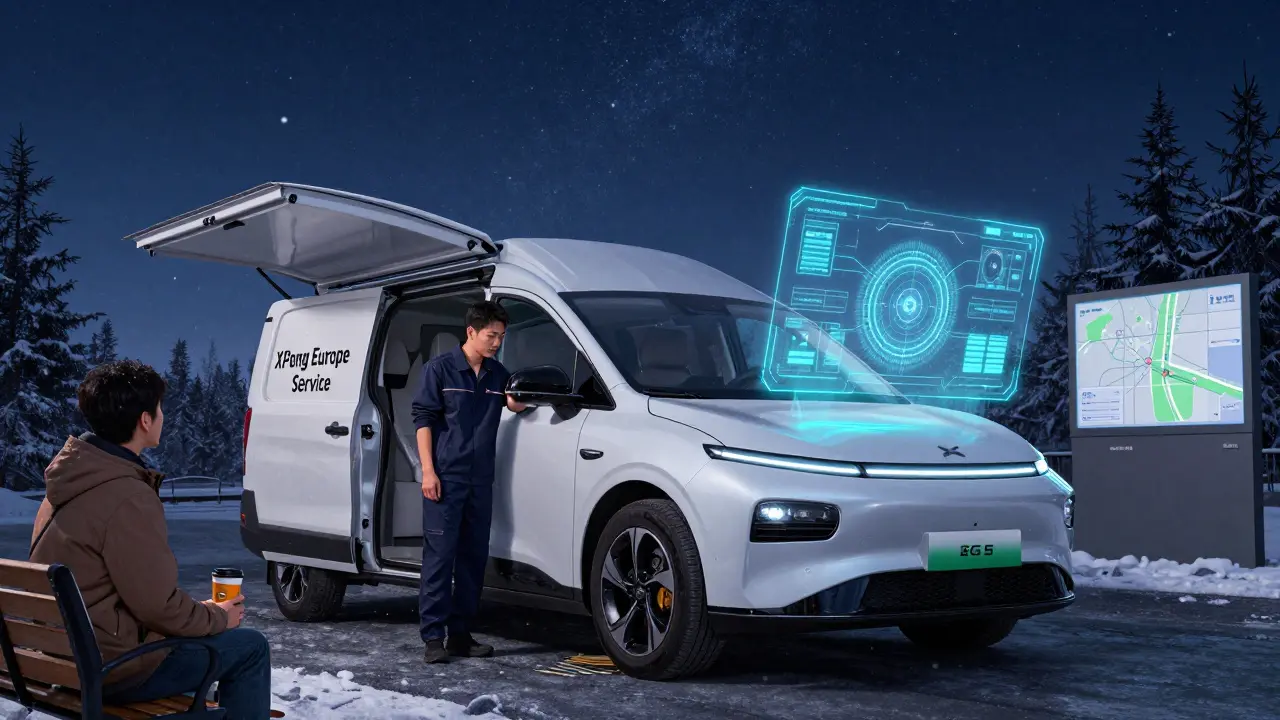
Yes, but availability varies. BYD has service centers in 15 European countries and plans to expand to 30 by 2026. NIO operates over 200 service points in Europe and North America. XPeng partners with local repair chains in Germany, the Netherlands, and Norway. For remote areas, many brands offer mobile service vans or remote diagnostics. Always check the brand’s official service map before buying.
Are Chinese EVs better than Tesla?
It depends on what you want. Tesla still leads in charging infrastructure and brand recognition. But Chinese EVs now beat Tesla in software update speed, battery longevity, and customer service. In 2024, a Consumer Reports survey found NIO and BYD ranked higher in owner satisfaction than Tesla in Europe. If you value updates, service, and price, Chinese EVs are the better choice. If you prioritize supercharging speed and software polish, Tesla still has an edge.
Will tariffs stop Chinese EVs from growing?
Not for long. Tariffs make cars more expensive, but Chinese brands are responding by building factories abroad. BYD’s Hungary plant serves Europe. NIO is planning a plant in Spain. XPeng is in talks to build in Mexico for the U.S. market. Tariffs may slow growth temporarily, but they won’t stop it. The real barrier is perception-not policy.
Rahul U.
December 29, 2025 AT 15:52Wow, this is actually the most balanced take on Chinese EVs I’ve seen in a while 🙌
BYD’s Blade Battery is a game-changer-safer, cheaper, and lasts longer. No hype, just facts.
Also, NIO’s swap stations in Norway? Genius. I’d trade 10 minutes of charging for 5 minutes of swapping any day.
And yes, software updates every two weeks? That’s not a car, that’s a smartphone on wheels. 🚗📱
E Jones
December 30, 2025 AT 02:24Let’s be real-this isn’t about EVs, it’s about China’s long-game economic takeover. They’re not selling cars, they’re selling surveillance tech disguised as transportation. Every XPeng update? Probably harvesting your driving data to train AI for military drones.
And don’t get me started on BYD’s ‘Blade Battery’-it’s just lithium iron phosphate wrapped in propaganda. The EU investigation? Too little, too late. They’ve been stealing IP since the 90s. This isn’t competition-it’s colonization with charging cables.
Meanwhile, American workers are getting laid off while Chinese state-owned factories churn out $20k cars with taxpayer money. Wake up, people. This isn’t innovation. It’s economic warfare with a touchscreen.
Barbara & Greg
December 31, 2025 AT 08:32It is, without question, a profound moral failure of Western industrial policy that we have allowed ourselves to be outmaneuvered in such a critical technological domain. The notion that market efficiency alone should dictate the fate of domestic manufacturing is not merely naive-it is an abdication of civic responsibility.
One cannot, in good conscience, applaud the economic ascendance of a regime whose labor practices and environmental standards are fundamentally incompatible with democratic values. The lower price point is not a virtue; it is a symptom of systemic exploitation.
And yet, the consumer, blinded by convenience and discount pricing, remains complicit. We are not just buying cars-we are financing authoritarian modernity.
selma souza
January 2, 2026 AT 07:23You wrote 'outpacing software updates'-that’s grammatically incorrect. You mean 'outpacing the frequency of software updates.' Also, 'lithium iron phosphate' should be hyphenated when used as a compound adjective: 'lithium-iron-phosphate chemistry.' And '1.2 million kilometers'-you’re mixing metric and imperial units inconsistently. This article reads like it was written by someone who Googled EV specs and then copied a Wikipedia paragraph.
Also, 'NIO’s customer satisfaction score is 8.9 out of 10'-where’s the source? No citation. Unacceptable for a piece that purports to be analytical.
Frank Piccolo
January 2, 2026 AT 12:33Let’s be honest-this whole thing is just China dumping cars on the world because their domestic market is saturated. They’re not better, they’re just subsidized. Tesla built a charging network from scratch. BYD didn’t-they just waited for someone else to pave the road and then undercut them.
And don’t even get me started on ‘NIO’s concierge service.’ What is this, a luxury hotel? I bought a car, not a personal assistant.
Also, ‘Chinese EVs are cheaper to maintain’? Sure, if you don’t mind waiting six months for a replacement part shipped from Shanghai. Meanwhile, my Ford dealer fixes my truck in 2 hours. That’s value.
And don’t tell me about ‘ecosystems.’ This isn’t Apple. It’s a state-run export scheme with Bluetooth.
James Boggs
January 3, 2026 AT 12:30This is an excellent overview. I appreciate how you broke down each brand’s strategy-it’s rare to see that level of clarity.
Also, the point about local manufacturing is critical. BYD in Hungary, NIO in the Netherlands-this isn’t just trade, it’s partnership. We should be welcoming innovation, not fearmongering.
And yes, software updates every two weeks? That’s what innovation looks like. Let’s not punish progress because it’s coming from somewhere new.
Addison Smart
January 4, 2026 AT 05:03I’ve lived in both the U.S. and China, and what’s happening here is a cultural and technological convergence that’s been decades in the making.
Western automakers spent years clinging to the idea that ‘Made in Germany’ or ‘Made in America’ was synonymous with quality. But quality isn’t a nationality-it’s a standard. And Chinese manufacturers have raised that standard.
Their willingness to invest in infrastructure-swap stations, mobile service vans, local repair networks-isn’t just smart business. It’s human-centered design.
And yes, Tesla led the charge, but leadership isn’t about who came first-it’s about who keeps moving forward. Right now, Chinese brands are moving faster, smarter, and with more empathy for the customer experience.
This isn’t a threat. It’s a mirror. And maybe, just maybe, it’s time we stopped being defensive and started being inspired.
David Smith
January 4, 2026 AT 20:40Okay, but have you SEEN the interior of a BYD Dolphin? It looks like a 2012 Kia with a bad case of impostor syndrome.
And don’t even get me started on NIO’s ‘concierge’-they send a guy with a clipboard to your driveway? That’s not luxury, that’s a middle school talent show.
Also, ‘software updates every two weeks’? That’s not innovation-that’s beta testing on your wallet. I don’t want my car to be a testbed for some intern’s side project.
And don’t tell me about ‘battery longevity’-I’ve seen the Reddit threads. Half the owners in Poland are stuck with broken chargers and no service centers.
This isn’t progress. It’s a dumpster fire with a touchscreen.
Lissa Veldhuis
January 6, 2026 AT 18:00Chinese EVs are literally just Tesla clones with cheaper materials and a bigger subsidy handout
And the way they lie about warranty? 10 years? Sure, if you ignore the fine print that says ‘only if you use their certified chargers and never drive in the rain’
Also NIO’s battery swap? Yeah, I’m sure the guy in the Netherlands is just chillin’ waiting to swap my battery at 2am
And don’t even get me started on XPeng’s ‘AI driver’-it’s just a fancy cruise control that thinks stop signs are decorative
These companies are not building cars they’re building propaganda machines with wheels
And the fact that people are falling for this? I’m not mad, I’m just disappointed
Michael Jones
January 8, 2026 AT 01:06Think about this for a second-this isn’t just about cars. It’s about how we define progress.
For decades, we thought innovation meant bigger engines, louder exhausts, and more chrome.
Now it’s about software, batteries, and service.
Chinese brands didn’t just beat us at the game-they changed the rules.
And instead of adapting, we’re screaming about tariffs and ‘stolen IP.’
What if the real threat isn’t China?
What if it’s our own refusal to evolve?
allison berroteran
January 8, 2026 AT 23:13I’ve been following this space for years, and honestly, I’ve never been more hopeful.
For so long, EVs felt like a luxury for the rich-Tesla, Porsche, Rivian. But now, someone like my sister, who works two jobs and lives in a small town, can actually afford a car that’s safe, reliable, and future-proof.
BYD’s Seal at €25k? That’s a game-changer for middle-class families.
And the software updates? They’re not just adding features-they’re making the car smarter over time. That’s not a gimmick. That’s dignity.
I used to think EVs were a fad. Now I think they’re a movement.
And Chinese brands? They didn’t just join it-they led it.
Gabby Love
January 9, 2026 AT 18:57Quick note: the part about XPeng’s G9 having 8 cameras and 12 ultrasonic sensors is correct, but it’s worth noting that Tesla’s FSD uses 8 cameras too-no lidar. So it’s not necessarily ‘more sensors’-it’s better sensor fusion.
Also, ‘lower labor costs in home markets’ doesn’t mean lower maintenance costs abroad. Service labor in Germany or the U.S. is still expensive, even for Chinese brands.
Just saying-don’t overstate the savings. But overall, solid breakdown.
Jen Kay
January 10, 2026 AT 00:19Oh, so now we’re supposed to applaud China for doing the exact thing we spent decades accusing them of: undercutting markets with state-backed production?
How quaint.
You praise their ‘ecosystems’-but ignore that those ecosystems are built on forced labor, surveillance tech, and intellectual property theft.
And yet, you call this ‘innovation’?
Let me be clear: this isn’t progress. It’s exploitation dressed in LED headlights.
And if you’re buying a Chinese EV because it’s cheap, you’re not a savvy shopper-you’re a participant in a global scam.
Rahul U.
January 10, 2026 AT 12:13Wow, I didn’t expect this to turn into a geopolitical debate 😅
But seriously-how many of us have actually *driven* one of these cars? Or talked to a real owner in Norway or Germany?
My cousin in Amsterdam has a BYD Dolphin. She says it’s quieter than her old Prius, the software is buttery smooth, and the warranty covered a faulty sensor in 3 days.
Meanwhile, her neighbor’s Tesla had a 3-week wait for a software fix.
Maybe the real story isn’t who’s subsidizing who-it’s who’s actually delivering for the customer.
Just saying. 🤷♂️
James Boggs
January 11, 2026 AT 05:58Exactly. The best counterargument to fear-mongering is lived experience.
My sister bought a NIO ET5 last year. She got a free battery swap during a snowstorm. The service rep brought her coffee.
She said it felt like being treated like a human, not a transaction.
That’s not state subsidy. That’s customer care.
And if that’s what’s being labeled ‘unfair competition,’ then maybe we need to ask ourselves: what kind of market do we actually want?