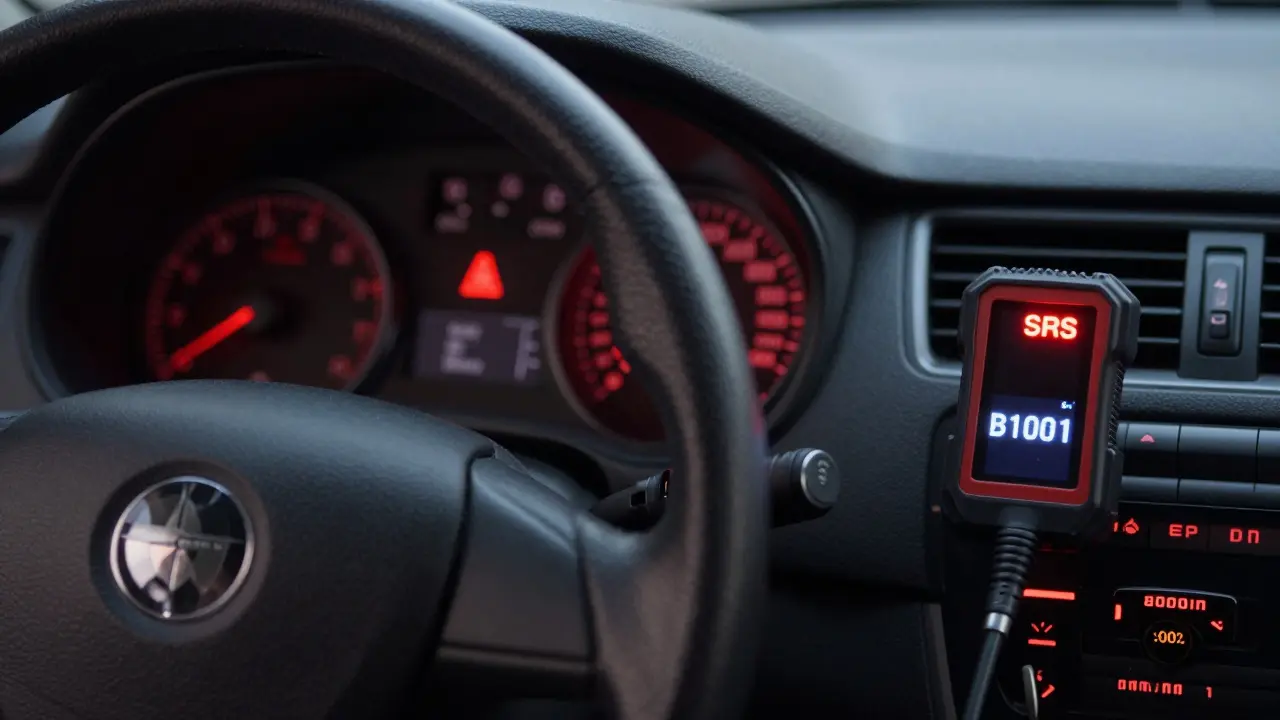
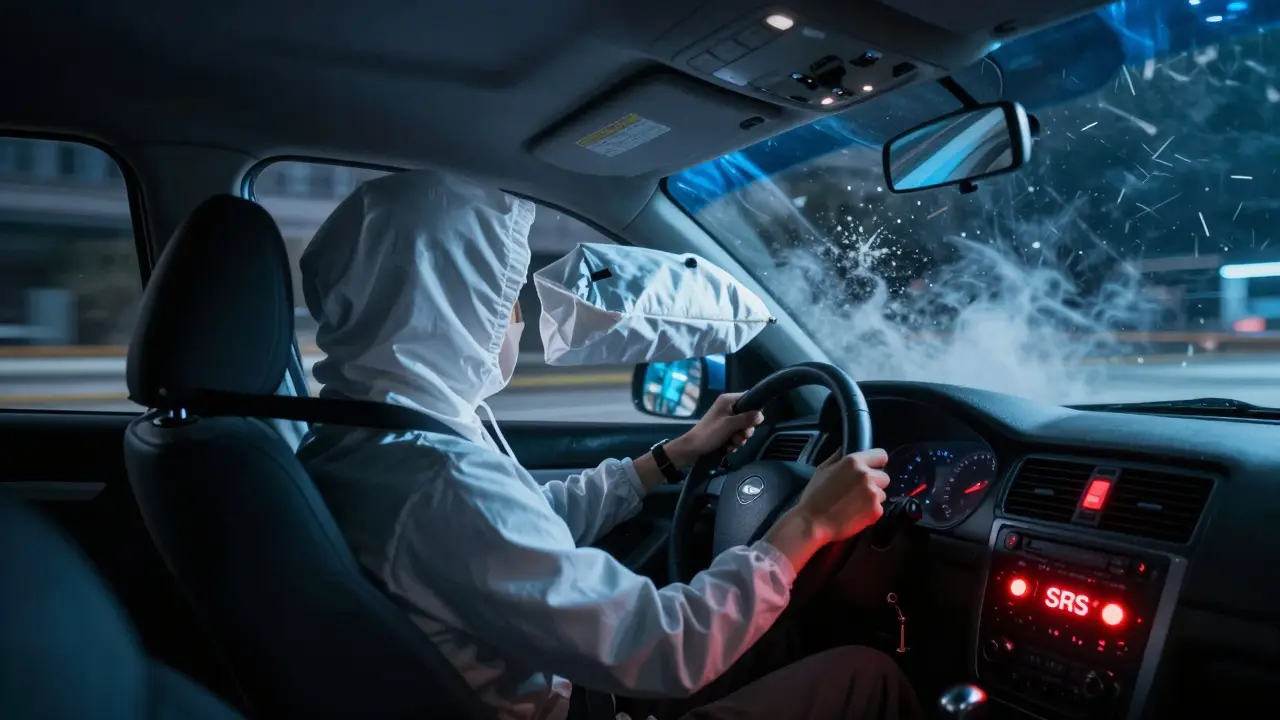
If your SRS warning light is on, your airbag system isn’t working. That’s not just a nuisance-it’s a safety risk. The SRS (Supplemental Restraint System) light isn’t like your check engine light. It doesn’t mean you should drive carefully. It means your airbags might not deploy in a crash. And if you’ve ever been in an accident where the airbags didn’t go off, you know how terrifying that is.
What the SRS Light Actually Means
The SRS light is tied to a network of sensors, impact detectors, seatbelt pretensioners, and airbag modules. It’s not one part failing-it’s a system check. When you start your car, the light should blink for 5 to 7 seconds and then turn off. If it stays on, flashes repeatedly, or never comes on at all, something’s wrong.
Common triggers include:
- A loose or damaged connector under the passenger seat
- A faulty clock spring in the steering wheel
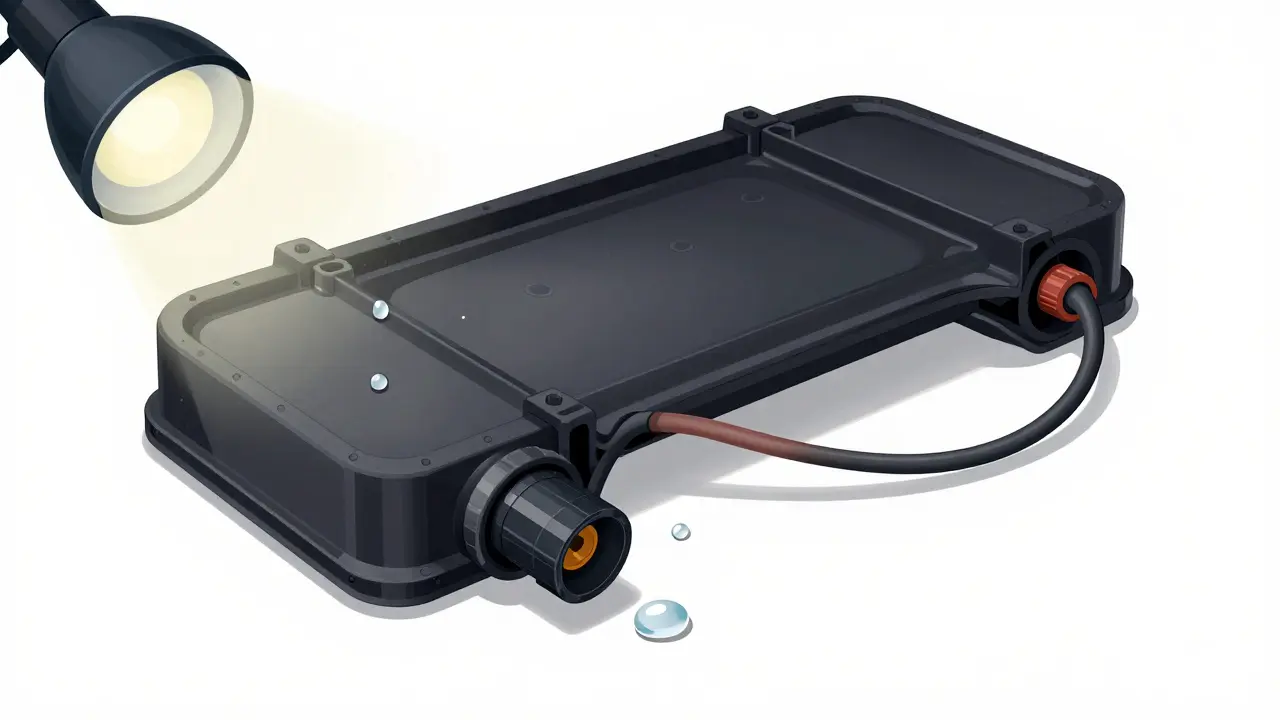
- Water damage from a leaky windshield or door seal
- A deployed airbag that wasn’t replaced properly
- A seatbelt buckle sensor that thinks the belt isn’t fastened
It’s not always obvious. You might not have been in a crash. You might not have touched anything. But even a small voltage drop from a weak battery can confuse the system. Or a child seat installed incorrectly can trigger a false fault code.
Why You Can’t Ignore It
Some people think, ‘I drive slowly. I’m careful. I don’t need airbags.’ That’s dangerous thinking. The National Highway Traffic Safety Administration (NHTSA) says airbags reduce fatal injury risk by 30% in frontal crashes. That’s not a small number. It’s the difference between walking away and not walking at all.
And it’s not just airbags. The SRS system includes seatbelt tensioners that pull you back into your seat milliseconds before impact. If those fail, you’re more likely to hit the steering wheel or dashboard-even with your seatbelt on.
Insurance companies know this. If your SRS light is on and you’re in an accident, they can deny a claim if they find the system was faulty. That’s not a rumor. That’s in the fine print of most policies.
How to Diagnose the Problem
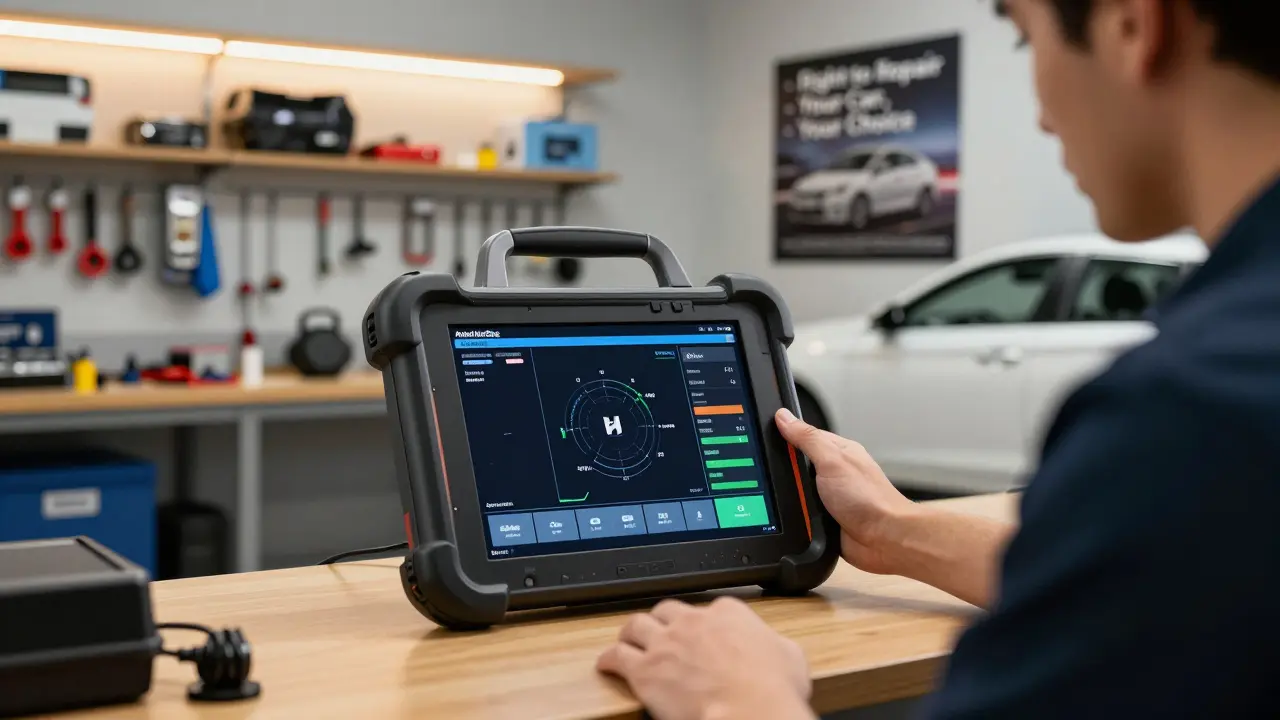
You can’t read SRS codes with a regular OBD2 scanner. That’s a common mistake. You need a diagnostic tool that talks to the airbag control module. Tools like the Autel MaxiCOM, Launch X431, or even a dealership’s factory scanner are required.
Here’s what a real diagnosis looks like:
- Connect the scanner to the OBD2 port under the dashboard.
- Select ‘SRS’ or ‘Airbag’ from the menu-not ‘Engine’ or ‘Transmission’.
- Read the fault codes. Common ones include B1000 (airbag circuit open), B1001 (driver airbag malfunction), or B1011 (passenger seat sensor fault).
- Check for pending codes. Sometimes the system only stores a code after multiple failures.
- Clear the codes and test drive. If the light comes back, the problem isn’t fixed.
Don’t just clear the code and walk away. That’s like turning off a smoke alarm because it beeped once. The alarm didn’t break-you just silenced it.
Common Fixes and Their Costs
Once you know the code, you can estimate what’s wrong. Here are the most frequent fixes:
| Problem | Typical Cost | DIY Possible? |
|---|---|---|
| Loose seatbelt connector | $50-$100 | Yes |
| Failed clock spring | $300-$600 | Yes, with caution |
| Bad seat occupancy sensor | $200-$400 | Maybe |
| Water-damaged control module | $800-$1,500 | No |
| Deployed airbag not replaced | $1,000-$2,500 | No |
Some people try to fix it with cheap eBay modules or ‘airbag bypass’ devices. Don’t. Those can disable the system permanently or cause it to deploy unexpectedly. There’s no safe shortcut.
What to Do If You Can’t Afford a Repair
Even if money is tight, don’t drive with the light on. If you can’t pay for a full repair right now, here’s what you can do:
- Visit a local auto parts store like AutoZone or O’Reilly-they often offer free diagnostic scans for SRS codes.
- Check if your car is under a recall. Many manufacturers have issued recalls for faulty SRS modules, especially in models from 2005 to 2015.
- Call your insurance agent. Some companies offer discounts for fixing safety systems, or even cover part of the cost if you’re a long-term customer.
- Ask for a payment plan. Many shops will let you pay in installments if you explain the situation.
Driving with the light on isn’t just risky-it’s irresponsible. If you’re in an accident and your airbags don’t deploy, you’re not just putting yourself at risk. You’re putting others at risk too.
Preventing Future Issues
Once your SRS system is fixed, protect it:
- Don’t use aftermarket seat covers that block seat sensors.
- Keep the area under your seats dry. If you spill something, clean it up immediately.
- Never tamper with airbag wiring. Even unplugging a connector without disconnecting the battery can trigger a fault.
- Replace your battery every 3-5 years. Weak voltage is a silent killer of electronic systems.
- Get your SRS system checked during every oil change. Most shops can run a quick diagnostic in 5 minutes.
It’s not expensive. It’s not complicated. But it’s essential.
When to Go to a Professional
Some fixes are too dangerous to attempt yourself. If your code points to:
- A deployed airbag needing replacement
- A faulty control module
- Any issue involving the steering column or steering wheel
-then take it to a certified technician. Airbag modules store high voltage. Improper handling can cause accidental deployment. That’s not a joke. People have been seriously injured trying to fix these themselves.
Look for ASE-certified mechanics or dealerships with SRS training. Ask if they use factory-level diagnostic tools. If they say they can fix it with a $50 scanner, walk away.
Final Reminder
Your car’s safety systems aren’t optional. They’re designed to keep you alive. The SRS warning light isn’t a suggestion. It’s a red flag. Fix it now. Don’t wait for the next rainstorm. Don’t wait for the next turn. Don’t wait for an accident to prove you were wrong.
One quick scan, one proper repair, and you’ve just given yourself and your passengers a better chance of walking away from a crash. That’s worth more than any repair bill.
Why does my SRS light come on after I replace the battery?
Replacing the battery can cause a power interruption that resets or confuses the SRS control module. The system may store a false fault code. After replacing the battery, you need to use a diagnostic scanner to clear the codes. If the light stays on, there’s likely an underlying issue-like a loose connector or damaged wiring-that wasn’t fixed by the battery change.
Can I drive with the SRS light on?
Technically, yes-but you shouldn’t. Your airbags and seatbelt pretensioners are disabled when the SRS light is on. In a crash, you won’t get the protection you expect. Insurance companies may also deny claims if they find the system was faulty. It’s not worth the risk.
Is the SRS light the same as the airbag light?
Yes. SRS stands for Supplemental Restraint System, which includes airbags, seatbelt tensioners, and crash sensors. The light is often labeled ‘Airbag’ on the dashboard, but it’s monitoring the entire SRS. The terms are used interchangeably.
How long does it take to fix an SRS issue?
Simple fixes like reconnecting a loose seat sensor take under 30 minutes. Replacing a clock spring or seatbelt buckle sensor takes 1-2 hours. If the control module is damaged or airbags need replacing, it can take 4-8 hours and require ordering parts. Always ask for a timeline before authorizing repairs.
Will my car pass inspection with the SRS light on?
In most U.S. states, a lit SRS light will cause a vehicle to fail safety inspection. It’s considered a critical safety defect. Even if your state doesn’t check it, you’ll still need to fix it to get insurance coverage and ensure your own safety.
chioma okwara
December 27, 2025 AT 00:35yo the SRS light ain't no joke i had mine on for 3 months 'cause i thought it was just a glitch... then my cousin got T-boned and her airbag didnt deploy. she walked away but barely. dont be that person.
Christina Morgan
December 28, 2025 AT 22:46Just wanted to say thank you for writing this so clearly. I'm a single mom who fixes my own cars when I can, and this is the first time I've seen a guide that doesn't make me feel dumb for not knowing the difference between OBD2 and SRS scanners. You're right-this isn't optional safety, it's survival gear. Also, AutoZone does free scans, and they're way nicer than you'd expect. 🙌
Kathy Yip
December 30, 2025 AT 01:22i read this whole thing and i just kept thinking about how we treat cars like they're just machines, but they're actually keeping us alive in ways we never notice. the seatbelt pretensioners? the way the system checks itself every time you start the car? it's like the car is whispering 'i got you'... and when that light comes on, it's whispering 'i'm scared too'.
also, i spelled 'pretensioners' wrong three times while typing this. sorry.
Bridget Kutsche
December 30, 2025 AT 13:14My husband ignored the SRS light for over a year. We got into a fender bender-no airbag, no deployment. He was fine, but the insurance company denied the claim because the system was flagged as faulty. We ended up paying $1,200 out of pocket for a clock spring replacement. Don't wait. Just fix it. Even if it's inconvenient. Even if you think you're a careful driver. It's not about you-it's about the person next to you, the kid in the backseat, the stranger you might hit in the rain.
Also, if you're replacing the battery, always disconnect the negative terminal first. And wait 10 minutes before reconnecting. It saves so many false codes.
Jack Gifford
December 30, 2025 AT 23:07Y'all are overcomplicating this. If the light's on, plug in a scanner. If it says B1001, it's the driver airbag. If it's B1011, it's the passenger seat sensor. No magic. No conspiracy. Just electronics. And yeah, if you're not gonna fix it, at least get a scan so you know what you're dealing with. Don't just guess. That's how people get hurt.
Sarah Meadows
December 31, 2025 AT 03:20Let me be clear: if your SRS light is on, you're driving a death trap. This isn't 'maintenance'-it's a federal safety violation. The NHTSA doesn't mess around, and neither should you. If you're in a vehicle with a disabled restraint system, you're not just risking your life-you're violating public safety standards. That's not an opinion. That's the law. And if your insurance denies your claim because of it? Good. You got what you deserved.
Nathan Pena
December 31, 2025 AT 06:15It's fascinating how the average driver conflates 'convenience' with 'safety.' You can't 'DIY' a clock spring replacement without risking catastrophic failure. The torque specs are precise. The ribbon cable is delicate. The airbag module is armed. And yet, Reddit is full of people posting 'fixed mine for $20 on eBay' like it's a TikTok hack. This isn't a smartphone. This is a pyrotechnic device strapped to your spine. You're not a mechanic-you're a liability.
Also, 'free diagnostic scans'? AutoZone doesn't have SRS-capable scanners. They read engine codes. That's marketing bait. Don't be fooled.
Mike Marciniak
January 1, 2026 AT 16:38Ever wonder why the SRS light comes on right after a battery change? They're not telling you the truth. The system doesn't just 'reset.' It's being remotely monitored. Every fault code is logged and sent to the manufacturer. They know when you're driving with it on. They know if you tried to clear it. And they're building a profile. One day, your insurance rates will spike. One day, your car will be flagged as 'unsafe.' One day, they'll refuse to honor your warranty. This isn't paranoia. It's data collection. And they're using your fear to sell you repairs.
VIRENDER KAUL
January 2, 2026 AT 12:09It is imperative that the motorist comprehend the gravity of the situation. The SRS system is not a mere indicator of malfunction; it is a critical component of passive safety architecture. Any attempt to circumvent its functionality constitutes a gross negligence of duty of care. Furthermore, the utilization of aftermarket components, particularly those procured from unregulated e-commerce platforms, introduces an unacceptable risk of unintended deployment or non-deployment. Such conduct is not only reckless but ethically indefensible. One must consult a certified technician without delay. The cost of inaction is incalculable.
Mbuyiselwa Cindi
January 4, 2026 AT 01:00My dad taught me: 'If your car's safety light is on, treat it like a smoke alarm in the middle of the night-don't ignore it, just fix it.' I took my 2010 Camry in, they found a loose connector under the passenger seat-$60 fix. I cried because I almost didn't go. Don't wait for a crash to learn this lesson. You owe it to yourself and everyone you ride with.
Also, if you're in South Africa and need help finding a shop, DM me. I know a few good ones.
Krzysztof Lasocki
January 5, 2026 AT 01:50So let me get this straight-you'd rather spend $200 on a new battery than $300 to fix the thing that might save your life? Cool. Cool cool cool. You're basically playing Russian roulette with a seatbelt. Congrats, you're the human version of a 'skip the oil change' meme. I hope your next crash is slow-motion and filmed for YouTube. For science.