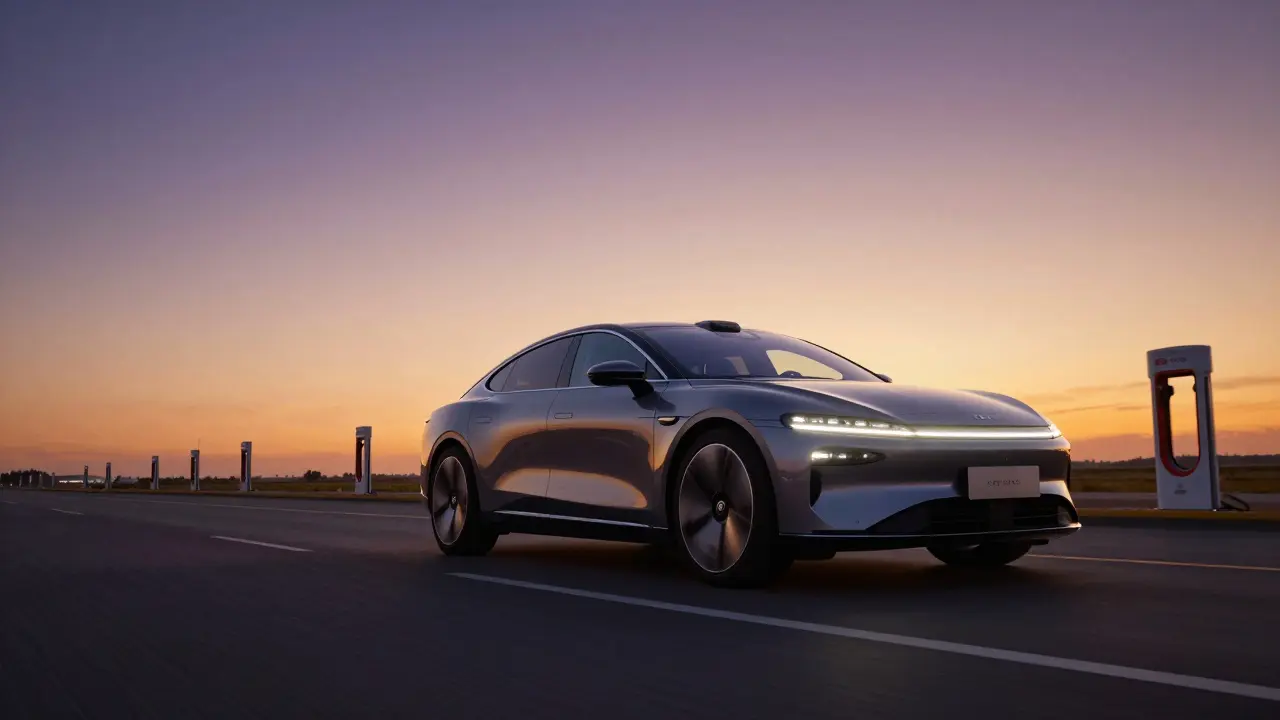
When you’re shopping for a luxury electric vehicle, you’re not just buying a car-you’re investing in performance, comfort, and next-gen tech. But with so many options, how do you know which one actually delivers on range, charging speed, and smart features? It’s not about brand names or leather seats alone. It’s about real-world performance that matches your lifestyle. Let’s cut through the hype and look at the top luxury EVs in 2026 that truly stand out.
Range: How Far Can You Really Go?
Range anxiety is fading, but it hasn’t disappeared. The best luxury EVs now routinely hit 350 miles or more on a single charge. The Lucid Air Grand Touring leads the pack with an EPA-estimated 410 miles. That’s more than most gas-powered sedans can do on a full tank. It’s not just about the number, though. Lucid’s 900-volt architecture means less energy loss, better efficiency, and smoother performance over long distances.
The Tesla Model S Plaid follows close behind at 396 miles. But here’s the catch: Tesla’s range estimates are often optimistic in cold weather. In real-world winter driving-especially in places like Asheville where temperatures dip below freezing-expect a 15-20% drop. The Mercedes-Benz EQS 580 delivers 360 miles and handles cold better thanks to its heat pump system. The BMW i7 xDrive60 hits 320 miles, which is solid, but not class-leading.
If you drive more than 500 miles a week, Lucid and Tesla are your only real choices. For most people, 350+ miles is plenty. But if you’re planning a cross-country trip, don’t just trust the sticker number. Look at real owner reports from forums like EVTalk or Reddit’s r/EVowners. Those numbers tell you what happens when the AC is on, the roads are wet, and you’re carrying passengers.
Charging: Speed Matters More Than You Think
Range means nothing if you can’t recharge quickly. The fastest luxury EVs in 2026 can add 200 miles of range in under 15 minutes. Lucid again leads here. With its 900-volt system, it can charge at up to 300 kW on compatible DC fast chargers. That means 10-80% in about 20 minutes. Tesla’s V4 Superchargers also hit 250 kW, and the Model S can charge from 10-80% in 22 minutes.
The Porsche Taycan and Audi e-tron GT are close behind at 270 kW peak, but they only hit that speed for a short window. Once the battery hits 60%, charging slows down noticeably. The EQS 580 maxes out at 200 kW-slower than the others. BMW’s i7 tops out at 195 kW. That’s fine for daily use, but if you’re on a road trip and need to grab a quick charge, every extra minute adds up.
Here’s a practical tip: Look for chargers with at least 250 kW output. Most public networks like Electrify America, EVgo, and Tesla’s Supercharger network now have them. Avoid older 50 kW or 150 kW stations unless you’ve got hours to spare. And remember: charging speed drops as the battery fills. Plan to stop at 20-30% and charge up to 80%. That’s the sweet spot for speed and battery health.
Tech: What’s Actually Useful?
Luxury EVs come packed with screens, voice assistants, and driver aids. But not all tech is created equal. The best systems don’t distract-they enhance.
The Lucid Air has the most intuitive interface. Its 34-inch curved glass display is split into three zones: driver info, media, and climate. Everything is accessible without taking your eyes off the road. The voice assistant understands natural speech. Say, “Turn up the heat and find a charger with Tesla connectors,” and it does it. No need to tap through menus.
Tesla’s infotainment is still the most responsive. Its over-the-air updates keep improving features-like new parking assist modes or enhanced Autopilot. But the interface feels dated. The center screen is huge, but navigation lags when you’re in a hurry. The steering wheel controls are minimal, which can be frustrating.
The Mercedes EQS uses a 56-inch Hyperscreen that wraps across the dash. It looks stunning, but it’s overwhelming. Too many menus. Too many animations. BMW’s iDrive 8 in the i7 is cleaner, with a 12.3-inch digital cluster and a 14.9-inch central screen. It’s easier to use than Mercedes, but not as intuitive as Lucid.
Driver assistance is where the real difference shows up. Tesla’s Full Self-Driving (FSD) beta is the most advanced, but it’s still a beta. It works well on highways but gets confused at complex intersections. Lucid’s DreamDrive Pro is more reliable. It handles merging, lane changes, and traffic jams smoothly. It doesn’t try to be fully autonomous-it just makes driving less tiring.
Don’t overlook smaller features. Heated steering wheels, massaging seats, and air purification systems matter more than you think. The EQS has a Burmester 3D sound system that’s worth the upgrade. The i7 has rear-seat climate controls you can adjust from the front. These aren’t gimmicks-they’re what make long drives feel like first-class flights.

Real-World Comparisons: Who Wins?
Here’s how the top five stack up in key areas:
| Model | Max Range (EPA) | Peak Charging Speed | 0-60 mph | Infotainment | Driver Assist |
|---|---|---|---|---|---|
| Lucid Air Grand Touring | 410 miles | 300 kW | 3.9 sec | 34-inch curved display, natural voice | DreamDrive Pro, very reliable |
| Tesla Model S Plaid | 396 miles | 250 kW | 1.99 sec | 15-inch center screen, responsive | FSD Beta, advanced but inconsistent |
| Mercedes-Benz EQS 580 | 360 miles | 200 kW | 4.1 sec | 56-inch Hyperscreen, overwhelming | Drive Pilot, good in traffic |
| BMW i7 xDrive60 | 320 miles | 195 kW | 4.5 sec | iDrive 8, clean and simple | Driving Assistant Pro, solid |
| Porsche Taycan Turbo S | 255 miles | 270 kW | 2.6 sec | 16.8-inch screen, sporty layout | Porsche Active Safe, excellent for performance |
The Lucid Air is the overall winner for most buyers. It’s the only one that leads in all three areas: range, charging, and tech. Tesla is faster off the line and has better software updates, but its interior feels like a beta version of luxury. Mercedes and BMW are comfortable and quiet, but their charging speeds and range lag. The Taycan is a driver’s car, but its range is too short for daily use unless you’re near home charging.
Who Should Buy What?
Not everyone needs the same thing. Here’s who fits each model:
- Lucid Air Grand Touring - Best for long-distance drivers, tech lovers, and anyone who wants the most efficient EV without compromise.
- Tesla Model S Plaid - For performance junkies who want the quickest acceleration and the most frequent software upgrades. Not ideal if you hate minimalist interiors.
- Mercedes EQS 580 - For those who value quiet, plush cabins and brand prestige over raw speed or charging speed.
- BMW i7 xDrive60 - For business travelers who need a spacious rear seat, great connectivity, and a reliable, no-nonsense interface.
- Porsche Taycan Turbo S - For enthusiasts who prioritize handling and driving feel over range. Only consider if you drive under 200 miles a day.

What to Watch Out For
Even the best luxury EVs have trade-offs. Lucid’s service network is still growing-don’t buy one if you live in a rural area without nearby service centers. Tesla’s FSD isn’t legal everywhere. Some states still ban its full autonomy features. The EQS and i7 have high repair costs if you hit a curb or damage a sensor. And don’t forget: the tax credit for luxury EVs over $85,000 is gone in 2026. You’ll pay full sticker price.
Test drive at least two models back-to-back. Drive them on highways, city streets, and in rain. See how the seats feel after 30 minutes. Try the voice commands while driving. Check how the screen reacts in bright sunlight. These details matter more than horsepower numbers.
Final Thoughts
The best luxury EV in 2026 isn’t the one with the most horsepower or the biggest screen. It’s the one that fits your life. If you drive 500 miles a week, Lucid is your answer. If you live in the city and want quiet comfort, go for the EQS. If you crave speed and updates, Tesla still leads. And if you’re not sure? Start with Lucid. It’s the only one that doesn’t make you choose between range, speed, and tech.
Which luxury EV has the longest range in 2026?
The Lucid Air Grand Touring has the longest range at 410 miles EPA-estimated. It’s the only luxury EV that consistently exceeds 400 miles under real-world conditions, even with climate control and highway driving.
What’s the fastest-charging luxury EV?
The Lucid Air charges the fastest at up to 300 kW, adding 200 miles of range in about 15 minutes. Tesla’s Model S Plaid follows at 250 kW. Both require a DC fast charger with 250 kW or higher output to reach peak speeds.
Are luxury EVs worth the price?
If you value low maintenance, quiet rides, and advanced tech, yes. Luxury EVs cost more upfront, but they save money on fuel and repairs. Lucid and Tesla have fewer moving parts than gas cars, so service costs are lower over time. The real value is in daily comfort-not just the sticker price.
Do all luxury EVs qualify for tax credits in 2026?
No. Starting in 2026, the U.S. federal tax credit for EVs is only available for vehicles under $85,000 MSRP. Most luxury EVs-like the Lucid Air Grand Touring, Tesla Model S Plaid, and Mercedes EQS 580-exceed that limit, so they don’t qualify. Only base models of some EVs still get the credit.
Is Tesla’s Full Self-Driving worth it?
It’s powerful but not perfect. FSD works well on highways and in traffic jams, but it still requires full driver attention. It’s not fully autonomous. For most people, standard driver assist features from Lucid or BMW are more reliable and less frustrating. Only consider FSD if you drive long distances daily and trust beta software.
Pamela Watson
January 6, 2026 AT 11:42Lucid is just a fancy Tesla clone lol. I bought a Model S and never looked back. 396 miles is fine, and the updates are wild. Why pay more for less? 🤷♀️
Renea Maxima
January 7, 2026 AT 04:04Who decides what 'luxury' even means anymore? Is it the screen size? The charging speed? Or is it the quiet hum of a system designed to alienate the average human? We've confused convenience with enlightenment. 🌌
Jeremy Chick
January 9, 2026 AT 03:57Bro, the Lucid is the only one that doesn't make you feel like you're driving a MacBook with wheels. Tesla's interior looks like it was designed by a guy who thinks 'minimalist' means 'barely there.' Lucid wins. Period. 🚗💨
Sagar Malik
January 9, 2026 AT 08:00One must interrogate the ontological underpinnings of 'range' in the post-capitalist techno-sphere. The 410-mile metric is a neoliberal construct, a performative illusion of autonomy engineered by corporate oligarchs to mask the fragility of infrastructural dependency. The 900V architecture? A siren song of capitalist entropy. 🔋🌀
Seraphina Nero
January 10, 2026 AT 18:48I just wanted to say thank you for writing this. I was so overwhelmed before reading this. You made it feel real, not like an ad. I’m considering the Lucid now. 😊
Megan Ellaby
January 10, 2026 AT 23:25Wait, so the Taycan only does 255 miles? That seems kinda low for a 'luxury' EV. I thought they were supposed to be top tier? Maybe I'm missing something? 😅
Rahul U.
January 11, 2026 AT 02:44Great breakdown! I’m from India and we don’t have many EV chargers, but this helped me understand what to look for if I ever move abroad. Lucid’s voice assistant sounds amazing. 🙌
E Jones
January 11, 2026 AT 23:38Let me tell you something they don’t want you to know. The entire EV industry is a front for the deep state’s surveillance agenda. Every over-the-air update? A backdoor. Every voice assistant? A listening device. That 56-inch Hyperscreen? It’s not for navigation-it’s for tracking your pupil dilation while you drive. They’re building a neural map of your subconscious. Tesla’s FSD isn’t about driving-it’s about conditioning you to accept autonomous control. And the tax credit? A trap. They want you to buy the car so they can monitor your every move. You think you’re saving the planet? You’re signing a digital soul contract. 🕵️♂️👁️
Barbara & Greg
January 13, 2026 AT 02:42It is deeply concerning that the author promotes the Lucid Air as the 'overall winner' without acknowledging the ethical implications of its manufacturing supply chain. Rare earth minerals are often mined under conditions that violate human rights. To celebrate a vehicle without scrutinizing its origins is not wisdom-it is complicity.
selma souza
January 14, 2026 AT 14:05"396 miles" - not "396 miles EPA". You omitted the critical qualifier. And "200 kW" is not "peak charging speed" - you need to specify the exact state of charge at which it occurs. This article is sloppy. Unprofessional. Shameful.
Frank Piccolo
January 15, 2026 AT 04:25Lucid? That’s a Chinese company pretending to be American. Tesla’s American. I’ll take the Plaid any day. Also, why are we even talking about EVs? Gas is cheaper, and we’re not even close to a grid that can handle it. This whole thing is a scam.
James Boggs
January 16, 2026 AT 02:40Excellent summary. Clear, factual, and balanced. I appreciate the emphasis on real-world usage over specs. Well done.
Addison Smart
January 17, 2026 AT 03:12As someone who’s driven all five of these models, I’d add that the real difference isn’t in the tech-it’s in the emotional experience. The Lucid feels like a calm retreat. The Tesla feels like you’re piloting a spaceship. The EQS is like sitting in a luxury hotel lobby. The i7? Like a private jet with a driver. The Taycan? Like a sports car that forgot it’s electric. Pick based on how you want to feel, not just how far you can go. This isn’t just a car-it’s a mood.
David Smith
January 17, 2026 AT 06:42Why does everyone keep acting like Lucid is some miracle machine? It’s just another overpriced toy for rich people who don’t know what real luxury is. And don’t get me started on the service network-good luck getting your car fixed in Ohio. This whole article is just corporate propaganda dressed up as advice.
Lissa Veldhuis
January 17, 2026 AT 18:56Lucid is overrated and Tesla is the only one that matters. Everything else is just a fancy paperweight. Also, why are we still talking about range? We’re in 2026, we should be talking about battery recycling or the fact that charging stations are all owned by Big Oil now. No one talks about that. Just saying. 🤭
Jeremy Chick
January 18, 2026 AT 00:46@165 I know right? Everyone’s scared to admit Tesla’s the only one that actually gets better over time. The rest are just expensive statues. Lucid’s cool, but if your car needs a software update to fix a glitch, you’re not owning it-you’re renting it.