
Most repair shops and service centers think they’re making money on parts and labor. But the real profit driver? How you split work between customer pay and warranty. Get this mix wrong, and you’re leaving cash on the table-or worse, burning through margins just to keep customers happy.
Here’s the hard truth: warranty work doesn’t make money. It covers labor and parts that the manufacturer pays for, but only at a fixed rate. That rate rarely matches your actual cost. Meanwhile, customer pay work-repairs your customer pays for outright-is where real margins live. The trick isn’t avoiding warranty work. It’s balancing both so you’re not drowning in low-margin claims while missing chances to upsell profitable repairs.
Why Warranty Work Feels Like a Necessity (But Isn’t Always)
Warranty claims come in because something broke within the manufacturer’s coverage window. That’s fine. But too many shops treat every warranty claim as a guaranteed win. It’s not.
Take a typical 3-year, 36,000-mile powertrain warranty. The manufacturer pays $85/hour for labor. Your shop’s actual labor cost? $110/hour. You’re losing $25 per hour just to do the work. Add in parts markups that are capped at 10% by the manufacturer, and you’re eating the difference. That’s not a cost of doing business. That’s a subsidy you didn’t negotiate.
And here’s what no one tells you: warranty claims often come with hidden costs. You need extra staff to handle paperwork. You need to wait weeks for approval. You lose time on diagnostics that the manufacturer doesn’t reimburse. A single warranty job can tie up your bay for two days-and net you $0 profit.
Customer Pay Is Where the Real Profit Lives
Customer pay work is different. You set the price. You control the markup. You get paid upfront or on completion. No waiting. No bureaucracy. No caps.
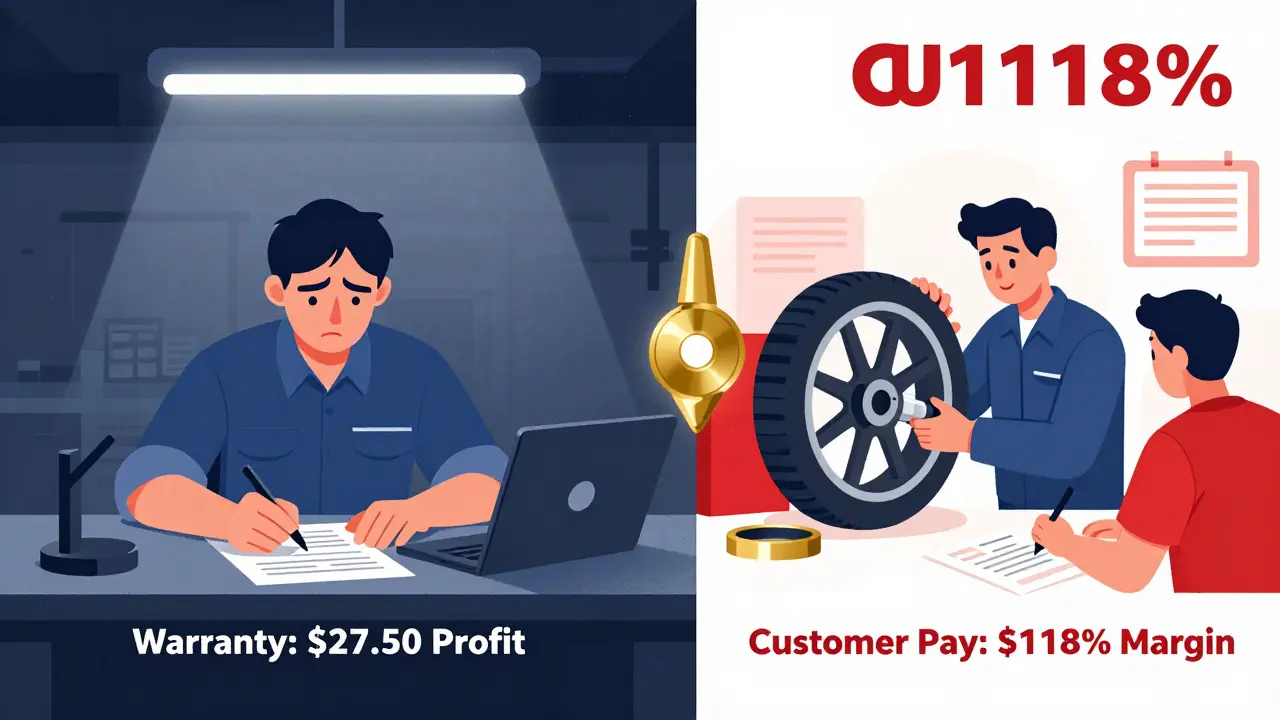
Let’s say a customer comes in with a noisy wheel bearing. The manufacturer’s warranty expired 6 months ago. You diagnose it, replace it, and charge $320. Your cost: $110 for the part, $90 for labor. That’s a 118% gross margin. That’s the kind of number that keeps your lights on.
Now compare that to a warranty job: same bearing, same labor, same part. But now you’re paid $85/hour × 1.5 hours = $127.50. The part? $100. Total payout: $227.50. Your cost? $200. Profit? $27.50. You did the same job. One pays 118% margin. The other pays 14%. That’s not a coincidence. That’s a business model.
The 70/30 Rule: A Simple Framework for Margin Growth
Top-performing service centers in New York, Chicago, and Atlanta have one thing in common: they aim for at least 70% of their revenue to come from customer pay. That doesn’t mean rejecting warranty work. It means structuring your workflow so warranty claims don’t dominate your schedule or your margins.
Here’s how to get there:
- Track every job by type: customer pay vs. warranty. Use your shop management software to tag each one.
- Calculate your monthly profit from each category. Don’t look at revenue-look at net profit after labor and parts cost.
- Set a target: 70% customer pay, 30% warranty. If you’re at 50/50, you’re in danger.
- When warranty claims exceed 35% of your workload, audit why. Are you over-relying on warranty because you’re not selling customer pay repairs?
One shop in Queens went from 48% customer pay to 73% in 8 months. How? They stopped accepting warranty claims for minor issues like brake pad wear that were just outside the warranty window. Instead, they trained their technicians to say: “Your warranty expired last month, but we can fix this now for $295. It’ll last 3 years. If you wait, you’ll pay more later.” Result? 82% of those customers said yes.
How to Turn Warranty Customers Into Customer Pay Customers
Warranty work isn’t the enemy. It’s a lead generator-if you handle it right.
Every time a customer comes in for a warranty repair, they’re already in your shop. They’re already worried. They’re already trusting you. That’s your moment.
Train your service advisors to ask three questions after the warranty job is done:
- “When was the last time you had your suspension checked?”
- “Have you noticed any vibrations or noises since the repair?”
- “Would you like us to do a full safety inspection while you’re here?”
That’s not upselling. That’s care. And it works. A 2025 survey of 1,200 U.S. repair shops found that shops using this method saw a 68% increase in customer pay follow-ups from warranty customers.
One shop in Buffalo started including a free 12-point inspection with every warranty repair. They didn’t charge for it. They didn’t advertise it. They just did it. Within 6 months, 41% of those customers came back for customer pay work-brake jobs, fluid flushes, timing belt replacements. All profitable. All theirs.
What Not to Do: The 3 Deadly Mistakes
Here’s where most shops fail:
- Mistake 1: Accepting every warranty claim without screening. If the issue is clearly wear-and-tear (like brake pads or tires) and the warranty just expired, don’t take it. Say: “That’s not covered anymore, but we can help you fix it now.”
- Mistake 2: Not tracking profit per job type. You can’t improve what you don’t measure. If you don’t know your margin on customer pay vs. warranty, you’re flying blind.
- Mistake 3: Treating warranty work as “free.” It’s not. It’s expensive labor with capped pay. Treat it like a cost center, not a revenue stream.
One shop in Ohio kept taking warranty jobs for transmission fluid leaks-because they thought it was “good volume.” Turns out, each job cost them $147 in labor and parts, and they got paid $132. They lost $15 per job. And they did 80 of them a month. That’s $1,200 a month in losses. They stopped. Their profit jumped 18%.

How to Build a System That Scales
You don’t need to be a genius to fix this. You need a system.
Start with your shop management software. Set up automated reports that show:
- Total customer pay revenue vs. warranty revenue
- Net profit for each category (after labor and parts)
- Number of warranty jobs per technician per week
- Conversion rate from warranty customers to customer pay follow-ups
Then, hold a weekly 15-minute huddle with your service advisors and lead techs. Review the numbers. Ask: “What’s our mix this week? Are we drifting? What can we do better?”
One shop in Brooklyn uses a simple whiteboard. On Monday, they write: “Target: 70/30. Last week: 62/38.” Every Friday, they update it. No fancy software. Just clarity. Their margins went up 22% in 6 months.
Final Thought: Margin Isn’t About Charging More. It’s About Choosing Better Work.
Increasing margin doesn’t mean raising prices. It doesn’t mean cutting corners. It means choosing the right kind of work.
Warranty work keeps your bay full. Customer pay work keeps your bank account full.
Stop treating warranty as your main business. Treat it as your entry point. Then, turn every warranty customer into a customer pay customer. That’s how you build a service business that lasts-not just survives.
Is warranty work always a loss?
Not always, but it’s often a loss on labor. Manufacturers pay fixed rates that rarely match your actual costs. Parts markups are capped, and administrative time isn’t reimbursed. If you’re not tracking net profit per warranty job, you’re likely losing money-even if the manufacturer pays you.
How do I convince customers to pay for repairs not covered by warranty?
Don’t sell them a repair. Sell them peace of mind. Use phrases like: “This part is worn out and could fail soon-leading to a much bigger repair.” Show them photos, explain the risk, and offer a free inspection. Most customers will pay when they understand the stakes.
Should I refuse warranty claims altogether?
No. Warranty work brings in new customers and builds trust. But don’t accept every claim. Screen for wear-and-tear issues that fall just outside warranty. Redirect those to customer pay with a clear, honest explanation. Keep warranty for true manufacturer defects.
What’s a good customer pay to warranty ratio?
Aim for 70% customer pay and 30% warranty. Shops hitting this ratio consistently report 20-30% higher net margins. Anything below 60/40 puts you at risk of margin erosion.
Can I use warranty work to upsell other services?
Absolutely. Every warranty customer is a warm lead. After the repair, offer a free safety or maintenance inspection. Most will accept. From there, you can recommend brake pads, fluids, or suspension work-all customer pay, all profitable.
Next steps: Start tracking your job mix this week. Pull your last 30 days of work. Separate customer pay from warranty. Calculate your net profit for each. If your warranty jobs are costing you money, adjust your approach. You don’t need more customers. You need better work.



rahul shrimali
January 20, 2026 AT 06:4270/30 rule is gold
Nikhil Gavhane
January 21, 2026 AT 23:21This is exactly what my shop started doing last year. We stopped chasing every warranty claim and started focusing on trust. Turned out customers appreciate honesty more than free fixes. Our profit jumped 25% in six months without raising prices. Just gotta stop treating warranty like free labor.
Bhagyashri Zokarkar
January 23, 2026 AT 07:27i just dont get why people think warranty is bad like its not like manufacturers dont know what theyre doing theyre just trying to screw us over with these capped rates and i swear if i had a dollar for every time a tech said "oh its just wear and tear" when it was clearly a design flaw i could buy a whole new shop
and dont even get me started on the paperwork its like filling out taxes but with more crying
also why do we even bother with inspections if no one ever pays for them i mean come on
my boss says we need to upsell but the customers just stare at us like we asked for their firstborn
and dont even tell me about the 12 point inspection thing i tried that once and got called a scam artist
also why do all the good customers have japanese cars and all the bad ones have american ones
and dont even get me started on the parts suppliers they charge more than the manufacturer and then act like its our fault
also why is it always the same 3 people who show up for warranty work like are they just wandering around looking for free repairs
and why do we have to do diagnostics for free when the manufacturer wont pay for it but then they charge us for the diagnostic code
also why do we even have a shop if the only thing we do is lose money
and why do we even bother with software when it just tells us what we already know which is that we’re drowning
also why do we even have a huddle if no one listens
also why do we even have a whiteboard if we just erase it every friday
also why do we even have a business
poonam upadhyay
January 23, 2026 AT 22:19OMG YES!!! I’ve been screaming this from the rooftops!! Warranty is a TAX on your soul!! 😭
My techs used to treat every warranty job like a gift from the gods… until I made them track profit per job. Then the lightbulbs went off. One guy cried. I didn’t care.
We stopped taking warranty on brake pads that expired 2 days ago. You know what happened? Customers said “Wow, you’re honest!” and then paid us $350 for a full brake job + rotors. No one complained. They were relieved.
Also, the “free inspection” trick? GENIUS. We started doing it with every warranty job-no charge, no sales pitch. Just: “Here’s what’s worn, here’s what’s fine.” 62% of them came back for paid work. One guy got his timing belt replaced because we showed him the cracks. He sent us a gift basket. With cookies. And a thank-you note. I cried. Again.
And stop calling it “upselling.” That’s what the sleazy dealers do. We’re not sleazy. We’re saving people from getting stranded on the highway with a broken suspension. That’s service. That’s care. That’s business.
Also-why are we still letting dealerships dictate our pricing? They pay $85/hour? Who the hell are they? The government? I pay my techs $110. They’re worth it. Stop apologizing for your value.
And if your shop is still doing 50/50? You’re bleeding. Cut the cord. Stop accepting warranty for tires, belts, and brake pads that expired last Tuesday. Say it like you mean it: “That’s not covered anymore, but we can fix it now before it kills you.” They’ll pay. They’ll thank you. And they’ll refer their friends.
Also-why is everyone still using paper logs? Get software. Use tags. Track profit. It’s 2025. You’re not in 2003.
And if you’re still thinking “but what if they go to the dealer?”-they won’t. The dealer charges $140/hour and takes 3 weeks to approve a claim. We’re faster, cheaper, and honest. That’s your edge.
Also-stop calling it “warranty work.” Call it “manufacturer-subsidized labor.” It’s not a benefit. It’s a cost center. Treat it like one.
And if your manager says “but we need the volume!”-tell them volume without profit is just noise. And noise doesn’t pay rent.
I’m not saying ban warranty. I’m saying: stop letting it run your shop. You’re not a charity. You’re a business. And your techs? They’re not slaves. They’re professionals. Pay them like it.
Bharat Patel
January 24, 2026 AT 20:42It’s funny how we treat warranty like a moral issue instead of a financial one. We think if we say no, we’re being heartless. But really, we’re just refusing to subsidize a broken system. The manufacturer sets the rate, not us. If they want to cover repairs, they should pay what it actually costs. Until then, we’re just giving away labor for free and calling it customer service.
But here’s the deeper thing: people don’t pay for repairs. They pay for peace of mind. That’s why the free inspection works. It’s not about the inspection-it’s about the feeling of being cared for. That’s what turns a warranty customer into a loyal one. Not the upsell. Not the quote. Just the quiet certainty that someone’s watching out for them.
And honestly? The 70/30 rule isn’t about profit. It’s about dignity. It’s about running a business where you don’t have to beg for money. Where you don’t have to beg manufacturers for fair pay. Where your time has value. That’s the real win.
Warranty work isn’t evil. It’s just not the foundation. And we’ve been building our houses on sand.
Eka Prabha
January 25, 2026 AT 16:57Let us not be naive. The entire warranty paradigm is a corporate construct designed to extract labor from independent shops while simultaneously maintaining the illusion of consumer protection. The manufacturer's fixed labor rate is not a pricing mechanism-it is a form of wage suppression disguised as industry standard. Furthermore, the cap on parts markups is a direct violation of free-market principles, effectively enforcing price controls under the guise of 'customer fairness.'
It is no coincidence that the most profitable service centers are located in urban centers with high labor costs and low manufacturer presence-this is not correlation, it is causation. The 70/30 rule is not a best practice-it is a survival tactic against institutionalized exploitation.
Moreover, the suggestion to 'train service advisors to ask questions' after warranty work is not customer care-it is psychological manipulation. The 'free inspection' is a Trojan horse for predatory upselling. While framed as benevolent, it exploits the customer's post-repair vulnerability. One must question whether such tactics, even if profitable, are ethically defensible.
Additionally, the reliance on shop management software for tracking profit margins reveals a troubling dependency on algorithmic governance. Are we becoming technicians of metrics rather than masters of craftsmanship? The whiteboard in Brooklyn is not a tool-it is a symbol of resistance against quantification.
Finally, the notion that 'warranty work keeps your bay full' is a dangerous fallacy. Full bays do not equate to financial health. Empty bays with high-margin work are preferable to full bays with negative margins. The real metric is not volume-it is value. And value, in this context, is being systematically eroded by corporate policy.
Do not mistake profitability for morality. But do not mistake moral compromise for business acumen either.
Rakesh Dorwal
January 26, 2026 AT 22:09India has been doing this for years-why do Americans act like this is new? We don’t wait for warranty to fix stuff. We fix it when it breaks. No bureaucracy. No waiting. No begging manufacturers for pennies. We just fix it. And we charge for it.
Why do you think Indian shops survive? Because we don’t let corporations tell us how to run our business. We don’t take their $85/hour. We charge what it’s worth. And people pay. Because they know-better to pay now than get stranded on the highway.
Stop acting like this is some genius insight. It’s just common sense. And common sense is not American anymore. It’s Indian.
Also-why do you think your techs are worth $110/hour? Because they’re skilled. Not because some corporate handbook says so. And if you’re not paying them that, you’re the problem.
Warranty? We don’t even have a word for it in our shop. We just say: ‘This is your car. We fix it. You pay. Simple.’
Vishal Gaur
January 28, 2026 AT 19:47ok so i read this whole thing and honestly i think the 70/30 thing is kinda sus
i mean like yeah warranty is low margin but you gotta take it or you lose customers right
and also the free inspection thing sounds like a trap like why would you give away free service unless you’re gonna upsell them into buying a new engine
also why do all the examples come from new york and chicago like what about rural shops
my shop is in a town of 2k people and we get like 2 warranty jobs a week and 3 customer pay and we’re fine
also the part about tracking every job in software? bro we use a notebook and a pencil and it works
also why is everyone talking about techs like they’re robots who need to be managed with whiteboards and huddles
my guy just fixes cars and i pay him cash every friday
also the whole ‘warranty is a cost center’ thing sounds like corporate jargon i don’t think we need to be talking like that
also i tried the brake pad thing once and the customer yelled at me for 20 minutes so now i just take the warranty
and also why do you keep saying ‘they’ll pay’ like customers are just waiting to be tricked into spending money
maybe they just want to get their car fixed without feeling like they’re at a car salesman convention
also why is this article so long
and why are there so many questions at the end
also i think you’re overcomplicating this
just fix the car. charge what you can. be honest. and go home.
Bharat Patel
January 30, 2026 AT 07:29That last comment? That’s the real truth. Not the 70/30 rule. Not the whiteboard. Not the software.
It’s just: fix the car. Be honest. Charge fairly. And treat people like humans-not profit centers.
The rest? Just noise. The system’s trying to make us think we need to be consultants to survive. But we’re mechanics. We fix things. That’s enough.
Maybe the real profit isn’t in the mix. Maybe it’s in the peace.