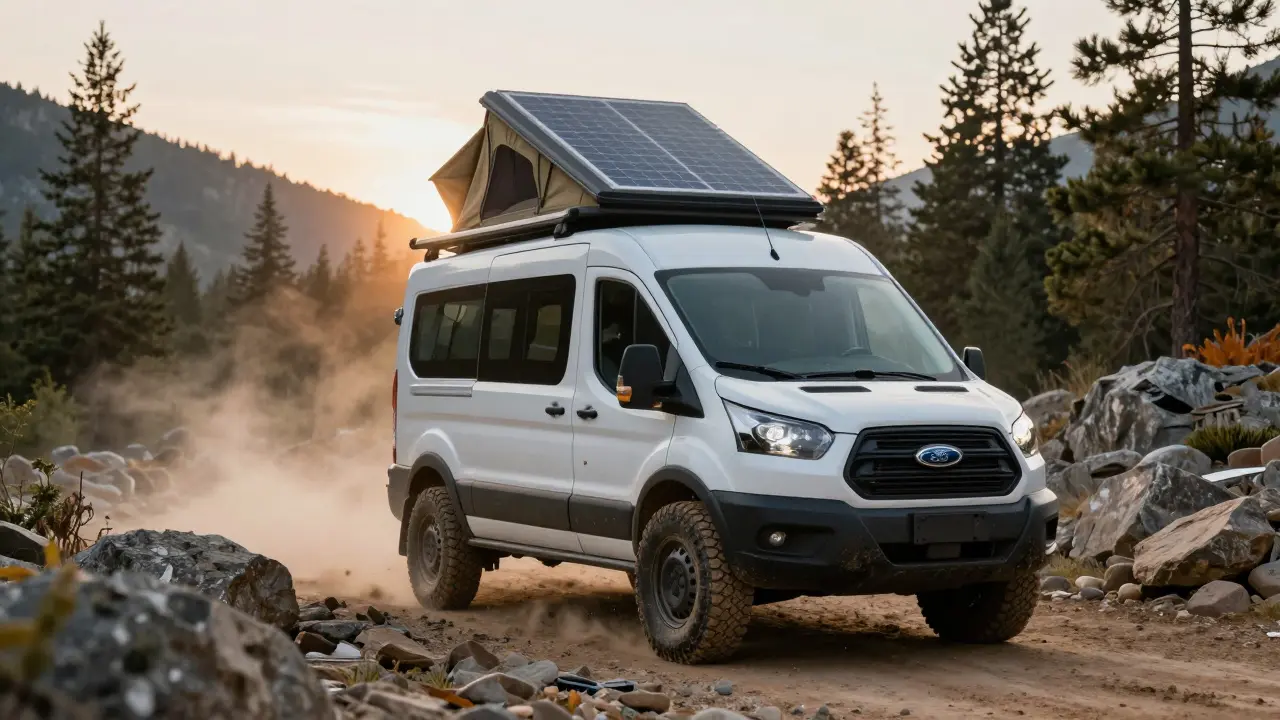
Most people think of vans as boxy city commuters or family shuttles. But if you’ve ever seen a dusty, lifted van parked beside a remote trailhead-tires caked in mud, rooftop tent popped, solar panels glinting in the sun-you know there’s a whole different world out there. Off-road vans aren’t just modified vehicles. They’re mobile homes built to handle dirt roads, river crossings, and weeks without a single gas station. And they’re not for the faint of heart-or the underprepared.
What Makes a Van Truly Off-Road Ready?
Not every van with all-wheel drive is built for the backcountry. A true off-road van needs more than traction. It needs ground clearance, durable suspension, locking differentials, and a chassis that won’t snap when you drop off a rock ledge. Stock vans like the Ford Transit or Mercedes Sprinter have the space, but they’re designed for highways, not washboards. That’s where conversion comes in.Real overland builds start with lifting the suspension. A 2- to 4-inch lift kit isn’t just for looks-it’s about clearing obstacles. A stock Transit sits about 7 inches off the ground at the axle. A lifted version hits 10 to 12 inches. That extra clearance lets you crawl over boulders without scraping the belly pan. But lift kits alone aren’t enough. You need heavy-duty shocks, like Fox 2.0 or King coilovers, to absorb the punishment. Stock suspension will bottom out on the first serious bump, turning your kitchen into a wrecking ball.
Then there’s the tires. Stock all-seasons? Useless. Most serious builders go with 33-inch all-terrain tires-think BFGoodrich KO2 or Toyo Open Country A/T III. They’re tougher, grippier, and can handle punctures from sharp rocks. Pair those with steel wheels. Aluminum wheels bend. Steel bends, then you fix it. One guy in Montana lost a wheel on a sharp ridge. He swapped it with his spare in 20 minutes because it was steel. Aluminum? He’d have been stuck for days.
Why 4x4 Conversion Matters More Than You Think
Two-wheel drive vans might seem fine for light trails. But if you’ve ever tried to climb a muddy hill in a rear-wheel-drive Sprinter, you know how quickly things go wrong. Mud, snow, loose gravel-these aren’t optional conditions. They’re the norm. That’s why 4x4 conversions aren’t a luxury. They’re a necessity.Most factory vans come with front-wheel or rear-wheel drive. Converting them to true 4x4 means adding a transfer case, front differential, and drive shafts. Companies like Unimog and Quigley Motor Company specialize in this. A Quigley-modified Ford Transit 4x4 can climb 45-degree inclines and ford 24 inches of water without a hitch. It’s not cheap-expect to pay $15,000 to $25,000 on top of the base van price-but it’s the difference between turning back and pushing through.
And don’t forget the locking differentials. A standard open differential sends power to the wheel with least traction-meaning if one tire spins on a rock, the other sits still. A locking diff forces both wheels to turn together. That’s what gets you out of a hole. Most serious builds include rear lockers as standard. Front lockers? That’s pro territory. But if you’re planning to tackle the Rubicon Trail or the Alaska Highway, you won’t regret it.
Power, Water, and Food: The Overland Trinity
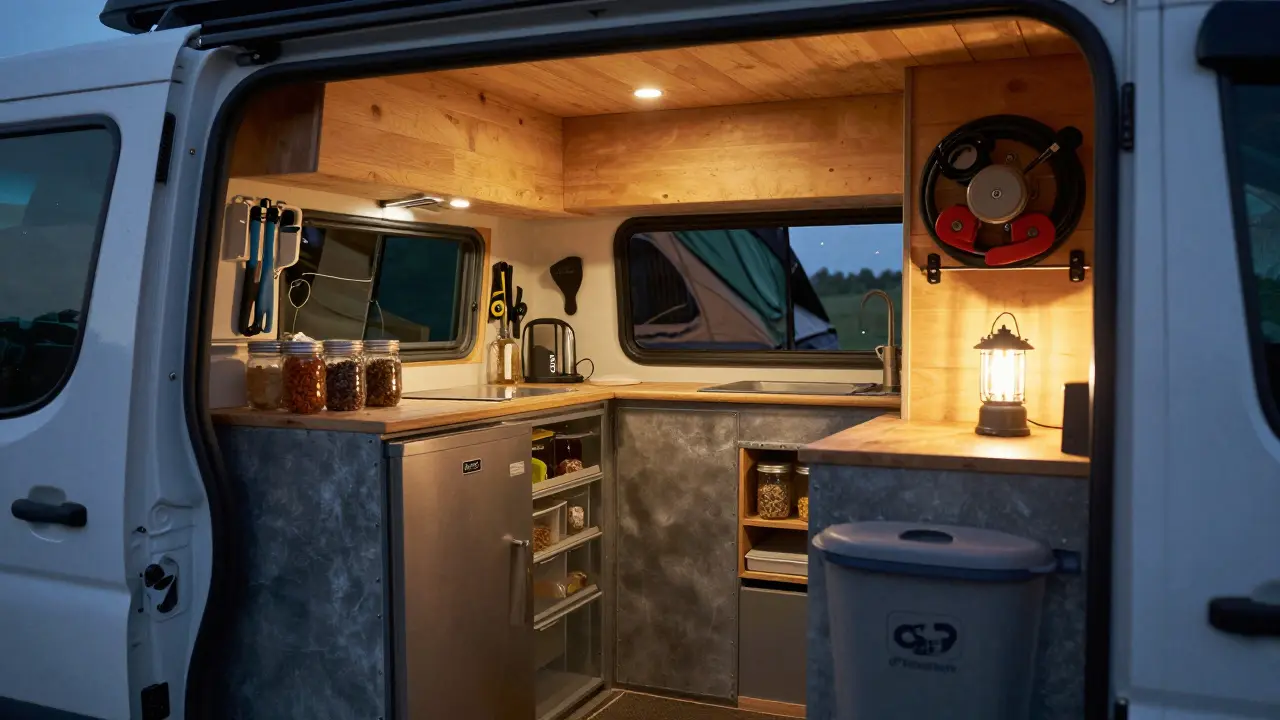
A van can look amazing with nice wood paneling and a fancy kitchen. But if you run out of power after two days, or your water tank leaks on day three, you’re not overland-ready-you’re just camping with wheels.Power is the first priority. Most builds use dual lithium batteries-like Battle Born or Renogy-paired with a 200- to 400-watt solar panel array on the roof. That setup can run a fridge, LED lights, a phone charger, and a small fan for days. Forget gas generators. They’re loud, heavy, and need fuel. Solar is silent and endless. One builder in Colorado ran his entire system for 17 days straight on solar alone, even through cloudy winter weather.
Water systems need to be sealed, insulated, and oversized. A 20-gallon freshwater tank is the bare minimum. Most go for 30 to 40 gallons. Pair that with a 12-volt water pump and a gravity-fed sink. For waste, composting toilets like the Nature’s Head are quiet, odor-free, and don’t need plumbing. No black water tank means no dumping stations. That’s freedom.
Food storage? A 12-volt fridge is non-negotiable. A standard cooler will melt in 12 hours under direct sun. A Dometic CFX3 or ARB fridge keeps food cold for weeks. And don’t forget the pantry. Mason jars, vacuum-sealed meals, and dried beans are the backbone of long trips. One couple in Patagonia lived off canned salmon, rice, and lentils for six weeks. They never missed a meal.

Essential Gear You Can’t Skip
You don’t need every gadget on the market. But there are a few things that make or break a trip:- Recovery gear: A winch (like a Warn 12K), a shovel, traction boards, and a tow strap. If you get stuck, you need to get out-fast.
- GPS and satellite communicator: Garmin inReach or SPOT X. Cell service vanishes in the mountains. These devices let you send SOS signals and share your location.
- Extra fuel: A 5-gallon jerry can tucked under the van. Some remote areas are 100 miles between stations.
- Tool kit: Not just wrenches. Welding rods, zip ties, JB Weld, spare fuses, and a tire plug kit. A broken alternator belt? Fix it with a zip tie and a 20-minute YouTube tutorial.
- Rooftop tent: No need to sleep on the floor. A Thule or Tepui tent adds comfort and keeps you dry, safe, and off the ground.
One builder in Alaska lost his rear axle seal on the Dalton Highway. He had a spare seal, the right tools, and a jack rated for 6,000 pounds. He replaced it in 90 minutes. No tow truck. No cell signal. Just grit and the right gear.
What Not to Do
Too many people rush into van builds. They buy a used Transit, slap on some wheels, and call it a day. Then they get stuck in the desert, run out of water, or fry their electrical system. Here’s what you should avoid:- Using cheap inverters: A $100 inverter from Amazon will die under load. Stick with pure sine wave inverters like Victron or Renogy. They handle fridges and microwaves without frying your electronics.
- Ignoring insulation: A van without proper insulation turns into an oven in summer and an icebox in winter. Use Reflectix or XPS foam. It’s cheap, easy to install, and makes a huge difference.
- Overloading the roof: Rooftop tents, solar panels, and gear racks add weight. Don’t exceed the van’s roof load limit. A 2024 Ford Transit has a 200-pound max roof load. Go over that, and you risk structural damage.
- Skipping a test drive: Build your van, then drive it 500 miles on rough roads before heading into the wild. You’ll find rattles, leaks, and wiring issues before you’re stranded.
Real-World Examples: Who’s Doing It Right
There are dozens of builders out there, but a few stand out. The Overland Journal team tested a modified 2023 Mercedes Sprinter with a Quigley 4x4 conversion, 35-inch tires, dual lithium batteries, and a full kitchen. They drove it from Arizona to Alaska-2,800 miles of gravel, snow, and river crossings. No breakdowns. No flat tires. Just one water pump failure, fixed with a $12 spare.Then there’s the Van Life Collective crew, who converted a 1998 Ford E-350 into a diesel-powered overland rig. They added a 120-gallon fuel tank, a 60-gallon water system, and a rooftop tent. They spent nine months in the Andes, surviving altitudes over 14,000 feet. Their secret? Simplicity. No fancy gadgets. Just reliable parts and a mindset that says, “If it breaks, I’ll fix it.”
These aren’t outliers. They’re proof that with the right build, a van can go anywhere.
Is an Off-Road Van Right for You?
Let’s be honest-not everyone needs this. If you’re planning weekend campouts near paved roads, a basic camper van is enough. But if you want to explore the Alaska Range, the Mojave Desert, or the Patagonian backcountry, then you need something built for it.Start small. Buy a used van. Add a solar panel and a battery. Test it on dirt roads. Then upgrade. Don’t spend $80,000 on a pre-built rig right away. Learn what you actually use. Most people end up removing half the gadgets they thought they needed.
Off-road vans aren’t about luxury. They’re about independence. The ability to wake up where no one else can reach. To drive past the last sign, past the last gas station, past the last cell tower-and still be okay. That’s the real appeal. And it’s not for everyone. But if you’re ready to go beyond the map? You already know what to do.
kelvin kind
January 15, 2026 AT 16:24Been running a lifted Transit for three years now. Solar + 33s + steel wheels = no regrets. Got stuck once in Utah, pulled out with traction boards and a beer. That’s the life.
Ian Cassidy
January 17, 2026 AT 01:15Yo, the real MVP here is the locking diff. Open diff = useless on anything past a gravel road. Quigley’s 4x4 conversion is the only way to go if you’re serious. And don’t even think about aluminum wheels - steel bends, aluminum shatters. Been there, bought the tow bill.
Zach Beggs
January 18, 2026 AT 11:38Agreed on the solar setup. I went with Renogy 300W and two Battle Borns. Haven’t touched a generator in 18 months. Even in Oregon winter, it’s enough for the fridge and lights. Just make sure your charge controller is good - that’s where people mess up.
Kenny Stockman
January 20, 2026 AT 09:27Biggest tip I can give? Test drive before you go full beast mode. I built my rig with every gadget under the sun - fancy kitchen, LED strips, Bluetooth speaker. Then I drove it 300 miles on a washboard road. Everything rattled loose. Took me three days to fix it. Start simple. Add stuff as you learn what you actually need. Less is more out there.
Antonio Hunter
January 22, 2026 AT 06:24It’s worth noting that the psychological shift required for true overlanding isn’t just about gear - it’s about embracing uncertainty. The van isn’t a luxury mobile home; it’s a mobile survival platform. You’re not camping - you’re adapting. The people who thrive are the ones who treat every breakdown as a puzzle, not a crisis. That’s why the Van Life Collective’s approach works: they don’t rely on gadgets, they rely on competence. And competence comes from repetition, not Instagram posts.
Paritosh Bhagat
January 23, 2026 AT 09:57Okay but let’s be real - if you’re spending $25k on a 4x4 conversion, you’re probably just trying to flex on Instagram. I’ve seen guys with $100k rigs crying because their rooftop tent leaked. Meanwhile, I drove a stock Honda Odyssey with a $300 tent and a cooler for 6 months across Nepal. No lift. No solar. No fancy tires. Just grit. You don’t need a Quigley to be an adventurer. You just need to stop buying things to feel like one.
Ben De Keersmaecker
January 24, 2026 AT 23:05Minor correction: the 2024 Ford Transit roof load limit is actually 220 lbs, not 200 - Ford updated it in the 2023 model year revision. Also, ‘reflectix’ is a brand name; the generic term is ‘reflective bubble insulation.’ And while you mentioned JB Weld, you didn’t specify that it’s only effective on clean, dry surfaces - oily or wet metal requires a different adhesive. These details matter when you’re 80 miles from the nearest town.
Aaron Elliott
January 26, 2026 AT 00:29One must question the fundamental premise: if one requires a vehicle capable of traversing the Rubicon Trail, why not simply purchase a purpose-built off-road platform - a Land Cruiser, a Jeep Wrangler, or even a Hilux - rather than retrofitting a commercial delivery van engineered for urban logistics? The entire enterprise reeks of performative self-reliance, a romanticized illusion of autonomy masquerading as practicality. The van, in its most honest form, is a compromise - a compromise in durability, in efficiency, in safety. And yet, we glorify it as if it were a cathedral. The real question is not whether one can survive in such a rig, but whether one ought to.