
You spent thousands on ads, hosted test drives, and trained your sales team. But half the people who visited your website never came back. They clicked, they browsed, they even added a car to their favorites-and then vanished. That’s not a fluke. It’s the norm. Most car shoppers don’t buy on their first visit. In fact, 87% of dealership website visitors leave without making a move. The question isn’t whether you lost them-it’s how to get them back.
Why Retargeting Works for Car Dealerships
People don’t buy cars like they buy coffee. It’s a big decision. They compare prices, check reviews, talk to friends, and visit multiple dealerships. Maybe they left your site because they wanted to see what Ford had to offer. Or maybe they were waiting for a better trade-in offer. Or maybe they just got distracted by a text message.
Retargeting doesn’t chase them. It reminds them. It says, "Hey, you were looking at that 2024 Honda CR-V. It’s still here. And we’ve got a $500 incentive this week."
Unlike cold ads that blast everyone on Facebook, retargeting only shows ads to people who already showed interest. That means your budget isn’t wasted on people who don’t care. It’s focused on warm leads-people who are 3x more likely to convert than new visitors.
Dealerships that use retargeting see a 25% to 45% increase in website return visits. And among those who return, 15% to 22% end up walking onto the lot. That’s not magic. That’s math.
How to Set Up a Retargeting Campaign That Actually Converts
You can’t just slap a pixel on your site and call it a day. Retargeting fails when it’s lazy. Here’s how to build one that works:
- Install a tracking pixel on every page of your website. Google Ads and Meta both offer free pixels. Make sure it’s firing correctly-test it with Facebook Pixel Helper or Google Tag Assistant.
- Segment your audience. Don’t treat everyone the same. Create separate audiences for:
- People who viewed a specific model (e.g., Ford F-150)
- People who spent more than 90 seconds on your inventory page
- People who added a vehicle to their favorites or saved a quote
- People who visited but didn’t fill out a lead form
- Set frequency caps. Showing the same ad 15 times in one day feels spammy. Limit it to 3-5 times per week. Most platforms let you set this automatically.
- Use dynamic ads. These ads automatically show the exact vehicle the person looked at. If they viewed a silver 2025 Toyota RAV4 with leather seats, your ad shows them that exact car-not a generic image of a RAV4.
- Add urgency. Use phrases like: "Only 2 left at this price," "Offer expires in 48 hours," or "Your saved vehicle just dropped $1,200."
One dealership in Ohio saw a 31% increase in test drive bookings after switching from static retargeting ads to dynamic ones that pulled real-time inventory data. They didn’t change their budget. They just made the ads smarter.
Where to Run Your Retargeting Ads
You’ve got options. But not all of them are equal.
| Platform | Best For | Pros | Cons |
|---|---|---|---|
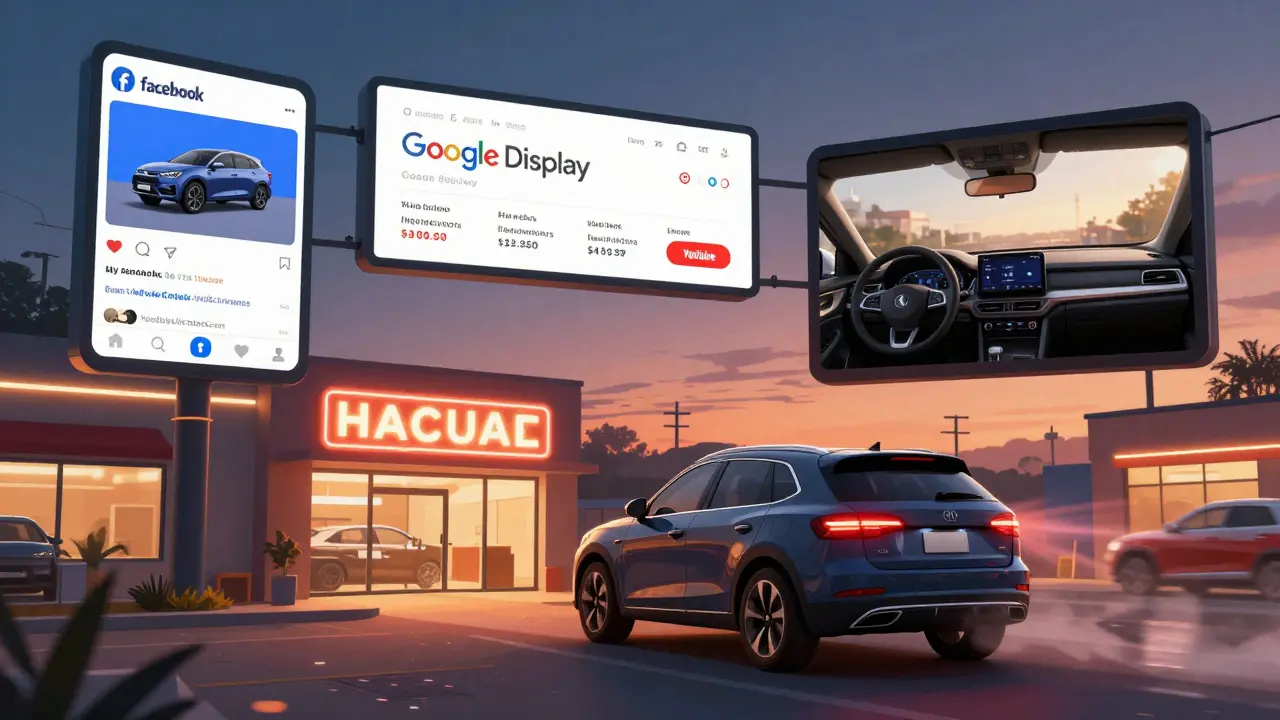
| Meta (Facebook & Instagram) | Visual shoppers, SUV/crossover buyers | High reach, great image/video support, detailed targeting | Ad fatigue if overused |
| Google Display Network | Price shoppers, research-heavy buyers | Shows ads on 2M+ sites, works well with search retargeting | Lower engagement than social |
| YouTube | High-intent buyers, demo seekers | Video ads show features, test drives, comparisons | More expensive per impression |
| Programmatic DSPs (e.g., The Trade Desk) | Large dealerships with big budgets | Full control, cross-device tracking, premium inventory | Requires technical setup and ongoing management |
Start with Meta and Google. They’re the easiest to set up and give you the fastest results. Once you’re comfortable, test YouTube for high-value models like trucks or luxury SUVs.
What to Say in Your Retargeting Ads
Generic ads like "Check out our inventory!" don’t move needles. Your message needs to answer the question they’re still asking themselves: "Why should I come back?"
Here are proven ad copy formulas that work:
- Urgency + Specificity: "The 2024 Hyundai Tucson you saved is now $1,500 off. Only 3 left."
- Social Proof + Scarcity: "17 people saved this 2025 Chevy Silverado this week. Only 1 left at this price."
- Value Add: "You looked at the Ford Mustang. Get a free car wash with your purchase this month."
- Comparison: "You viewed the Toyota RAV4. See how it stacks up against the Honda CR-V-with real pricing."
One dealer in Texas tested three versions of the same ad. One said "Visit us today!" Another said "Your favorite car is still available." The third said "Your saved 2024 Jeep Wrangler just got a $2,000 discount."
The third one converted 47% better. Why? It reminded them of their own action-and gave them a reason to act now.
Retargeting Doesn’t End at the Ad
Getting someone back to your site is only half the battle. What happens when they land there matters just as much.
Make sure your landing page matches the ad. If the ad shows a red 2025 Ford Explorer with a $2,000 discount, the landing page should show that exact car-with the discount clearly visible. No surprises. No scrolling to find the price.
Also, add a simple lead capture form right on the page. Don’t make them click through five pages to get a quote. A one-click form with just name, email, and phone number works best. Offer a free service coupon or a personalized financing estimate in exchange for their info.
And don’t forget follow-up emails. If they didn’t book a test drive, send a short email 24 hours later: "Hey, we noticed you were looking at the 2024 Honda Pilot. We’ve got a special offer for you this week. Want to schedule a drive?"

Common Mistakes That Kill Retargeting Results
Even good campaigns fail because of small errors.
- Retargeting everyone. If you target people who visited your homepage for 2 seconds, you’re wasting money. Focus on those who engaged deeply.
- Not excluding converters. Don’t show ads to people who already bought. It’s annoying and burns budget.
- Using the same creative for 6 months. Ad fatigue is real. Refresh your visuals and copy every 30 days.
- Ignoring mobile. Over 70% of car shoppers use phones to research. Make sure your ads and landing pages load fast and look good on small screens.
- Forgetting privacy. Make sure your retargeting setup complies with CCPA and GDPR. Disclose data use in your privacy policy.
One dealership in Arizona was spending $8,000 a month on retargeting. They were showing ads to people who bought cars 3 weeks ago. Once they excluded converters and narrowed their audience to only those who viewed a vehicle for more than 2 minutes, their cost per lead dropped by 38%.
Measuring What Matters
Don’t just track clicks. Track what moves the needle:
- Return visit rate-how many people came back after seeing your ad?
- Lead form submissions from retargeted traffic
- Test drive bookings from retargeted users
- Conversion rate-what percentage of retargeted visitors actually bought?
Compare these numbers to your non-retargeted traffic. If retargeted visitors convert 2x higher, you’re doing it right.
Most dealerships see a return of $5 to $8 for every $1 spent on retargeting. That’s not a guess. That’s what the data shows.
What’s Next?
Retargeting isn’t a one-time fix. It’s a system. Start small. Pick one vehicle model. Run a 30-day test. Track the results. Then expand.
Pair retargeting with email marketing. Use CRM tools to tag leads who visited your site but didn’t buy. Send them a personalized message 5 days later: "Still thinking about the 2024 Kia Sorento? We just got in three more with the same specs."
And remember: the goal isn’t to chase every visitor. It’s to reconnect with the ones who showed real interest. Those are the people who will walk through your door.
How long should I retarget someone after they visit my website?
Most dealerships retarget for 30 to 60 days. That’s long enough to catch someone who’s still comparing, but short enough to avoid annoying them. After 60 days, the likelihood of conversion drops sharply. You can extend it to 90 days for high-ticket vehicles like luxury SUVs or trucks, but only if you refresh the ad creative.
Can I retarget people who visited my competitors’ sites?
No, you can’t directly retarget people who visited other dealerships. Retargeting only works on people who have been on your own site. But you can use lookalike audiences on Meta or Google to find people similar to your past visitors. That’s not retargeting-it’s prospecting based on behavior.
Do I need a big budget to run retargeting ads?
No. You can start with as little as $10-$20 per day. The key isn’t spending more-it’s being smart. Focus on high-intent audiences (people who viewed specific vehicles), use dynamic ads, and exclude people who already bought. Even small dealerships see strong returns with tight targeting.
Why are my retargeting ads not converting?
Three common reasons: 1) Your landing page doesn’t match your ad-people see a different car or price, 2) You’re showing too many ads too often, which feels spammy, and 3) You’re not offering a clear next step. Add a strong CTA: "Book a test drive," "Get your personalized quote," or "Claim your $500 discount."
Should I retarget people who called my dealership?
Only if they didn’t complete the sale. If they called, talked to a salesperson, but didn’t buy, retargeting can help. Use a CRM to tag those leads. Then show them ads with incentives like free maintenance or extended warranty offers. But if they already bought, stop. Don’t annoy your new customers.
Retargeting isn’t about tricking people into coming back. It’s about giving them a reason to. The right message, at the right time, to the right person-that’s how you turn window shoppers into buyers.

Stephanie Serblowski
December 26, 2025 AT 16:19Okay but let’s be real - if your retargeting ads are still showing the same boring car pic from 6 months ago, you’re not reminding people. You’re haunting them. 🤡 Dynamic ads + urgency = magic. I saw a dealer in Austin boost conversions by 42% just by swapping static creatives for real-time inventory pulls. Also, stop targeting people who bought 3 weeks ago. That’s not marketing, that’s emotional abuse.
Renea Maxima
December 28, 2025 AT 03:40What if the real problem isn’t retargeting… but the fact that we’ve turned car buying into a behavioral experiment? We’re not reminding people - we’re manipulating their dopamine loops. That ‘$500 incentive’? It’s not a deal. It’s a trap. We’ve turned human desire into a CTR metric. 🌑
Jeremy Chick
December 29, 2025 AT 17:33Bro. I ran this exact setup for my buddy’s dealership last year. $15/day on Meta + dynamic ads + excluded converters. Got 11 test drives in 22 days. One guy came in, saw his exact car, and bought it on the spot. No BS. This shit works. Stop overthinking it. Just set it up and let the algorithm eat.
Sagar Malik
December 31, 2025 AT 01:43Actually, the entire premise is flawed. Retargeting is a surveillance capitalism tool disguised as ‘customer experience.’ You track every scroll, every hover, every millisecond of hesitation - then weaponize it. And you call it ‘marketing.’ Meanwhile, GDPR is laughing in the background. The real ROI? Your soul. 🤖
Seraphina Nero
December 31, 2025 AT 22:35This is actually super helpful. I’m not in auto sales, but my cousin runs a small dealership and she was struggling. I’m sending her this. The part about matching the ad to the landing page? That’s golden. So many sites mess that up. Simple stuff, but it makes a huge difference.
Megan Ellaby
December 31, 2025 AT 23:22Wait so if someone just looked at a car for 10 seconds, you’re still showing them ads? That’s kinda creepy… I get targeting people who saved it or spent 90+ sec, but like… if they just clicked by accident? Maybe don’t follow them to their mom’s house? 😅 Also, love the urgency tips - ‘only 2 left’ is so effective. My uncle bought a truck because of that exact line.
Rahul U.
January 2, 2026 AT 21:18Excellent breakdown. 🙌 The segmenting strategy alone is worth a thousand ad dollars. I’ve seen dealers waste 70% of budgets on broad audiences. Precision > volume. Also, mobile optimization is non-negotiable - 78% of research happens on phones. If your landing page takes 4 seconds to load, you’ve already lost. 👌
E Jones
January 3, 2026 AT 01:34Let me tell you what they don’t want you to know - this whole retargeting system is controlled by a shadow cabal of Silicon Valley data brokers who sell your browsing habits to the highest bidder. They’re not just tracking your car searches - they’re mapping your emotional vulnerabilities. That ‘$2,000 discount’? It’s not a sale. It’s a trigger. They know you’re stressed about payments. They know you’re scared of being ripped off. They know you cried last Tuesday because your cat died. And now they’re showing you a silver RAV4 with a blinking ‘BUY NOW’ button. You’re not a customer. You’re a data point with a credit score. And they’re feeding you lies wrapped in leather seats. Wake up. 🕵️♂️💔
Barbara & Greg
January 3, 2026 AT 19:38While the tactical advice herein is not without merit, one must consider the ethical implications of behavioral manipulation in consumer markets. The normalization of persistent, algorithm-driven persuasion erodes the autonomy of the purchasing individual. One cannot, in good conscience, endorse systems that exploit cognitive biases under the guise of ‘convenience.’
selma souza
January 5, 2026 AT 14:10You wrote ‘they were looking at that 2024 Honda CR-V’ - it should be ‘they were looking at the 2024 Honda CR-V.’ Also, ‘you’re not chasing them, you’re reminding them’ - that’s a cliché. And you missed a comma after ‘free car wash.’ This entire article is riddled with grammatical errors. How can anyone trust your advice when you can’t even write a proper sentence?