If you’re looking at a Triumph Bonneville and a Moto Guzzi V7 side by side, you’re not just comparing two bikes-you’re choosing between two different ways of riding. One feels like a British gentleman’s Sunday drive. The other? Like an Italian nonna handing you a plate of pasta while humming a tune only she understands. Both are modern takes on retro roadsters. Both look like they rolled straight out of the 1970s. But under the skin? They’re worlds apart.
Design: British Elegance vs Italian Soul
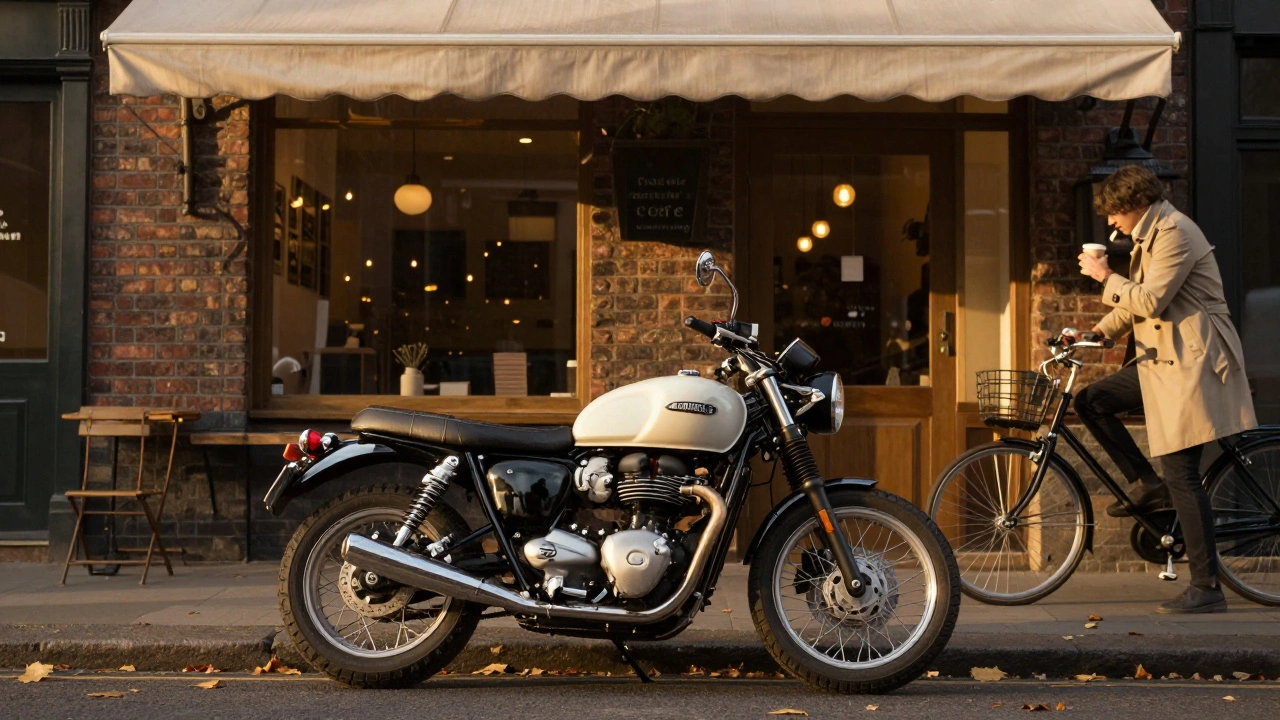
The Triumph Bonneville doesn’t shout. It whispers. Its lines are clean, its tank is smooth, and the chrome glints just enough without being flashy. It’s the kind of bike that looks right parked outside a coffee shop in Portland or a village pub in Devon. The seat is low, the handlebars are wide but not aggressive, and the overall posture is relaxed. You sit on it, not in it.
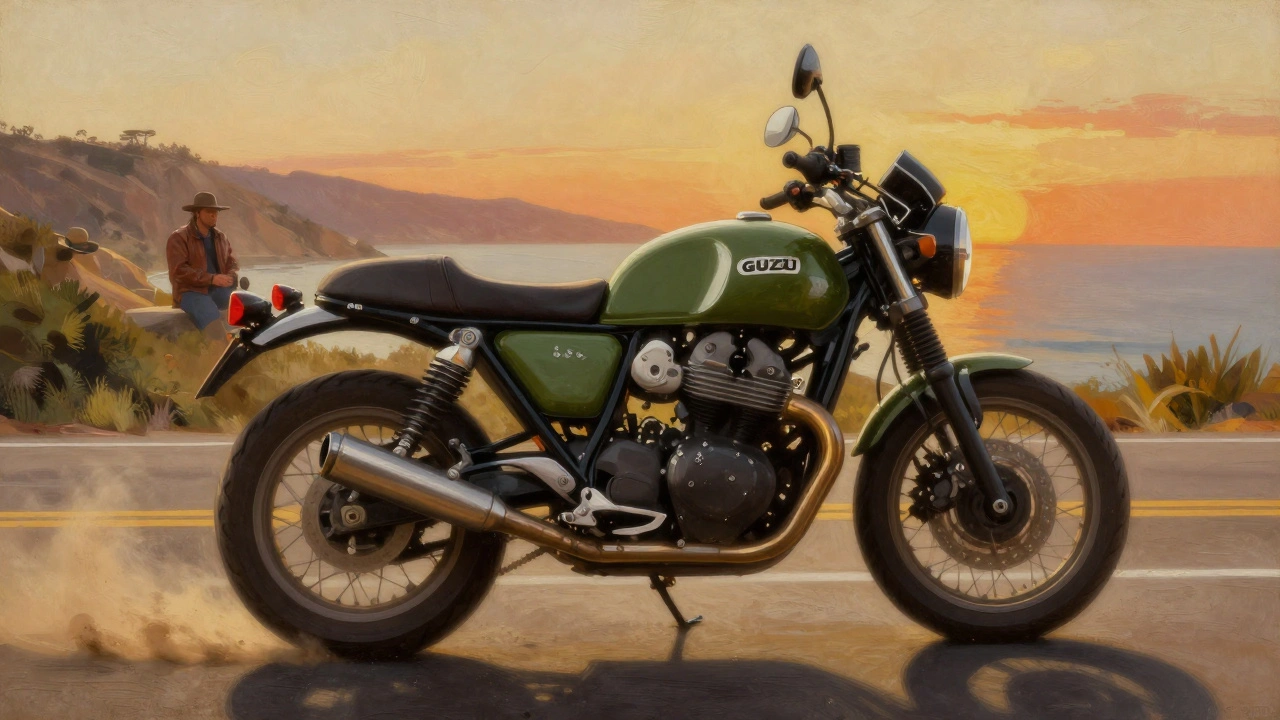
The Moto Guzzi V7, on the other hand, has character carved into every curve. The tank has a subtle bulge near the fuel cap, like it’s holding a secret. The engine isn’t hidden-it’s the star. The 90-degree V-twin sticks out like a proud chest, and the exhaust pipes sweep back like wings. It doesn’t just look retro-it looks Italian. You can’t miss the fact that this bike was built by people who think motorcycles should make noise, smell like oil, and feel alive.
Engine: Air-Cooled Twins with Different Personalities
Both bikes use air-cooled, 850cc, 90-degree V-twin engines. Sounds similar, right? Don’t be fooled.
The Triumph Bonneville’s engine is smooth. It’s tuned for effortless torque at low RPMs. You get 54 horsepower and 59 lb-ft of torque. It pulls cleanly from idle, and the throttle response is buttery. There’s no vibration. It doesn’t rattle your fillings. It’s engineered for comfort, not drama. You can ride all day without your wrists going numb.
The Moto Guzzi V7’s engine? It’s got heartbeat. Literally. The 90-degree V-twin has a distinct thump-thump rhythm you feel in your chest. It’s tuned to deliver 65 horsepower and 48 lb-ft of torque-less torque than the Triumph, but it comes on with more attitude. The engine is mounted transversely, so the crankshaft runs side to side. That means the whole bike leans when you accelerate or brake. It’s not a flaw-it’s a feature. You feel connected to the engine in a way you don’t with most modern bikes.
Triumph’s engine is quiet. Moto Guzzi’s is loud-and proud of it. You’ll hear the clatter of the timing chain, the pop of the exhaust on decel. It’s not polished. It’s real.
Ride Quality: Comfort vs Character
The Bonneville rides like a well-sprung armchair. The suspension is soft, the seat is plush, and the bike feels stable at highway speeds. It’s the kind of machine you can ride from Detroit to Chicago without a break. The brakes are decent, the controls are intuitive, and the weight (498 lbs wet) feels manageable.
The V7 is lighter-475 lbs wet-but it doesn’t feel that way. The engine’s placement and the way the frame flexes make it feel a little more alive. The suspension is stiffer, and the seat is narrower. You’ll notice bumps more. You’ll feel the road more. That’s not a bad thing if you like being part of the ride. But if you’re commuting in winter or carrying a passenger, you’ll miss the Bonneville’s cushioning.
The Bonneville leans into corners with predictable grace. The V7? It leans like it’s dancing. The transverse V-twin gives it a unique feel-when you turn, the engine’s mass shifts, and the bike responds with a subtle, almost human sway. It’s not for everyone. But if you’ve ever ridden a vintage Ducati or a 1970s Moto Guzzi, you’ll recognize the feeling. It’s nostalgic. It’s thrilling.
Technology: Modern Touches on Classic Frames
Neither bike is stuck in the past. Both have modern electronics, but they use them differently.
The Triumph Bonneville comes with ride-by-wire throttle, traction control, and two ride modes (Road and Rain). The instrument cluster is a clean analog dial with a small digital screen. It’s minimalist but functional. The bike also has LED lighting, ABS, and a USB charging port. Everything is there, but nothing overwhelms you.
The Moto Guzzi V7 has ride modes too-three of them: Rain, Touring, and Sport. It also has ABS and traction control. But the electronics feel more like an afterthought. The digital display is basic. The ride modes don’t change the engine’s character as dramatically as you’d expect. The real tech here is the engine itself. The V-twin’s unique layout means it doesn’t need fancy electronics to feel special. It’s analog soul with digital safety nets.
Ownership: Maintenance and Cost
Triumph has a strong dealer network in the U.S. Parts are easy to find. Routine maintenance-oil changes, valve checks, chain adjustments-is straightforward. You can do most of it yourself with basic tools. The Bonneville’s engine is sealed and reliable. You’ll likely go 10,000 miles between major services.
Moto Guzzi? You’ll need to be a little more hands-on. The transverse V-twin means the engine is harder to access. Changing the oil requires removing the right-side cover. The timing chain needs checking every 15,000 miles. And while parts are available, they’re not always stocked at every shop. If you live in a small town, you might need to ship parts or drive to a specialist.
Price-wise, both bikes are close. The Bonneville starts around $10,500. The V7 starts at $10,200. But insurance for the Guzzi can be 10-15% higher in some states. Why? Because insurers see it as more of a “niche” bike. It’s not as common, so repair costs are higher.
Who Should Buy Which?
If you want a retro bike that feels modern, quiet, and reliable-the Triumph Bonneville is your pick. It’s the bike you’ll ride to work, on weekend trips, and through rainstorms. It’s the one your partner won’t complain about. It’s the one you’ll still love in five years.
If you want a bike that makes people stop and stare-if you want to feel like you’re riding a piece of Italian history, with every gear shift and throttle roll-you’ll love the Moto Guzzi V7. It’s not the easiest bike to live with. But it’s the one that makes you smile when you start it up. It’s the bike that doesn’t just get you from A to B-it makes the journey matter.
Real-World Scenarios
Picture this: You’re in Michigan in November. Rain is falling. You’re heading to a mechanic’s shop with a friend. You hop on the Bonneville. It’s warm, dry, and smooth. You don’t feel the cold. You don’t feel the wet. You just ride.
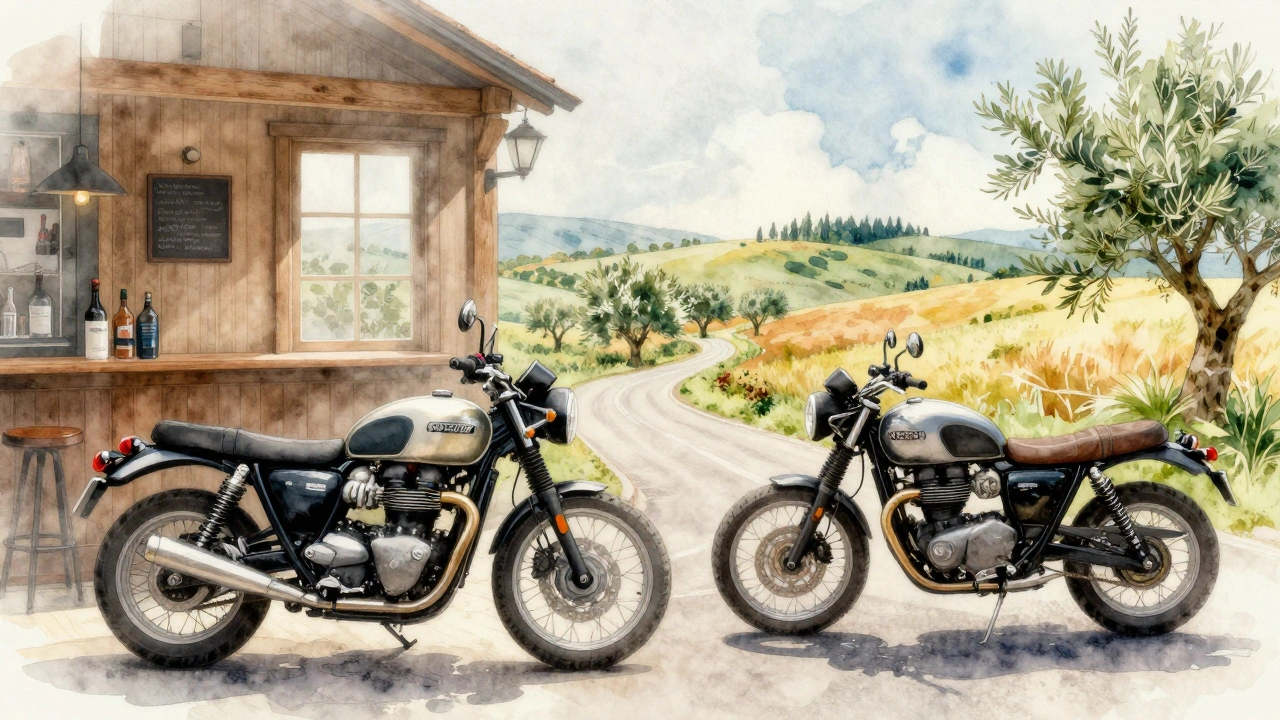
Now picture this: You’re in California in June. The sun’s out. You pull into a roadside café. You park the V7. A group of guys in vintage leather jackets walk over. One taps the engine. Says, “That’s a Guzzi, right?” You nod. He grins. “I had one in ’78. Still miss it.” That’s the V7’s magic. It doesn’t just move you. It connects you.
| Feature | Triumph Bonneville | Moto Guzzi V7 |
|---|---|---|
| Engine Type | 850cc air-cooled parallel twin | 850cc air-cooled 90° V-twin |
| Power | 54 hp | 65 hp |
| Torque | 59 lb-ft | 48 lb-ft |
| Weight (wet) | 498 lbs | 475 lbs |
| Seat Height | 30.7 inches | 30.5 inches |
| Engine Mount | Longitudinal | Transverse |
| Ride Modes | 2 (Road, Rain) | 3 (Rain, Touring, Sport) |
| ABS | Yes | Yes |
| Starting Price (2025) | $10,500 | $10,200 |
Frequently Asked Questions
Is the Triumph Bonneville a good first bike?
Yes, especially if you’re drawn to retro style but want modern reliability. The Bonneville’s low seat, light weight, and smooth power delivery make it forgiving for new riders. It’s not as twitchy as some European bikes, and its traction control helps in wet conditions. Many riders start on this model and stay with it for years.
Why is the Moto Guzzi V7 more expensive to insure?
Insurers see the V7 as a niche bike with fewer parts available and higher repair costs. Its unique engine layout means not every mechanic can work on it, and parts often need to be shipped from Europe. That increases risk-and premiums. The Bonneville, being more common in the U.S., has lower insurance rates.
Can I fit a passenger on either bike?
Yes, both come with passenger pegs and a two-up seat. But the Bonneville’s wider, cushioned seat makes it more comfortable for longer rides. The V7’s seat is narrower and firmer, so your passenger might feel every bump. For weekend trips, either works. For cross-country, the Bonneville wins.
Which one holds its value better?
The Triumph Bonneville holds its value slightly better. It’s more popular in North America, so there’s a larger resale market. The Moto Guzzi V7 has a cult following, but fewer buyers. After three years, you’ll likely recover 65-70% of the Bonneville’s price. The V7? More like 60-65%.
Do either of these bikes need special maintenance?
The Bonneville needs standard motorcycle upkeep: oil changes every 5,000 miles, chain adjustment, and valve checks every 10,000 miles. The V7 requires the same, but the transverse V-twin means more labor to access parts. Timing chain inspection is critical every 15,000 miles. If you’re not comfortable working on engines, the Bonneville is easier to maintain.
Final Thought
Neither bike is perfect. But neither needs to be. The Triumph Bonneville is the dependable friend who shows up on time. The Moto Guzzi V7 is the wild cousin who shows up late-but always brings the best stories. Choose the Bonneville if you want a bike you can ride every day. Choose the V7 if you want a bike that reminds you why you fell in love with motorcycles in the first place.

Teja kumar Baliga
December 7, 2025 AT 12:10Love how you described the Guzzi as an Italian nonna handing you pasta-perfect. I grew up in Mumbai with my grandfather’s old Guzzi in the garage, and that same smell, that same thump, it’s magic.
Kelley Nelson
December 8, 2025 AT 21:48While I appreciate the poetic liberty taken in this analysis, one must acknowledge that the Triumph Bonneville represents the pinnacle of restrained British engineering-whereas the Guzzi, for all its theatrics, is essentially a 1970s mechanical artifact masquerading as a modern motorcycle.
Zelda Breach
December 10, 2025 AT 16:33Of course the Bonneville’s ‘smooth’-it’s been neutered to appeal to people who think ‘vibration’ is a bad word. Meanwhile, the Guzzi’s got soul, and you know what? That’s why it costs more to insure. Insurance companies fear authenticity.
Aryan Gupta
December 11, 2025 AT 01:31Correction: The Bonneville has a parallel twin, not a V-twin. You said both are 90-degree V-twins. That’s factually incorrect. Also, ‘nonna’ is Italian, not French. And why is the seat height listed as 30.5 vs 30.7? That’s a 0.2 inch difference-statistically irrelevant. Fix your data.
Gareth Hobbs
December 13, 2025 AT 00:10Y’all in the US just don’t get it. The Guzzi’s transverse V-twin? That’s proper engineering. The Bonneville? Just a Japanese engine in a British skin. And don’t get me started on how Triumph outsources everything now-bloody Chinese parts in a ‘British’ bike. Pathetic.
Nicholas Zeitler
December 13, 2025 AT 05:18Let me just say-this is the most balanced, thoughtful comparison I’ve read in years. Seriously. The way you captured the feeling of each bike? That’s not just writing. That’s storytelling. And the maintenance notes? Lifesaver for new riders. Thank you.
Alan Crierie
December 13, 2025 AT 08:52For anyone considering the V7: if you’re the type who enjoys tinkering, it’s a joy. If you want to just ride and forget, get the Bonneville. Also, the Guzzi’s engine note at 3,000 RPM? Pure serotonin. 🎶
k arnold
December 14, 2025 AT 04:35Wow, another ‘choose your vibe’ article. Next time just put a flowchart: ‘If you like silence → Bonneville. If you like your neighbors calling the cops → Guzzi.’ Done.
Fredda Freyer
December 15, 2025 AT 07:59There’s a deeper truth here: the Bonneville is the bike you buy because you want to ride. The V7 is the bike you buy because you want to be a rider. One is a tool. The other is a mirror. The Guzzi doesn’t just reflect the road-it reflects your relationship with motion, with noise, with history. It’s not about torque numbers or seat height. It’s about whether you want to be a passenger in your own life, or its co-author. That’s why, after five years, you’ll still stare at your Guzzi in the garage and smile-even if it’s covered in dust. And you’ll know: you chose the story, not just the machine.