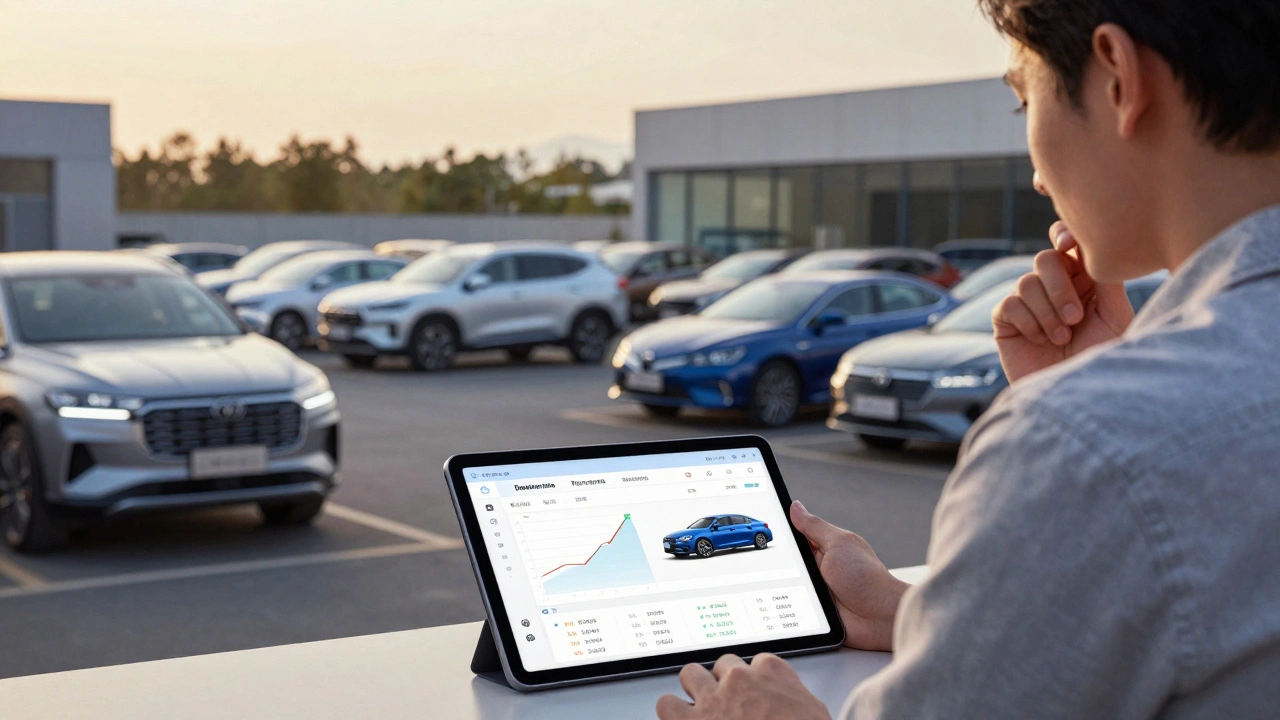
Dealerships that guess how many cars to order end up losing money. Too many vehicles on the lot means storage costs, depreciation, and tied-up cash. Too few means lost sales and frustrated customers. The difference between profit and loss often comes down to one thing: inventory forecasting.
Why Guessing Doesn't Work Anymore
Five years ago, dealers could rely on last year’s sales patterns. If a Honda Civic sold 40 units in January, they’d order 45 this year. Simple. But that’s not how the market works anymore. In 2025, supply chains are still recovering from global disruptions. Semiconductor shortages shifted demand from trucks to compact EVs. Inflation changed what buyers can afford. Trade-in values fluctuated by 15% in some markets. And online car shopping means customers compare prices across states, not just counties. If your inventory plan doesn’t adjust to these shifts, you’re not managing inventory-you’re gambling.What Drives Demand in Today’s Market?
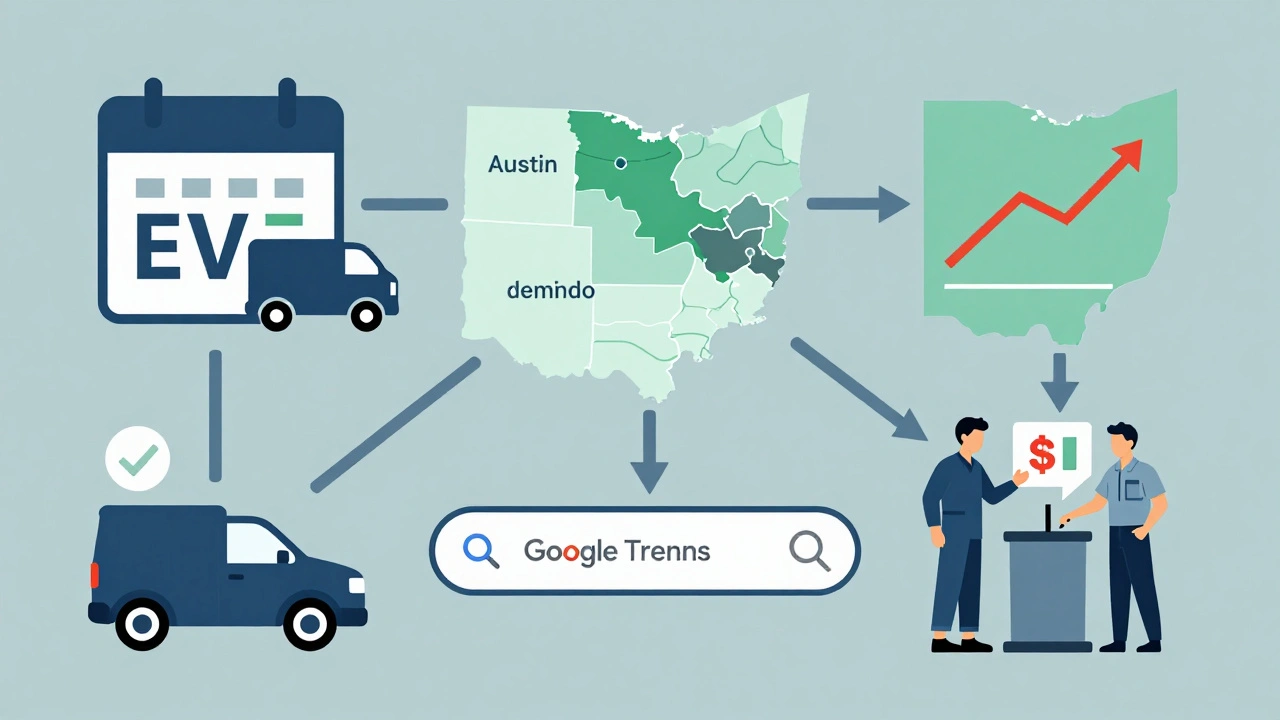
You can’t forecast without knowing what moves the needle. Here are the five real factors that actually matter:- Seasonal trends-Trucks sell more in spring, hybrids spike in fall when gas prices rise, and EVs see surges after federal tax credit announcements.
- Local economic shifts-A factory closing in Ohio drops demand for full-size pickups. A new tech hub opening in Austin boosts demand for EVs and premium SUVs.
- Competitor pricing-If three dealerships in your region slash prices on used Toyota Camrys, you’ll see demand for yours drop within days.
- Online search behavior-Google Trends data shows a 68% increase in searches for “affordable electric SUVs” in the Midwest since January 2025.
- Trade-in volume and quality-If your service center is seeing more high-mileage vehicles come in for trade-ins, you’ll need more budget-friendly models on the lot.
How to Build a Real Forecast (Not a Spreadsheet Fantasy)
Forget pulling numbers from past years and adding 5%. That’s not forecasting-it’s wishful thinking. Here’s what works:- Start with your actual sales data-Pull the last 18 months. Not just total units, but by make, model, trim, color, and price range. Look for patterns: Did the Black Edition Trailhawk sell out every time? Did the base-model Corolla linger for 90+ days?
- Layer in market data-Use free tools like Edmunds’ Market Insights, Kelley Blue Book’s Inventory Trends, and Google Trends. Don’t just look at national data-filter by your ZIP code or DMA region.
- Track competitor inventory-Visit five nearby dealerships weekly. Note what’s selling fast, what’s been sitting for 60+ days, and what’s been discounted. Use screenshots. Set up alerts for price drops.
- Connect with your service department-They see what’s breaking down. If 12% of trade-ins this month are 2018-2020 Ford F-150s with transmission issues, you know those models will flood the used market soon. Don’t overstock them.
- Adjust weekly-Don’t wait for monthly meetings. If your top-selling model sold out in 10 days, order more. If your luxury sedan sat for 45 days, reduce next order by 30%.
The Tools That Actually Help
You don’t need a $50,000 AI system. But you do need the right tools.- Dealer.com’s Inventory Planner-Integrates with your DMS and shows real-time demand signals by model. Used by over 1,200 U.S. dealers.
- AutoTrader’s Market Pulse-Free dashboard showing regional demand surges and inventory levels by make.
- Google Sheets + free APIs-Use Google Trends data pulled weekly via API. Combine it with your DMS export. Create a simple dashboard: “Top 5 models moving fastest” vs. “Top 5 sitting too long.”
- WhatsApp groups with local dealers-Yes, really. In Eugene, five independent dealers share weekly inventory snapshots. One noticed a spike in Honda HR-V returns after a recall. They all adjusted orders. No one got stuck with bad stock.
What to Avoid at All Costs
Here are the three mistakes that sink dealership inventory:- Ordering based on what the manufacturer pushes-OEMs want to move slow-selling models. Your job is to move what your customers want. If your region hates blue sedans, don’t order 15 of them just because the rep said they’re “on promotion.”
- Ignoring used inventory-Used cars make up 60% of your revenue. If you’re forecasting new car sales but ignoring trade-in volume and condition, your whole forecast is broken.
- Waiting for “perfect data”-You’ll never have it. Start with 80% of the data you have. Refine as you go. A 70% accurate forecast that’s updated weekly beats a 95% accurate one that’s done quarterly.
Real Example: How a Small Dealership Cut Excess Stock by 40%
A family-owned Toyota dealership in Springfield, Oregon, had 78 vehicles sitting over 90 days in early 2025. Their old system ordered based on last year’s sales-same models, same colors. They started tracking:- Searches for “Toyota Corolla hybrid under $22K” in their county-up 82%
- Competitors discounting 2022 Corollas by $3,500
- Service department reporting 14 trade-ins of 2019-2021 Corollas with timing chain issues
What’s Next: Predictive Forecasting Is Coming
The next wave isn’t just tracking trends-it’s predicting them. Some dealers are testing AI tools that combine:- Local weather patterns
- Gas price changes
- Job postings in nearby industries
- Car insurance claim rates by model
Start Today: Your 7-Day Inventory Forecasting Plan
You don’t need a big budget or a tech team. Here’s what to do in one week:- Day 1: Export your last 18 months of sales data by model and trim.
- Day 2: Visit three competitors. Note what’s selling fast and what’s sitting.
- Day 3: Check Google Trends for your top 5 models in your ZIP code.
- Day 4: Talk to your service manager. Ask: “What models are coming in for trade-ins that are breaking down?”
- Day 5: Identify your top 3 slow-movers. Reduce next order by 40%.
- Day 6: Identify your top 3 fast-sellers. Increase next order by 25%.
- Day 7: Set a calendar reminder to review this every Monday morning.
Final Thought: Inventory Is a Conversation, Not a Number
Your inventory isn’t a spreadsheet. It’s a conversation with your customers, your competitors, and your local market. The best forecasts aren’t made in boardrooms-they’re made by listening. Stop guessing. Start observing. Adjust weekly. The dealers who win in 2025 aren’t the ones with the biggest budgets. They’re the ones who pay attention.How often should I update my dealership inventory forecast?
Update your inventory forecast every week. Monthly reviews are too slow. The market moves fast-gas prices, competitor discounts, and consumer searches can shift in days. A weekly check lets you react before you’re stuck with unsold cars.
Can I use free tools for inventory forecasting?
Yes. Google Trends, Kelley Blue Book’s Inventory Trends, and Edmunds’ Market Insights are free and accurate enough for small to mid-sized dealerships. Combine them with your own sales data in Google Sheets, and you’ll have a working system without spending a dime.
What’s the biggest mistake dealers make with inventory?
The biggest mistake is ordering based on what the manufacturer pushes, not what customers want. OEMs want to clear slow-moving models. Your job is to sell what your local buyers are searching for and willing to pay for. Ignore the push, listen to the market.
Should I forecast new and used inventory separately?
Absolutely. Used inventory makes up 60% of most dealerships’ revenue. Trade-in volume, condition, and local demand for used cars are completely different from new car trends. Forecast them as two separate streams-you’ll avoid overstocking used cars that are falling in value.
How do I know if my forecast is working?
Track two metrics: days on lot and sell-through rate. If your average days on lot drops below 45 and your sell-through rate (units sold / units received) stays above 85% for your top 5 models, your forecast is working. If not, adjust.

Tyler Springall
December 2, 2025 AT 02:17This is the kind of shallow, corporate fluff that passes for insight these days. You don't need a spreadsheet to know people want affordable, reliable transportation-not another overpriced EV that costs more than their mortgage. Dealers are just chasing trends like lemmings while ignoring the real issue: consumers are broke, and they're not buying luxury nonsense anymore. This entire article reads like a sales pitch disguised as strategy.
Colby Havard
December 3, 2025 AT 02:48While the author presents a compelling case for data-driven inventory management, one must not overlook the fundamental epistemological flaw inherent in predictive modeling: the assumption that historical patterns, even when augmented with real-time market signals, can reliably forecast human behavior in a context of systemic economic volatility. The market is not a deterministic system; it is a chaotic, emergent phenomenon shaped by psychological, sociological, and geopolitical variables that no algorithm, however sophisticated, can fully encapsulate. Therefore, while tactical adjustments are prudent, one must never confuse statistical correlation with causal certainty.
Amy P
December 3, 2025 AT 21:03OMG YES. I just bought a car last month and I swear I spent 11 hours online comparing prices, colors, trim levels-then walked into a dealership and they had ZERO of what I wanted but 17 of the exact model I was trying to avoid. I cried in the parking lot. This article gets it. The fact that dealers still don't get that we're not just buying a car-we're buying a solution to our life chaos-is insane. I'm telling all my friends to ask their dealer: 'What are you ordering next week? And why?' If they can't answer, run.
Ashley Kuehnel
December 5, 2025 AT 12:22Hey everyone! Just wanted to say this post is SO helpful-I'm a small dealer in Ohio and I started using Google Sheets + Edmunds data last month. I dropped 4 of my slowest SUVs and doubled down on Corolla Hybrids based on local search trends. Sales jumped 30% in 3 weeks! Also, talking to the service team was a game-changer-they told me 8 of the last 12 trade-ins were 2019 Accords with timing belt issues, so I stopped ordering those. No fancy AI needed-just paying attention. If you're reading this and still guessing, please try this. You won't regret it. :)
adam smith
December 5, 2025 AT 23:19Good advice. I agree. Weekly updates. Check competitors. Use free tools. Do not order what manufacturer says. Used cars matter. This is smart.
Mongezi Mkhwanazi
December 7, 2025 AT 03:40Let us not delude ourselves with this so-called 'forecasting'-it is nothing more than a modern-day form of divination, dressed in the garb of data analytics. The entire premise rests upon the delusion that markets can be tamed, quantified, and controlled by mortal men. The semiconductor shortage? Inflation? Trade-in fluctuations? These are symptoms of a broken system, not variables to be optimized. The true cause of dealership failure is not poor forecasting-it is the moral bankruptcy of a system that values profit over people, efficiency over empathy, and algorithms over human intuition. You cannot predict demand when demand is shaped by desperation, not data.
Zelda Breach
December 8, 2025 AT 15:11Oh please. 'Use Google Trends'? You think some guy in Iowa typing 'affordable electric SUV' means anything? This whole thing is a Silicon Valley fantasy. Real dealers know inventory isn't about data-it's about who you know. I've been in this business 30 years. I don't need APIs. I know which families are moving in, which factories are hiring, and which neighbors are trading up. Your 'weekly updates' are just noise. Real dealers don't chase trends-they set them. And if you're still using Google Sheets, you're already behind.
Alan Crierie
December 9, 2025 AT 08:52Brilliant piece-thank you for writing this with such clarity. I particularly appreciated the point about WhatsApp groups with local dealers; it’s a humble, human solution that cuts through the tech hype. One small correction, though: in the 'Tools That Actually Help' section, you mention 'Dealer.com’s Inventory Planner'-I believe the correct name is 'Dealer.com Inventory Planner' (no apostrophe). Minor, but I’m a stickler for details. 😊 Also, the final thought-'Inventory is a conversation'-is absolutely perfect. We forget that cars aren’t just products; they’re part of people’s lives. Keep this kind of thinking alive.