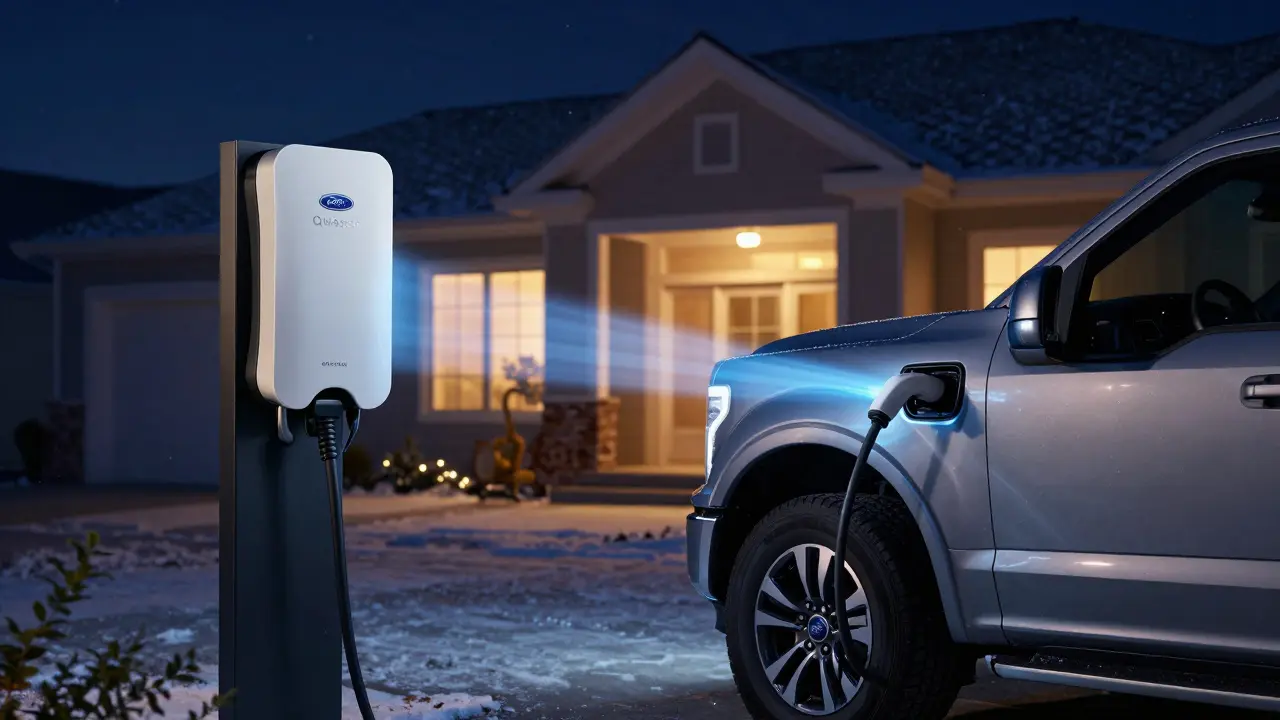
Most people think of electric vehicles as just cars that don’t use gas. But if you own a modern EV with bidirectional charging, your car is also a mobile power station. On a hot summer day when the grid goes down, your Tesla, Ford F-150 Lightning, or Hyundai Ioniq 5 can keep your fridge running, your lights on, and your medical devices powered-all without plugging into a wall. That’s Vehicle-to-Home (V2H). And if your utility pays you for sending power back during peak demand, that’s Vehicle-to-Grid (V2G). These aren’t futuristic ideas anymore. They’re real, available, and already saving people money across the U.S.
What Exactly Is V2H?
V2H means your electric vehicle sends electricity from its battery to power your home. It works through a special bi-directional charger that flips the flow: instead of pulling power from the grid to charge your car, it pushes power from your car into your house. You need three things to make it happen: an EV that supports bidirectional charging, a compatible home energy system (like a smart inverter or energy gateway), and a certified installer.
Not all EVs can do this. Right now, only a handful of models in the U.S. support V2H: the Nissan Leaf (with the CHAdeMO adapter), the Ford F-150 Lightning (with the Pro Power Onboard system), the Hyundai Ioniq 5 and Ioniq 6, and the Kia EV6. Tesla doesn’t offer it yet in the U.S., though it’s available in Japan and Europe. The key is whether the car’s software and hardware allow power to flow out, not just in.
Most homeowners use V2H as backup power during outages. In Michigan, where winter storms knock out power for days, families with V2H systems report keeping their homes warm and lights on for 2-5 days on a full charge. A typical EV battery holds 60-100 kWh. A typical U.S. home uses about 30 kWh per day. So if you’re careful with energy use-turning off non-essential devices-you can stretch that power for multiple days.
How Does V2G Work?
V2G takes V2H one step further. Instead of just powering your own house, your EV sends electricity back to the utility grid. Utilities pay you for it. This isn’t charity-it’s smart grid management. During hot afternoons, when everyone turns on AC, the grid gets overloaded. V2G lets utilities tap into thousands of parked EVs to smooth out that spike. In return, you get paid per kilowatt-hour you give back.
Right now, V2G is mostly in pilot programs. California, New York, and Texas have active trials. In California, Pacific Gas & Electric (PG&E) pays participants $1.50 per kWh during peak events. That’s more than double the retail rate. If you send back 10 kWh during a 4-hour event, you earn $15. In a year, with a few events, you could earn $150-$400 just by leaving your car plugged in.
It’s not about selling power every day. Utilities only call for power during high-stress moments-usually 2-8 times a year. Your car’s battery doesn’t wear out faster from this. Studies from the University of California, Davis, show that V2G cycling (discharging and recharging) adds less than 1% to annual battery degradation. That’s less than driving 1,000 extra miles a year.
Equipment You Need to Get Started
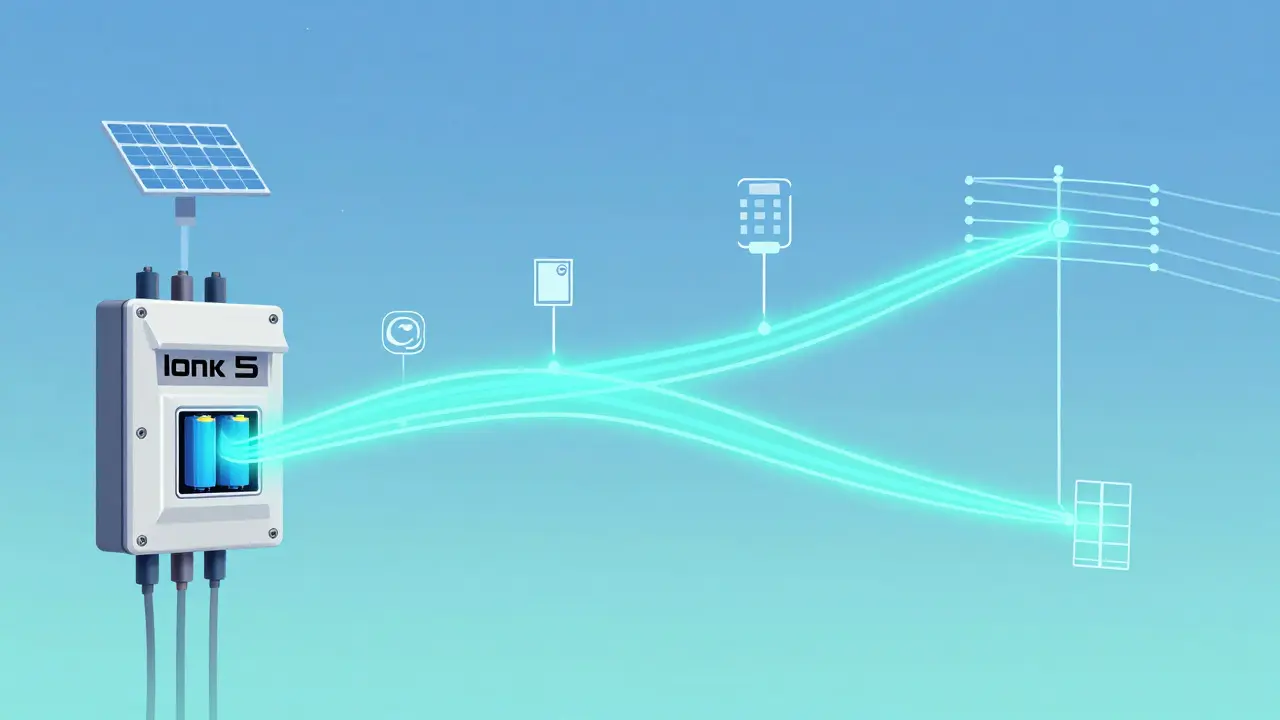
You can’t just plug your EV into a regular outlet and start sending power back. You need hardware that handles the complex back-and-forth flow. Here’s what’s required:
- Bidirectional EV charger-like the Wallbox Quasar, ChargePoint Home Flex with V2H/V2G mode, or the Ford Intelligent Backup Power system. These cost $1,200-$2,500 installed.
- Home energy manager-a smart device that decides when to draw from your car, when to charge it, and when to send power to the grid. Examples: Enphase Energy IQ8, Tesla Powerwall (with third-party integration), or the Fronius Symo Hybrid.
- Utility approval-V2G requires formal permission from your power company. Some states require a separate meter or interconnection agreement.
- EV with bidirectional capability-again, only select models work. Check your car’s manual or contact the manufacturer before buying a charger.
Installation usually takes a full day. A licensed electrician runs a dedicated circuit from your charger to your main panel, then connects the energy manager. Most systems are designed to work even if the grid goes down-so your home stays powered during outages.
Costs vs. Savings: Is It Worth It?
Let’s break down the numbers. In Michigan, where electricity costs about $0.17/kWh:
- Upfront cost: $3,000-$6,000 (charger + installation + energy manager)
- Annual savings from V2H: $200-$600 (avoiding generator fuel, reducing outage damage)
- Annual earnings from V2G (if available): $150-$400 (based on 2-4 utility events)
- Federal tax credit: 30% of system cost under the Inflation Reduction Act (up to $1,400)
That means your system could pay for itself in 5-8 years. And that’s before considering increased home value. A 2024 study by the Lawrence Berkeley National Laboratory found homes with EV charging and battery backup sold for 3-5% more than comparable homes without.
Some people worry about battery wear. But modern EV batteries are designed to last 15-20 years. Most manufacturers guarantee 70% capacity after 8 years or 100,000 miles. V2H and V2G use shallow discharges (typically 20-80% state of charge), which is actually easier on the battery than constant 0-100% cycling.
Who Benefits Most From V2H and V2G?
Not everyone needs this. But if any of these sound like you, it’s worth looking into:
- You live in an area with frequent power outages (like during winter storms or wildfires).
- You have solar panels and want to store excess energy in your car instead of a home battery.
- You’re on a time-of-use electricity plan and want to charge your car at night (cheap) and use it during the day (expensive).
- You want to reduce your carbon footprint without installing a home battery.
- You’re curious about earning money from your car’s battery.
For example, a retiree in Grand Rapids with a Nissan Leaf and solar panels uses V2H to power essential circuits during outages. She doesn’t pay for a backup generator. She doesn’t need a Powerwall. Her car does it all.
On the flip side, if you drive less than 5,000 miles a year and your utility doesn’t offer V2G payments, the return on investment may be too slow. But if you’re planning to buy an EV anyway, getting one with bidirectional charging adds long-term flexibility.
What’s Next for V2H and V2G?
By 2027, nearly every new EV sold in the U.S. will support bidirectional charging. The Biden administration’s EV charging plan includes $2.5 billion for V2G infrastructure. Utilities in 18 states are already testing programs. Michigan’s DTE Energy just launched a pilot with 500 Ford F-150 Lightning owners.
Future systems will be smarter. Imagine your car automatically discharging to your home when your solar panels aren’t producing, then sending extra power to the grid when your bills are highest. AI will optimize when to charge, when to store, and when to sell-based on weather, grid demand, and your schedule.
There’s also a growing movement to use EVs as community microgrids. In rural areas, a few parked EVs can power a clinic or school during storms. In cities, fleets of taxis or delivery vans could help stabilize the grid without needing new power plants.
Common Myths About V2H and V2G
- Myth: V2G will ruin your battery. Truth: Shallow discharges (20-80%) are ideal for battery health. Most systems avoid deep discharges.
- Myth: Only Teslas can do this. Truth: Tesla doesn’t offer it in the U.S. yet. Nissan, Ford, Hyundai, and Kia lead the market here.
- Myth: It’s too complicated. Truth: Once installed, it runs automatically. You just plug in and forget it.
- Myth: You need solar to make it worthwhile. Truth: You can use V2H just for backup power. No solar needed.
The biggest barrier right now isn’t technology-it’s awareness. Most EV owners don’t even know their car can power their house. Dealerships rarely mention it. But that’s changing fast.
Can any electric vehicle do V2H or V2G?
No. Only EVs with bidirectional charging hardware and software support it. In the U.S., that includes the Nissan Leaf, Ford F-150 Lightning, Hyundai Ioniq 5 and Ioniq 6, and Kia EV6. Tesla, Rivian, and Chevrolet Bolt do not currently support it in the U.S. market. Always check your vehicle’s manual or contact the manufacturer before buying a charger.
Do I need solar panels to use V2H or V2G?
No. V2H works just fine to power your home during outages using only your EV’s battery. Solar panels can help by recharging your car during the day, but they’re not required. Many users rely on grid charging at night and use their car as a backup during the day.
How much does a V2H or V2G system cost to install?
A full system-including a bidirectional charger, home energy manager, and professional installation-typically costs between $3,000 and $6,000. Federal tax credits cover 30% of that cost (up to $1,400). Some utilities offer rebates on top of that, bringing the net cost down to $2,000-$4,000 in some areas.
Will V2G shorten my EV’s battery life?
Studies show minimal impact. Most V2G systems limit discharges to between 20% and 80% state of charge, which is actually gentler on batteries than daily 0-100% charging. The University of California, Davis, found V2G adds less than 1% to annual battery degradation-far less than regular driving.
Can I use V2H during a power outage?
Yes, and that’s one of its main benefits. When the grid goes down, a properly installed V2H system automatically switches your home to battery power from your EV. It’s seamless-no manual setup needed. Just make sure your system includes an islanding feature, which prevents power from flowing back into the grid during outages (required for safety).
If you’re thinking about buying an EV, ask about bidirectional charging. It’s not just a feature-it’s a shift in how we think about energy. Your car isn’t just a way to get from point A to point B anymore. It’s part of your home’s power system. And in a world where outages are getting more common and electricity prices keep rising, that’s not just convenient-it’s essential.

Dave Sumner Smith
January 10, 2026 AT 14:09Cait Sporleder
January 10, 2026 AT 22:09Paul Timms
January 12, 2026 AT 18:10Destiny Brumbaugh
January 13, 2026 AT 04:35Sara Escanciano
January 14, 2026 AT 19:22Elmer Burgos
January 15, 2026 AT 05:35Jason Townsend
January 17, 2026 AT 02:19Antwan Holder
January 18, 2026 AT 21:23Angelina Jefary
January 20, 2026 AT 03:54Jennifer Kaiser
January 21, 2026 AT 02:57TIARA SUKMA UTAMA
January 21, 2026 AT 17:58Jasmine Oey
January 22, 2026 AT 16:37Marissa Martin
January 24, 2026 AT 05:35Aimee Quenneville
January 26, 2026 AT 04:11Cynthia Lamont
January 26, 2026 AT 16:10