
Ever hit the gas in a turbocharged car and felt the engine stumble or surge like it’s out of breath? That’s not just bad driving-it’s bad boost control. Too much pressure, and you risk blowing a head gasket. Too little, and your car feels sluggish, even with a big turbo. The secret to smooth, powerful, and safe boost isn’t just more fuel or bigger injectors. It’s understanding the three core pieces that manage pressure: the wastegate, the blow-off valve (BOV), and the electronic solenoid. Get these right, and your turbo responds like a well-tuned instrument. Get them wrong, and you’re gambling with engine damage.
What Does a Wastegate Actually Do?
The wastegate is the turbo’s pressure regulator. It’s a valve that lets exhaust gas bypass the turbine wheel when boost hits the target. Without it, the turbo would spin faster and faster, pushing more and more air into the engine until something breaks-usually the pistons or head gasket.
Stock wastegates are often small and flimsy. They’re designed for OEM reliability, not performance. When you upgrade your turbo or tune for more power, that stock wastegate can’t handle the extra exhaust flow. Result? Boost creep-where pressure keeps climbing past your target, even if your ECU says to stop.
Upgrading to an external wastegate is one of the most effective ways to gain control. These are larger, more robust valves mounted outside the turbo housing. They’re connected to a dedicated actuator that responds faster and with more force than the stock internal version. A 38mm or 44mm external wastegate can handle 600+ horsepower reliably. Brands like GReddy, Turbosmart, and Forge make units that are widely trusted in the tuning community.
But a big wastegate alone isn’t enough. You need a way to tell it exactly when to open. That’s where the solenoid comes in.
How Electronic Solenoids Control Boost
The electronic boost control solenoid (EBCS) is the brain behind modern boost management. It sits between the turbo’s boost pressure source and the wastegate actuator. Instead of relying on a fixed spring and mechanical pressure, the EBCS uses the ECU to open and close a valve rapidly-often hundreds of times per second.
This allows for precise control. Want 18 psi at 4,000 RPM but only 14 psi at 2,500? The ECU can adjust the solenoid’s duty cycle to make that happen. Stock systems often use a simple 2-port solenoid. Upgrading to a 3-port or 4-port version gives you more control over venting and reference pressure, reducing lag and improving response.
Many tuners pair a 3-port solenoid with a larger external wastegate. The solenoid bleeds off some pressure from the actuator line, tricking the wastegate into staying closed longer. This lets you run higher boost without needing a stiffer spring. It’s like giving your wastegate a remote control.
Popular solenoids like the GReddy e-Manage, Turbosmart e-Boost 2, and the AEM F/IC are calibrated for specific ECUs and turbo setups. You can’t just plug any solenoid into any car-compatibility matters. If you’re using a standalone ECU like Haltech or Link, the tuning flexibility is even greater. You can map boost pressure by gear, RPM, throttle position, or even coolant temperature.
Blow-Off Valves: More Than Just the Sound
Everyone loves the ‘psssh’ sound of a BOV. But its real job isn’t noise-it’s protecting the turbo and intake system when you lift off the throttle.
When you let go of the gas pedal, the throttle closes. But the turbo is still spinning, pushing air into a sealed system. That trapped air has nowhere to go, so it slams back into the compressor wheel. This causes compressor surge, which wears out bearings and can damage the impeller over time.
A BOV vents that excess pressure to the atmosphere (atmospheric) or back into the intake upstream of the throttle body (recirculating). Recirculating BOVs are quieter and don’t disrupt the air-fuel ratio, so they’re required on cars with MAF sensors. Atmospheric BOVs vent to the air, making more noise and sometimes causing a momentary lean condition. That’s why they’re popular in race cars but can trigger check engine lights on street cars.
Not all BOVs are equal. Cheap ones leak pressure or stick open under boost. High-quality units like those from Forge Motorsport, HKS, or Turbosmart use durable springs and precision-machined pistons. They seal tightly under pressure and open instantly when you lift off the throttle.
Some tuners run both a recirculating BOV for daily driving and a separate atmospheric one for track days. It’s a bit of a hack, but it works if you’re willing to swap lines.
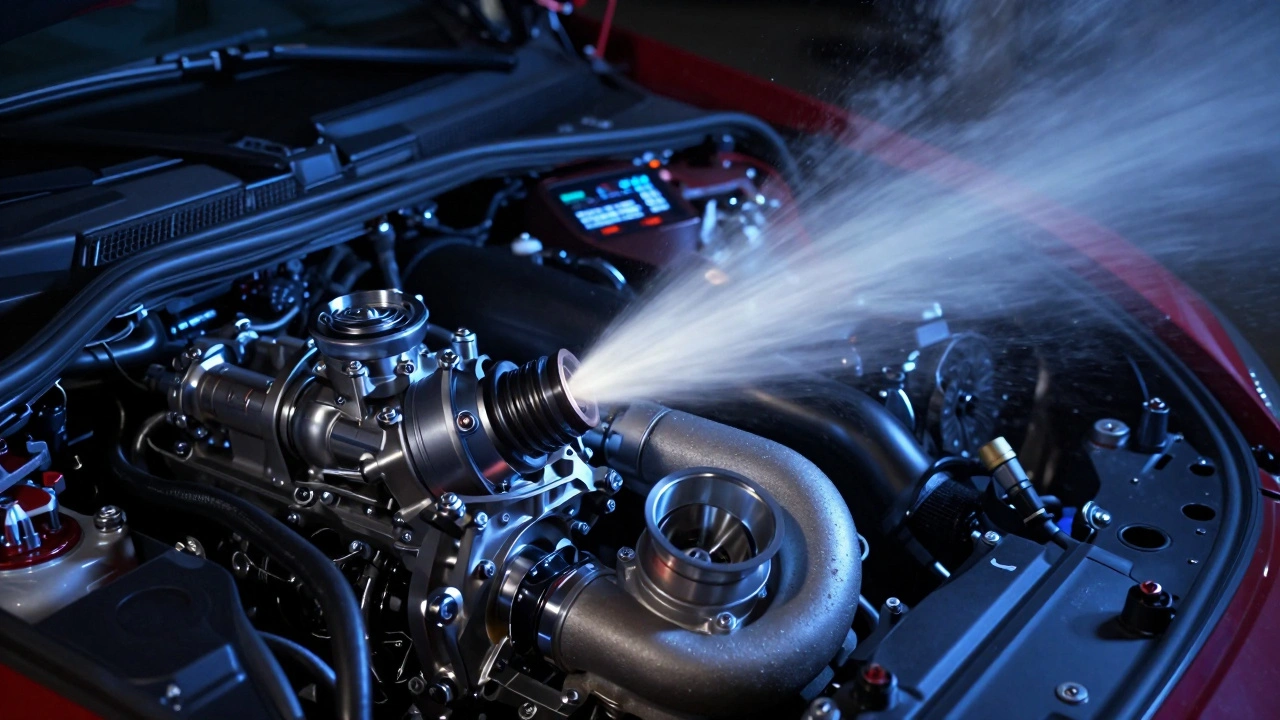
Putting It All Together: The System Workflow
Think of boost control as a team. Each part has a role:
- The ECU decides how much boost you need based on your tune.
- The electronic solenoid takes that signal and adjusts pressure to the wastegate actuator.
- The wastegate opens or closes to let exhaust bypass the turbine, controlling how fast the turbo spins.
- The BOV releases pressure when you lift off the throttle, preventing surge and protecting the turbo.
Here’s a real-world example: You’re in 3rd gear, accelerating hard. The ECU commands 20 psi. The solenoid reduces bleed-off to the wastegate actuator, keeping the wastegate closed. The turbo spins up, building boost. You hit redline, shift, and lift off the throttle. The throttle closes. The BOV instantly opens, venting the pressurized air. The turbo slows down without surge. You downshift and get back on the gas-boost builds again, smooth and fast.
Break any part of this chain, and the whole system suffers. A leaking BOV? Boost drops off between shifts. A weak solenoid? Boost creeps. A clogged or stuck wastegate? You risk detonation or engine failure.
Common Mistakes and How to Avoid Them
Most people upgrade one piece and wonder why things still feel off. Here are the top three mistakes:
- Installing a big wastegate but keeping the stock solenoid - The stock solenoid can’t respond fast enough. You’ll still get boost creep. Always upgrade the solenoid when upgrading the wastegate.
- Using an atmospheric BOV on a MAF-equipped car - The ECU doesn’t know air is being vented, so it keeps injecting fuel. Result? Rich mixtures, poor fuel economy, and possible misfires.
- Ignoring boost control line integrity - A cracked vacuum line or loose fitting can cause erratic boost. Use reinforced silicone lines and metal fittings. Check for leaks with soapy water under boost.
Also, don’t just crank up the boost. More pressure means more heat, more stress, and more risk. A well-tuned 18 psi with good intercooling and fueling is safer and faster than a poorly managed 25 psi.
What You Need to Know Before You Buy
Before spending money, ask yourself:
- Is your car stock, mildly modified, or fully built?
- Are you using a stock ECU or a standalone?
- Do you have a MAF sensor or a speed-density system?
- What’s your target horsepower?
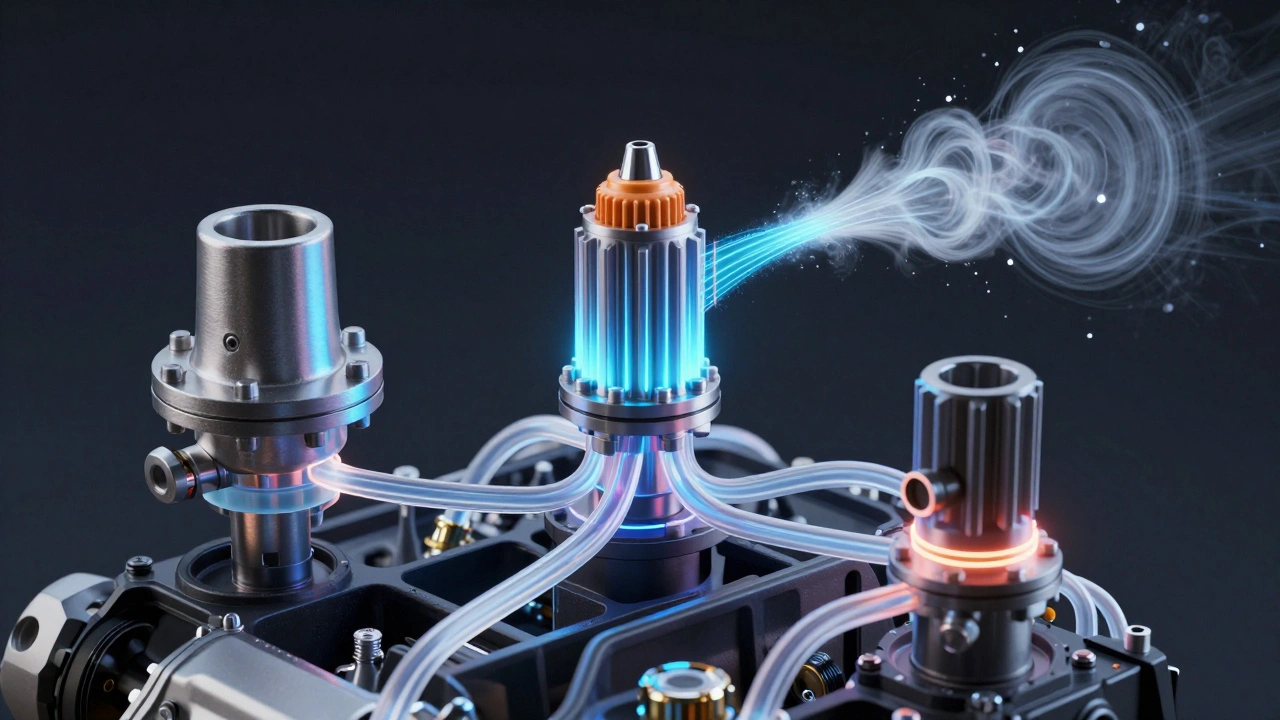
For a stock ECU with a 200-300 hp upgrade, a 3-port solenoid and a quality recirculating BOV are enough. For 400+ hp, you’ll need an external wastegate, a 4-port solenoid, and possibly a bypass valve setup. For track-only cars, atmospheric BOVs are fine. For daily drivers, stick with recirculating.
Brands like Turbosmart, GReddy, and Forge have kits designed for specific cars. Don’t guess-check their application guides. A kit made for a Subaru WRX won’t fit a Mitsubishi Evo without modification.
Final Thoughts: Control Is Everything
Boost isn’t about raw power. It’s about control. The best turbo setups aren’t the ones with the biggest turbos-they’re the ones that respond predictably, stay stable under load, and shut down cleanly when you let off. That’s the result of a properly matched wastegate, solenoid, and BOV.
Start with the solenoid. It’s the smartest piece. Then match the wastegate to your power goals. Finally, pick the BOV that fits your driving style and emissions setup. Get those three right, and your turbo won’t just make power-it’ll make it cleanly, safely, and reliably.
Can I use a BOV without upgrading my wastegate?
Yes, you can. A BOV doesn’t affect how much boost your turbo makes-it only prevents surge when you lift off the throttle. But if your wastegate is stock and your boost is already creeping, a BOV won’t fix that. You’ll still risk overboost and engine damage. Upgrade the wastegate and solenoid first if you’re running more than stock power.
Do I need a 3-port or 4-port solenoid?
A 3-port solenoid is the sweet spot for most street and track cars. It gives you precise boost control and is easy to install. A 4-port is overkill unless you’re running a dual-port wastegate, a very high boost level (over 30 psi), or a standalone ECU with advanced logic. For 90% of users, a 3-port is enough.
Why does my boost drop when I shift gears?
That’s usually a sign of a leaky BOV or a bad boost control line. When you shift, the throttle closes and the BOV opens. If it’s leaking under pressure, boost bleeds off too early. Check your BOV’s seal and all vacuum lines. Replace rubber hoses with silicone ones if they’re old or soft.
Can I run a BOV and a wastegate from the same vacuum source?
No. They need separate, dedicated lines. If you tee them together, the BOV will interfere with the wastegate’s ability to hold boost. This causes erratic pressure spikes and poor throttle response. Always use individual lines from the compressor housing or a dedicated boost tap.
Is electronic boost control better than manual?
Yes, for most people. Manual boost controllers are simple and reliable, but they’re fixed. You can’t adjust boost by gear or RPM. Electronic control lets you fine-tune pressure across the entire powerband. It’s especially useful for daily drivers who need low-end torque and high-end power. Manual controllers are fine for race cars with one fixed boost setting.
If you’re planning to tune your turbo car, start with the solenoid and wastegate. Those two are the foundation. The BOV is the finishing touch. Get the core right, and your car won’t just be fast-it’ll be predictable, safe, and fun to drive.





Teja kumar Baliga
December 12, 2025 AT 18:04Love this breakdown! I just swapped my stock BOV for a Forge recirculating unit and the difference in throttle response is insane. No more hesitation when shifting.
Nicholas Zeitler
December 13, 2025 AT 05:33Finally, someone explains this without jargon overload! I used to think boost creep was just ‘turbo lag’-turns out, it’s my stock wastegate crying for help. Upgraded to a Turbosmart 44mm last week-no more overshoot, even at 22 psi. Life-changing.
k arnold
December 14, 2025 AT 23:54Wow. A whole essay on how to not blow up your engine. I thought you just turned the boost knob until it made a noise.
Tiffany Ho
December 16, 2025 AT 20:35I just got my first turbo car and I was so scared to touch anything but the gas pedal. This helped me feel less lost. Thanks for making it simple.
michael Melanson
December 17, 2025 AT 13:52Agreed on the solenoid being the smartest piece. I ran a manual controller for two years, then switched to a 3-port EBCS. The difference in smoothness is night and day. No more boost spikes at 4k RPM.
lucia burton
December 18, 2025 AT 12:31Let me just say, if you're running a MAF sensor and you're using an atmospheric BOV, you're essentially running a rich condition every time you lift off, which can lead to carbon buildup on your valves, which can lead to misfires, which can lead to catalytic converter damage, which can lead to a $2,000 repair bill you didn't need. Please, for the love of all that is holy, use recirculating on street cars.
Denise Young
December 20, 2025 AT 01:31Oh, so THAT’S why my boost kept dropping mid-shift? I thought it was my clutch slipping. Turns out my BOV was leaking like a sieve. Replaced it with a Turbosmart unit and now it holds like a tank. Also, yes-silicone lines. Rubber hoses are a scam.
Sam Rittenhouse
December 20, 2025 AT 04:18I remember the first time I heard a proper BOV vent-pure adrenaline. But then I learned it was killing my fuel economy and confusing my ECU. Now I run a recirculating setup. It’s not as loud, but it’s smarter. And honestly? The satisfaction of a clean, controlled boost curve is way more satisfying than any ‘psssh’.
Fred Edwords
December 21, 2025 AT 02:33Correction: The ECU doesn’t ‘decide’ boost-it executes a pre-programmed map. Also, ‘boost creep’ is caused by exhaust flow exceeding wastegate capacity, not ‘flimsy’ valves. And please, stop calling solenoids ‘brains.’ They’re actuators. Precision matters.
Ananya Sharma
December 21, 2025 AT 14:26Everyone talks about ‘control’ like it’s some holy grail. But the real issue is that turbocharging is inherently inefficient. You’re burning fuel to spin a turbine just to compress air, which then heats up and needs intercooling, which adds weight and complexity. Why not just use a supercharger? Or better yet-why not drive a naturally aspirated car and enjoy the linear response? This whole ‘boost control’ obsession is just a band-aid on a broken philosophy.
kelvin kind
December 21, 2025 AT 17:19BoV or not, check your lines. Mine was leaking for months. Took me forever to notice. Soapy water FTW.
Ian Cassidy
December 22, 2025 AT 13:263-port solenoid + external wastegate = the dream. I run a 2.5L turbo on a 2.0L block. This setup keeps it stable up to 28 psi. No flinching.
Ronak Khandelwal
December 23, 2025 AT 23:34Boost isn’t just about power-it’s about harmony. The wastegate breathes, the solenoid listens, the BOV releases. It’s like a symphony of pressure. And when it’s right? You don’t just drive-you feel the machine breathe with you.
Jeff Napier
December 25, 2025 AT 03:53Or maybe the whole system is designed to fail so you keep buying upgrades. Think about it. If your car ran perfectly, the aftermarket wouldn’t exist. Who really benefits here?