
When you think about what affects your car insurance rates, you probably imagine your driving record, the type of car you drive, or where you live. But there’s another big factor most people don’t realize is working behind the scenes: your credit score. And it doesn’t just matter a little-it can change your monthly bill by hundreds of dollars, depending on where you live.
Why Credit Score Even Matters for Car Insurance
Insurance companies don’t just look at your driving history. They use credit-based insurance scores, which are different from your regular FICO score but pulled from the same data. These scores predict how likely you are to file a claim. Studies by the Federal Trade Commission and industry groups show that people with lower credit scores tend to file more claims, even when their driving records are clean. That’s why insurers treat credit history like a risk filter.It’s not about whether you’re good with money. It’s about patterns. Someone who pays bills late, carries high balances, or has collections on their report is statistically more likely to get into an accident or file a claim. Insurers use this to set prices-not because they’re punishing you, but because the math says it works.
How Much Your Credit Score Can Change Your Premium
The difference isn’t small. In states where credit-based scoring is allowed, drivers with poor credit can pay over twice as much as those with excellent credit. For example:- In Texas, a driver with a poor credit score (300-579) pays an average of $2,890 per year for full coverage. Someone with an excellent score (800-850) pays just $1,210.
- In Florida, the gap is even wider: $3,120 vs. $1,080.
- In Michigan, where rates are already high, the difference jumps to $3,500 vs. $1,450.
That’s a $1,600 to $2,000 annual swing-enough to cover a full tank of gas every month for a year.
State-by-State Breakdown: Where Credit Matters Most
Not all states let insurers use credit scores. Some ban it entirely. Others allow it with restrictions. Here’s how it breaks down as of 2026:| State | Allows Credit Scoring? | Average Premium Difference (Poor vs. Excellent Credit) | Notes |
|---|---|---|---|
| California | No | $0 | Banned since 2012. Insurers use driving record, vehicle type, and location only. |
| Michigan | Yes | $2,050 | One of the highest premiums in the U.S. Credit score adds to already high base rates. |
| Florida | Yes | $2,040 | High claim frequency drives heavy reliance on credit scoring. |
| Texas | Yes | $1,680 | Large population and high accident rates make credit a major factor. |
| New York | Yes | $1,420 | Regulated closely-insurers must justify how they use credit data. |
| Hawaii | No | $0 | Banned since 2019. Only driving history and location matter. |
| Maine | No | $0 | Banned in 2022. One of the first states to eliminate credit-based pricing. |
| Utah | Yes | $1,590 | Low population, but high rate of uninsured drivers increases reliance on credit. |
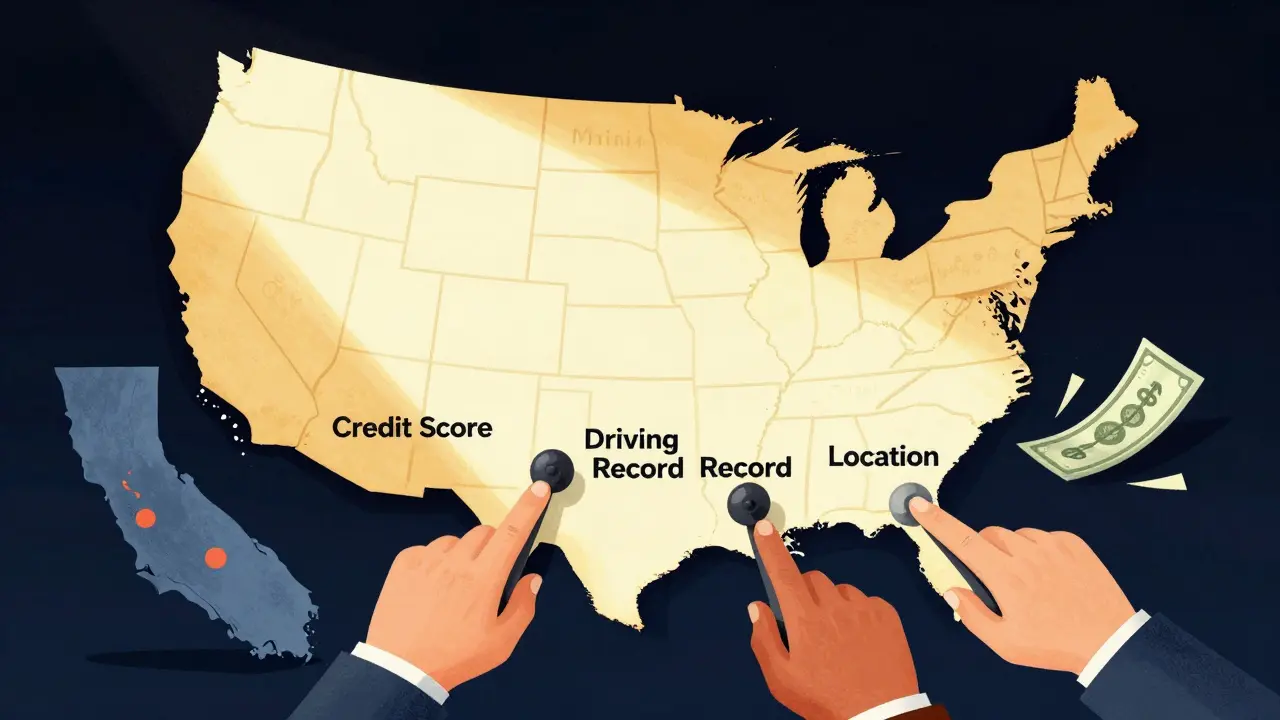
States like California, Hawaii, and Maine have banned the practice after public pressure and studies showing it disproportionately affects low-income communities. But in most of the country, your credit score still plays a major role.
What Counts as ‘Poor’ vs. ‘Excellent’ Credit for Insurance?
Insurance companies don’t use your FICO score directly. They use a version called an insurance score, which weighs payment history, outstanding debt, credit age, and recent inquiries. Here’s what insurers typically see:- Excellent: 750-850-Low risk. Best rates.
- Good: 700-749-Still low risk. Minor rate increases.
- Fair: 650-699-Moderate risk. Noticeable rate hikes.
- Poor: 300-649-High risk. Highest premiums.
Even if your FICO score is 720, your insurance score might be 680. That’s normal. Insurance scores are designed to predict claims, not loan repayment. So a person who pays off their credit card every month but has a short credit history might still get flagged as higher risk.
What You Can Do to Lower Your Premium
If you live in a state where credit scoring is allowed, here’s what actually works:- Check your credit report. Errors happen. One study found that 1 in 5 consumers had a mistake on their credit report that affected their insurance score. Get a free report at AnnualCreditReport.com.
- Pay bills on time. Payment history makes up 40% of your insurance score. Set up autopay if you have to.
- Lower your credit utilization. Keep balances under 30% of your limit. Paying down a $5,000 balance on a $10,000 card can boost your score in weeks.
- Don’t open new credit before shopping for insurance. Hard inquiries can drop your score temporarily.
- Ask for a re-evaluation. After six months of better credit habits, call your insurer. Many will re-score you and lower your rate.
One driver in Ohio lowered her premium by $410 a year after fixing a billing error and paying down two credit cards. She didn’t change her car or her driving record. Just her credit.

What If You Live in a State That Bans Credit Scoring?
If you’re in California, Hawaii, or Maine, your credit score doesn’t affect your rate at all. That’s good news-but it doesn’t mean your premiums are low. These states often have other factors driving up costs:- High population density → more accidents
- Strict liability laws → higher payouts
- Expensive medical care → higher claim costs
In California, for example, average premiums are still among the highest in the nation-not because of credit, but because of lawsuits, urban traffic, and repair costs. So even if your credit is perfect, you’re still paying more than someone in rural Iowa.
How to Find the Best Rate Regardless of Credit
The best way to save money on car insurance isn’t to fix your credit (though that helps). It’s to shop around. Rates vary wildly between insurers-even for the same person with the same score.For example, in Texas:
- State Farm: $1,900/year for poor credit
- Geico: $1,750/year
- Progressive: $2,300/year
- Allstate: $2,600/year
That’s a $700 difference just from choosing a different company. Always get at least three quotes. Use comparison tools like The Zebra or NerdWallet. And don’t assume your current insurer gives you the best deal-most people overpay by $500+ a year.
Final Thoughts: Credit Isn’t the Whole Story
Yes, your credit score affects your car insurance rate in most states. But it’s not destiny. You can improve it. You can shop around. You can challenge errors. And if you live in one of the few states that bans credit-based pricing, you’re already protected from this particular financial penalty.The real takeaway? Don’t ignore your credit-but don’t let it scare you either. Focus on what you can control: paying bills on time, keeping debt low, and comparing insurers every year. That’s how you actually save money-no matter where you live.
Does checking my credit for car insurance hurt my score?
No. When an insurance company checks your credit, it’s a soft inquiry. Soft pulls don’t affect your credit score at all. Only hard inquiries-like applying for a loan or credit card-do. You can get quotes from multiple insurers without worrying about damage.
Can I refuse to let my insurer use my credit score?
Only in states that ban the practice. In states where it’s allowed, insurers can legally require it as part of their pricing model. You can’t opt out. But you can switch to a different insurer that might weight it less heavily.
Do all insurance companies use credit scores the same way?
No. Each insurer has its own formula. Some weigh payment history more heavily. Others focus on debt levels. One company might give you a great rate even with a 620 score, while another charges you double. That’s why shopping around matters more than trying to fix your credit alone.
I just filed for bankruptcy. Will my car insurance go up?
Yes, in most states. Bankruptcy can drop your credit score below 500, which puts you in the highest-risk category. But some insurers offer programs for people rebuilding credit. Call your provider and ask if they have a re-rating option after six months of on-time payments.
Does my spouse’s credit score affect my car insurance if we’re on the same policy?
Yes. If you’re on a joint policy, insurers look at both credit scores. They usually use the lower of the two to set your rate. So if one of you has poor credit, it can raise the whole policy’s cost-even if the other person has perfect credit.