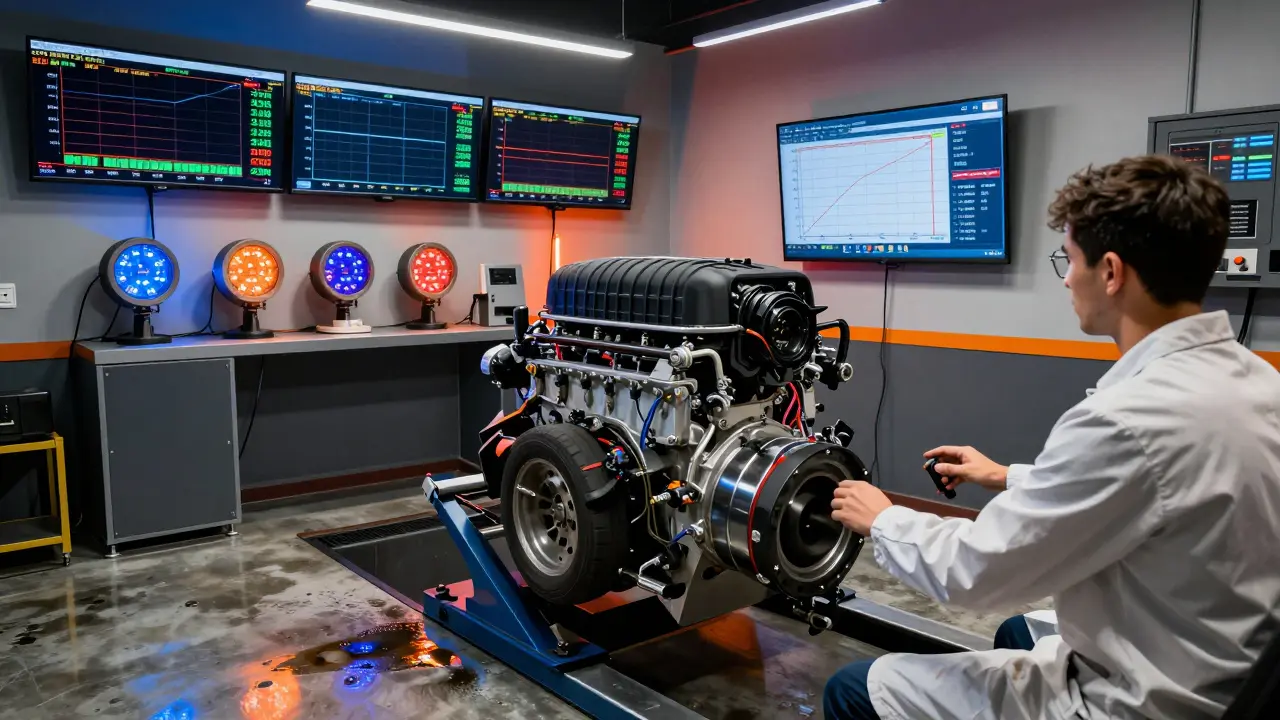
Engine tuning isn’t just about making your car louder or adding a spoiler. It’s about balancing power, efficiency, and reliability - and getting it wrong can cost you thousands. You might see YouTube videos of guys tweaking their ECU with a laptop in the driveway, but real professional engine tuning? That’s a science. And there are moments when doing it yourself isn’t just risky - it’s dangerous.
What Professional Engine Tuning Really Means
Professional engine tuning means adjusting the engine’s air-fuel mixture, ignition timing, boost pressure, and throttle response using real-time data from a dynamometer. It’s not about swapping out a cold air intake or installing a performance chip. Those are modifications. Tuning is calibration. A skilled tuner uses data from sensors, logs fuel trims, monitors knock sensors, and tests under load to make sure every cylinder fires at the perfect moment. This isn’t guesswork. It’s precision engineering.
Most street cars come from the factory with conservative settings. They’re tuned for emissions, fuel economy, and durability across a wide range of climates and fuel qualities. A professional tune removes those restrictions - but only if done correctly. A bad tune can melt pistons, blow head gaskets, or cause catastrophic engine failure. That’s why you need someone who’s seen what happens when things go wrong.
Signs You Need a Professional Tune
- Your car feels sluggish after adding a turbocharger or supercharger
- You’ve installed a high-flow exhaust and now the check engine light comes on
- Your fuel economy dropped after modifying the intake system
- You hear knocking or pinging under load - especially when accelerating
- You’re planning to run higher-octane fuel or E85 and want to maximize gains
These aren’t just "nice-to-have" fixes. They’re red flags. A turbocharged car running stock timing with increased boost? That’s asking for a blown engine. A car on E85 without adjusting fuel maps? It’ll run lean, overheat, and seize. You don’t need to be a mechanic to know something’s wrong - but you do need an expert to fix it right.
Why DIY Tuning Often Fails
There’s a reason professional tuners charge $500 to $1,200 for a full dyno tune. It’s not because they’re overcharging. It’s because they’re using equipment most people don’t have - and they’ve spent years learning what the data means.
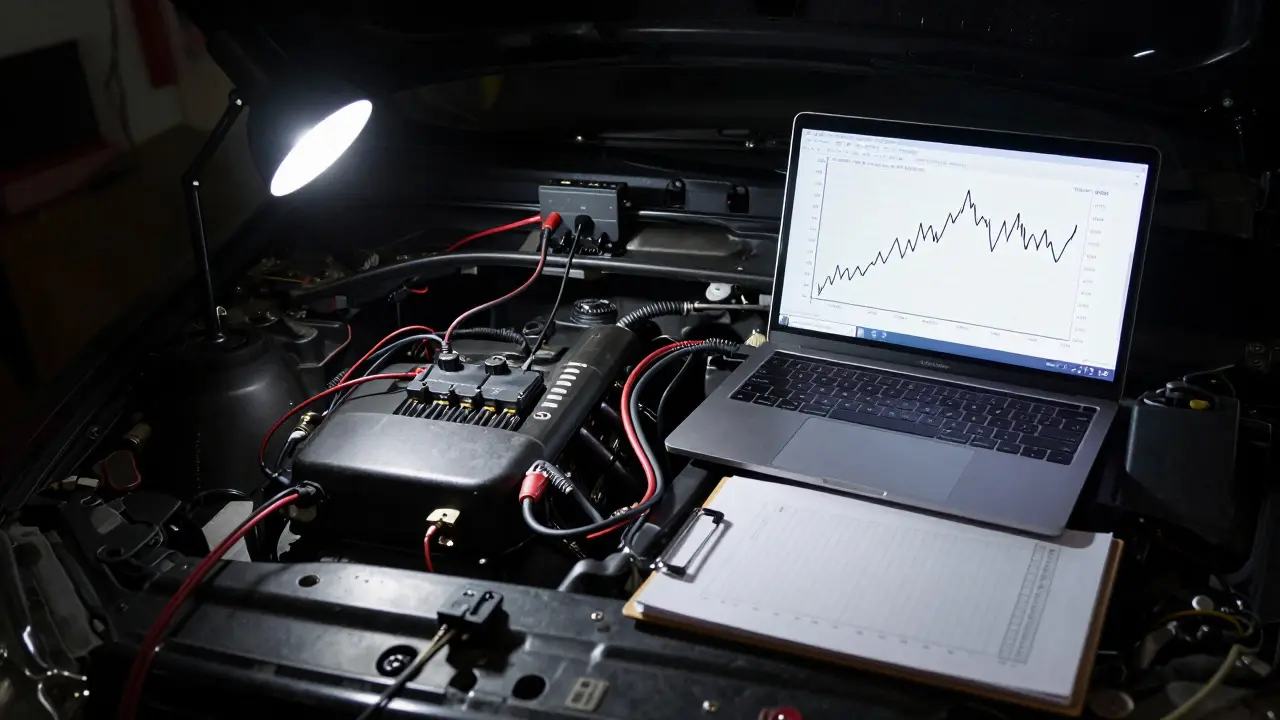
DIY tuners often rely on pre-loaded maps from forums. Those maps were made for a car with the exact same mods, in the same climate, using the same fuel. Your car? It’s different. Even small differences - like a slightly clogged fuel injector, a worn spark plug, or a dirty MAF sensor - can throw off a generic tune. And if you’re tuning blindly? You’re gambling with your engine.
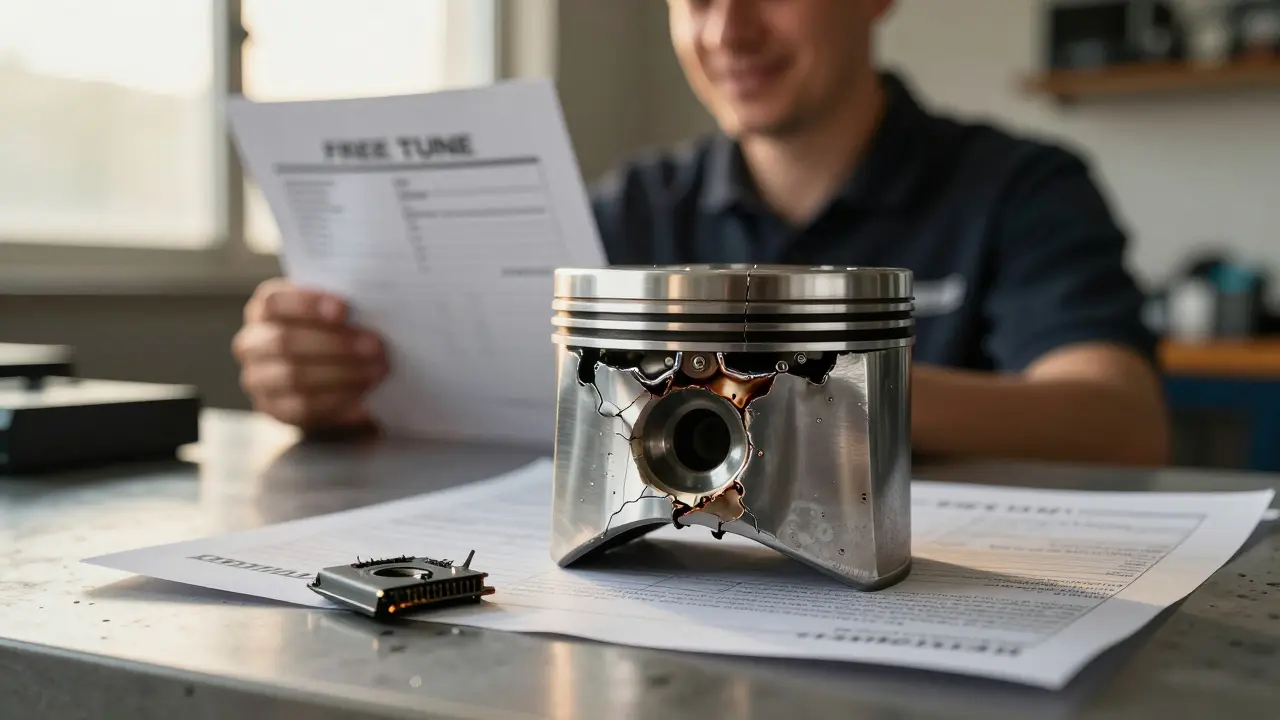
One tuner in Detroit told me about a guy who flashed a "high-performance" ECU file he downloaded. The car ran fine on the highway - until he hit full throttle on the freeway. The engine detonated. The pistons cracked. Repair cost: $8,700. He saved $400 on the tune. He lost $8,300 on the engine.
When Professional Tuning Is Non-Negotiable
Some upgrades absolutely require professional tuning. If you’ve done any of these, skip the DIY route:
- You’ve added forced induction (turbo or supercharger)
- You’ve changed the compression ratio (pistons, rods, head gasket)
- You’re running E85, race fuel, or high-octane blends
- You’ve upgraded the fuel system (pumps, injectors, lines)
- You’ve modified the exhaust or intake to a degree that changes airflow dynamics
These changes alter how the engine breathes and burns fuel. The factory ECU can’t adapt. It doesn’t know your new injectors are 30% larger. It doesn’t know your turbo spools 200 RPM sooner. Without recalibration, the engine runs too rich or too lean - and either floods or burns itself alive.
The Dyno Test: Your Engine’s Stress Test
A professional tune isn’t just a software update. It’s a live test. A dynamometer simulates real-world driving loads while measuring horsepower, torque, and air-fuel ratios in real time. The tuner watches the data as you accelerate - adjusting fuel and timing in 100-RPM increments.
Here’s what happens during a real dyno session:
- The car is secured to the rollers
- Engine temperature and oil pressure are monitored
- Wideband O2 sensors track air-fuel ratio across the RPM range
- The tuner pulls data logs and makes iterative changes
- After each change, the car is tested again - until the power curve is smooth and the fuel trims are stable
This process takes 2 to 4 hours. It’s not magic. It’s methodical. And it’s the only way to ensure your modifications actually work - without killing your engine.
What to Look for in a Professional Tuner
Not all tuners are created equal. Here’s what separates the good from the bad:
- They use a dyno - not just a laptop and a guess
- They ask about your driving habits - daily driver? Track car? Towing? This changes the tune
- They explain their process in plain language - no jargon without translation
- They provide a printout or digital log of the final tune
- They have experience with your exact make, model, and engine
Ask to see their past work. A reputable tuner will have before-and-after dyno graphs. They’ll show you how torque and horsepower improved across the entire RPM band - not just at peak. If they can’t show you data? Walk away.
The Hidden Cost of Skipping Professional Help
People think tuning is about speed. It’s not. It’s about safety. A poorly tuned engine doesn’t just lose power - it can destroy itself.
Here’s what you risk if you skip a professional tune:
- Piston damage from detonation
- Valve and head gasket failure from overheating
- Transmission stress from sudden power spikes
- Voided factory warranty
- Failed emissions tests
One client in Ann Arbor had a 2021 WRX with a cat-back exhaust and intake. He flashed a "free tune" from a forum. Within 300 miles, the engine started misfiring. The repair? $6,200. The tune cost $20. He lost $6,180.
Professional tuning isn’t an expense. It’s insurance.
When You Can Skip the Pro (And Still Be Safe)
Not every modification needs a dyno tune. If you’ve done minor upgrades - like a high-flow air filter, a less restrictive exhaust, or upgraded spark plugs - and you haven’t changed airflow dynamics or fuel delivery, you might be fine with a stock tune. Many modern ECUs can adapt automatically.
But even then, it’s smart to get a baseline tune. A simple 30-minute check on the dyno can confirm your car is running safely. You’ll know if your new parts are actually helping - or if they’re just adding noise.
Final Rule: If You’re Unsure, Get a Pro
Engine tuning isn’t like changing your oil. There’s no "I’ll just try it and see." One wrong setting can turn a $20,000 car into a $5,000 project. The difference between a good tune and a bad one isn’t just horsepower. It’s whether your engine lives or dies.
If you’re asking yourself whether you need a professional - you do. Don’t wait until something breaks. Don’t rely on a forum post. Don’t trust a YouTube tutorial with 500 views. Find a certified tuner with a dyno, real experience, and a track record. Your engine will thank you.
Can I tune my engine with just a laptop and a downloaded file?
You can, but you shouldn’t. Downloaded files are made for specific cars with identical mods. Your car’s condition - fuel quality, sensor health, wear, climate - is unique. A generic tune can cause lean conditions, overheating, or detonation. Without a dyno to verify, you’re guessing. And guessing with an engine is how you end up with a $7,000 repair bill.
How much does professional engine tuning cost?
Expect to pay between $500 and $1,200 for a full dyno tune, depending on your car, complexity, and location. Basic tunes for naturally aspirated cars start around $500. Forced induction or E85 conversions often cost $800-$1,200. Some shops include a follow-up tune after a break-in period at no extra charge.
Will tuning void my warranty?
Yes - but only if the dealership can prove the tune caused the failure. Many manufacturers can detect modified ECU files. However, if you’re using a reputable tuner who tunes conservatively and keeps logs, the risk is lower. Some tuners offer warranty-safe tunes that don’t trigger factory alerts. Always ask before proceeding.
Do I need a tune after installing a cold air intake?
Usually not. Most cold air intakes are designed to work within factory parameters. Modern ECUs can adjust fuel delivery automatically. But if you notice poor throttle response, rough idle, or the check engine light, then a tune may be needed to optimize airflow. A quick dyno check can confirm whether you gained anything - or if the intake is just louder.
What’s the difference between a tuner and a mechanic?
A mechanic fixes broken parts. A tuner optimizes performance. A mechanic might replace a faulty oxygen sensor. A tuner uses that sensor’s data to adjust fuel maps for maximum power. Tuners work with software, data logs, and dynamometers. Mechanics work with wrenches and diagnostic tools. You need both - but for different reasons.


Sandeepan Gupta
February 17, 2026 AT 19:54Professional engine tuning isn't about showing off. It's about respecting the engineering that went into your car. Factory settings are conservative for a reason: longevity and safety. When you modify, you're changing the balance. A dyno tune isn't a luxury-it's a necessity. I've seen too many guys lose engines because they thought a forum map was enough. Save the money now or pay ten times later.
Don't gamble with your engine. Get the data. Trust the process.
Tarun nahata
February 18, 2026 AT 18:46Bro this is the most real thing I’ve read all week. You don’t tune an engine like you tune a guitar. It’s not a vibe. It’s physics. I had a buddy who slapped a cheap ECU file on his turbo Civic. Three weeks later-poof. $9k engine rebuild. He still thinks it was ‘bad luck.’ Nah. It was laziness with consequences. Pay the $800. Live to drive another day.
Noel Dhiraj
February 20, 2026 AT 06:16Good post. Really good. I used to think I could DIY everything. Then I blew a head gasket on my WRX after a 'free tune' from Reddit. Turned out my MAF was dirty and the map didn't account for it. A professional tuner caught it in 15 minutes on the dyno. I learned the hard way: modifications without calibration are just noise and risk.
Now I always get a baseline tune. Even for minor stuff. It’s cheaper than a tow truck.
vidhi patel
February 21, 2026 AT 04:32It is imperative that individuals who engage in automotive modifications comprehend the fundamental principles of internal combustion engine dynamics. To suggest that a downloaded ECU file is an adequate substitute for professional dynamometer-based calibration is not merely irresponsible-it is a gross negligence of mechanical science. One cannot optimize combustion efficiency without empirical data. The assertion that 'modern ECUs adapt automatically' is a dangerously misleading oversimplification.
Priti Yadav
February 22, 2026 AT 22:30Yeah right. All this 'professional tuning' nonsense. Who do you think made the factory maps? Some corporate drone in Detroit? Nah. They're just trying to sell you more parts. I've been tuning my own cars since 2012. Never had a problem. They just scare you with stories to get you to pay $1000 for a 2-hour session. I bet 80% of these 'tuners' are just copying maps from the same 3 guys on Facebook.
Ajit Kumar
February 23, 2026 AT 21:08It is a fundamental error in reasoning to equate the installation of aftermarket components with the necessity of professional tuning. While it is true that forced induction, altered compression ratios, and fuel system upgrades require recalibration, the blanket statement that 'if you are unsure, you need a pro' is a fallacy of false dichotomy. Many modern ECUs possess adaptive learning algorithms capable of compensating for minor modifications. To dismiss all DIY efforts as 'gambling' is to ignore decades of empirical evidence from the tuning community. Furthermore, the assertion that 'a bad tune can melt pistons' is hyperbolic without qualifying the percentage of cases in which this occurs. Statistics, please.
Diwakar Pandey
February 25, 2026 AT 16:51I used to think I was too cool for dyno tuning. Then I bought a used 2015 STI with a cold air intake and a cat-back. Ran fine for months. Then one day, it started hesitating at 4k RPM. Took it to a tuner. Turns out the MAF was coated in oil from the filter. The stock tune was barely holding it together. He cleaned it, recalibrated, and now it pulls like a freight train.
Point is: even if it seems fine, get it checked. Five hundred bucks for peace of mind? Worth it.
Geet Ramchandani
February 26, 2026 AT 14:14Oh wow, another 'pay me $1000 or your engine will explode' post. Let me guess-this guy runs a tuning shop. Or he’s on commission. Or he’s just scared of technology. I’ve seen people spend $2000 on a 'professional tune' only to find out the guy used a map from 2017. The dyno is just a fancy way to charge more. Meanwhile, real tuners in Germany and Japan do it with laptops and logic. You’re being sold fear, not expertise.
Pooja Kalra
February 27, 2026 AT 23:01Is engine tuning really about power? Or is it about control? The machine becomes an extension of the self. But when we outsource calibration to strangers with laptops, are we not surrendering autonomy? The dyno is a mirror. It reflects not just torque curves, but our desperation to be faster, louder, better. Perhaps the real question isn't whether to tune-but why we feel the need to.
Sumit SM
March 1, 2026 AT 14:11Let’s be clear: tuning is not a service. It’s a science. And science demands verification. A downloaded map? That’s not tuning-that’s hoping. A dyno? That’s measurement. That’s data. That’s accountability. I’ve reviewed over 200 ECU logs. The ones with smooth, stable fuel trims across the entire RPM range? They all came from a dyno session. The ones with wild spikes? Always DIY. The numbers don’t lie. Trust the data, not the forum.
Jen Deschambeault
March 3, 2026 AT 13:39This is why I always recommend people start with a baseline tune-even if they think they don’t need it. I had a 2018 Civic with just a filter and exhaust. Thought I was fine. Got it on the dyno. Turns out the intake was causing a lean spot at 3500 RPM. The tuner fixed it in 20 minutes. Gained 7 hp and smoothed out the throttle. Didn’t even cost me $300.
It’s not about going fast. It’s about going right.
Kayla Ellsworth
March 3, 2026 AT 22:14So if I install a cold air intake, I need to pay $800 to avoid my engine turning into a pile of scrap metal? Cool. Meanwhile, my 1995 Miata with a Weber carburetor and a $20 tune from a guy in a garage runs better than half the cars on the road. Maybe the problem isn’t DIY tuning. Maybe it’s overpriced shops selling fear.
Soham Dhruv
March 5, 2026 AT 16:16man i just got a new exhaust and intake and was gonna try a free map but now im not so sure
my buddy said he did the same thing and blew his turbo last year
so i think i'll bite the bullet and go to the dyno
even if it's just to chill and see how it all looks on the log
no rush, but i dont wanna be that guy
Bob Buthune
March 6, 2026 AT 12:46I just wanna say… I lost my dad last year. He was the one who taught me how to wrench. He always said, 'If you don't know, ask. If you can't afford it, wait.'
I ignored that. I flashed a map. My car started knocking. I kept driving. I thought I could fix it later.
It died on the highway. I had to call a tow truck. I cried in the parking lot.
I didn't lose a car.
I lost the last thing he gave me.
I got it tuned. Now it runs perfect.
But I'll never forget how stupid I was.
Don't be me.