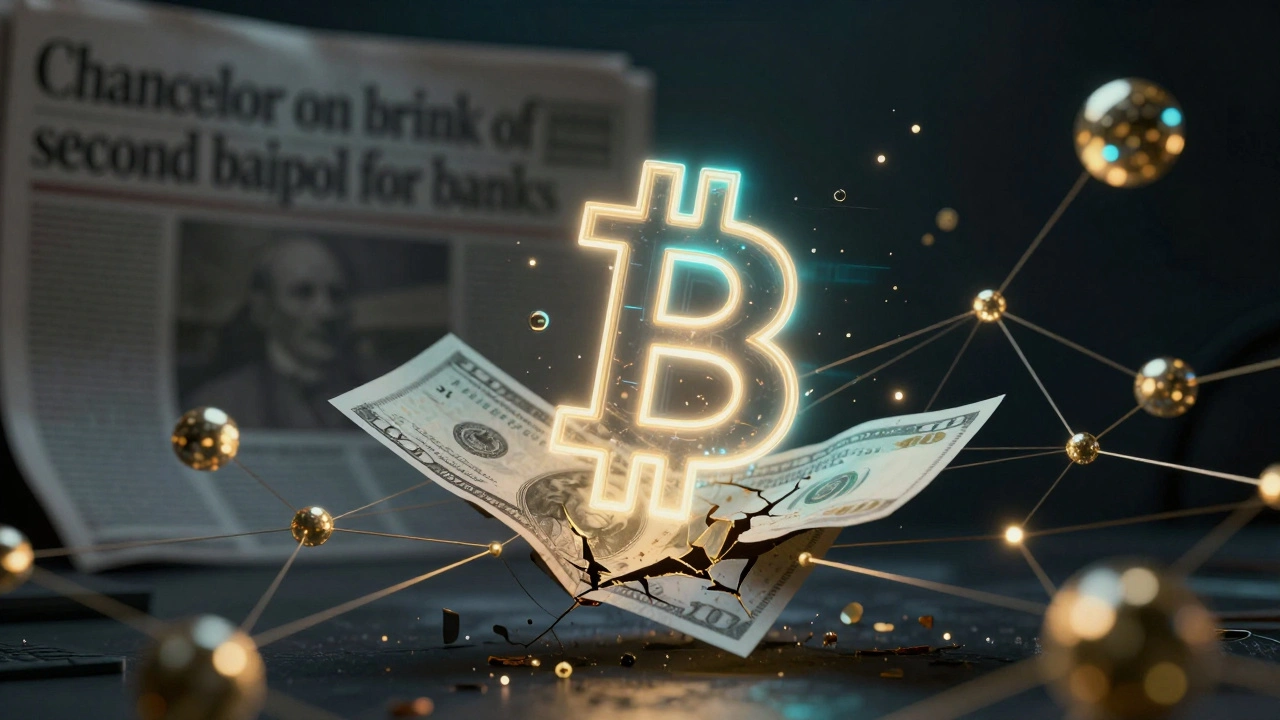
Bitcoin isn’t just another digital coin. It’s the first one that actually worked - and it changed everything. Before Bitcoin, no one had figured out how to send money directly from person to person without a bank, government, or middleman. The idea sounded impossible. How do you stop someone from copying digital money? How do you make sure no one cheats? Bitcoin solved both problems - and it did it without anyone in charge.
How Bitcoin Started
In 2008, a person or group using the name Satoshi Nakamoto published a 9-page paper titled "Bitcoin: A Peer-to-Peer Electronic Cash System." It didn’t get much attention at first. But on January 3, 2009, Nakamoto mined the first block - called the genesis block - and embedded a headline from The Times: "Chancellor on brink of second bailout for banks." That wasn’t just a timestamp. It was a statement. Bitcoin was built as a reaction to the financial system’s failures.
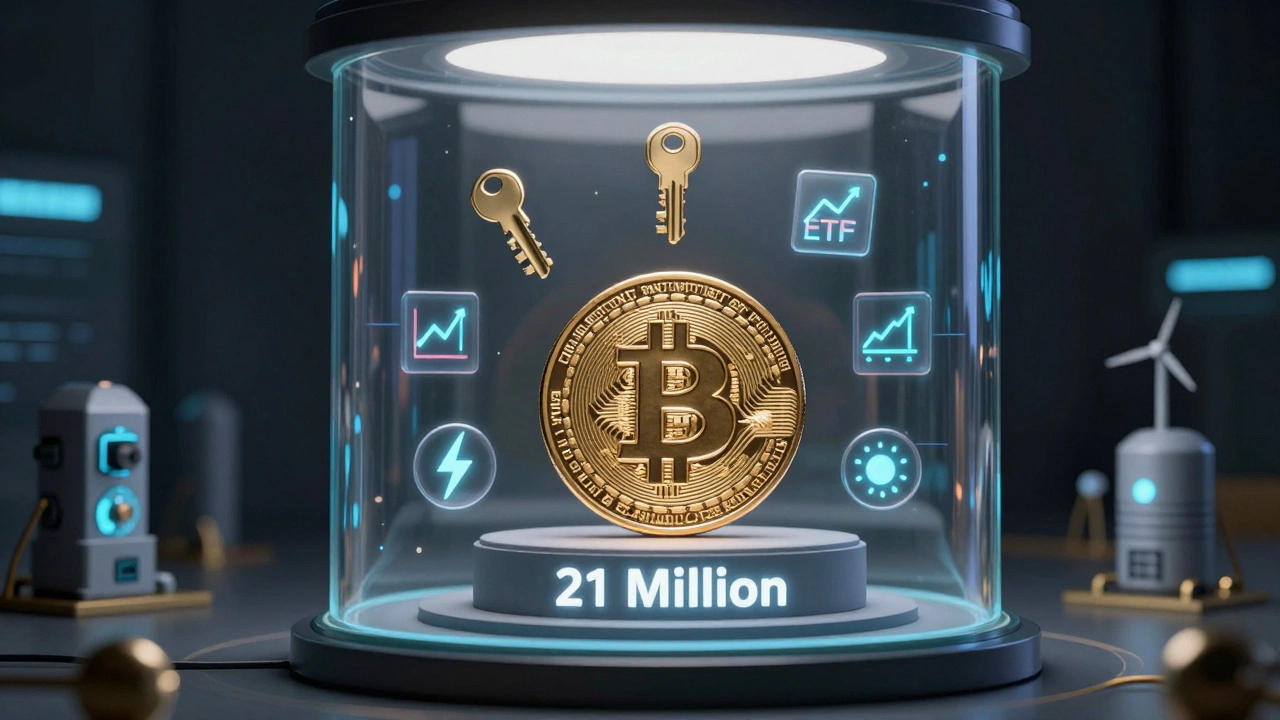
Unlike traditional money, Bitcoin doesn’t come from a central bank. It’s created by computers solving hard math problems. This process is called mining. Every 10 minutes, a new block of transactions is added to the public ledger - the blockchain. Miners who solve the puzzle first get rewarded with new bitcoins. There will only ever be 21 million bitcoins. As of 2025, about 19.6 million have been mined. That scarcity is intentional. It’s what makes Bitcoin different from dollars or euros, which can be printed whenever a government wants.
How Bitcoin Works
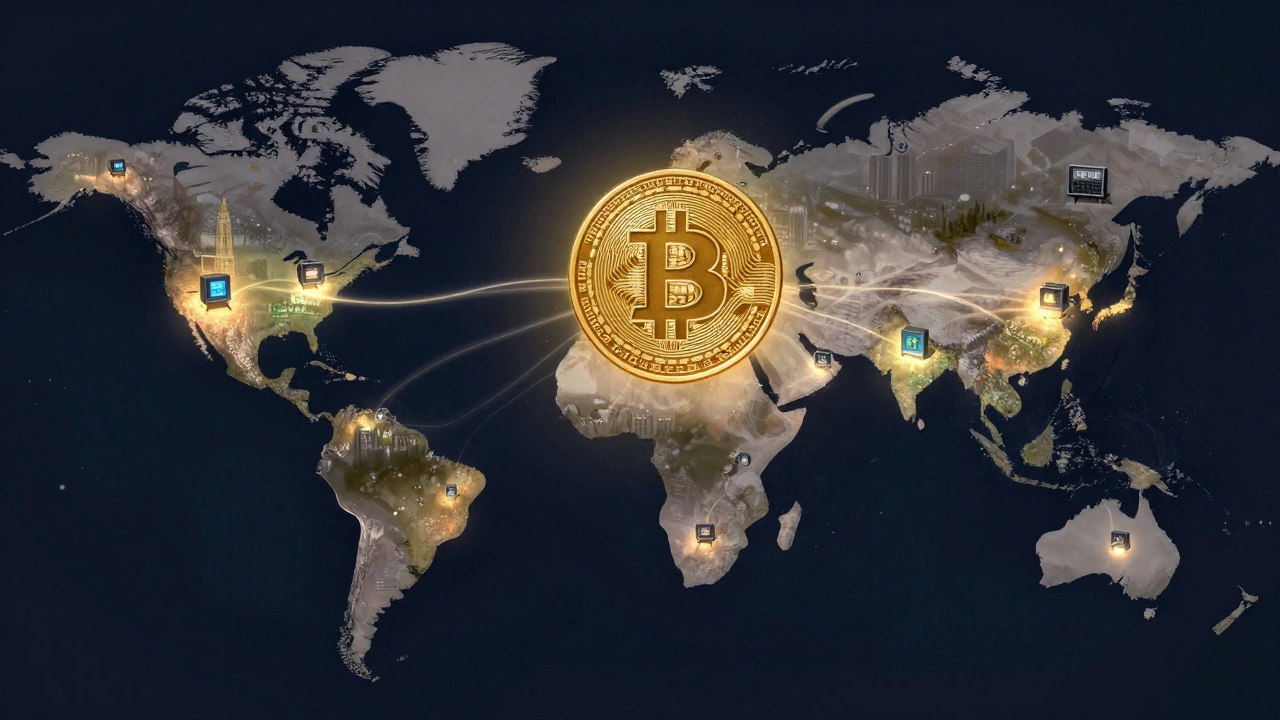
Every Bitcoin transaction is recorded on a public, global ledger called the blockchain. This isn’t stored on one server. It’s copied across tens of thousands of computers around the world. If someone tries to change a transaction, the network rejects it. That’s because every computer checks every other computer’s copy. It’s like having 30,000 people watching you write a check - and none of them will let you lie.
To send Bitcoin, you need a digital wallet. This isn’t a physical thing. It’s a pair of keys: a public key (your Bitcoin address) and a private key (your password). Your public key is like your bank account number - you can share it to receive money. Your private key is like the PIN to your account. Lose it, and your Bitcoin is gone forever. No one can recover it. No customer service line can help.
Transactions are confirmed by miners. They bundle up recent transactions, solve a cryptographic puzzle, and add the block to the chain. In return, they get newly created bitcoins and small fees paid by users. During busy times, like when Bitcoin’s price spikes, fees can jump. In November 2021, one transaction cost over $60. Today, fees average around $1-$3. That’s still higher than PayPal or Venmo - but it’s a trade-off for being decentralized.
Bitcoin vs. Other Cryptocurrencies
There are over 25,000 cryptocurrencies now. Ethereum, Solana, Dogecoin - they all have their fans. But Bitcoin still dominates. As of 2025, it makes up about 40% of the entire crypto market. Why? Because it’s the oldest, the most secure, and the most trusted.
Ethereum lets you build apps on top of its network - things like loans, games, and automated contracts. Bitcoin doesn’t do that. It’s simpler. It’s just money. And that’s exactly why some people prefer it. Think of Bitcoin as digital gold. It’s not meant for buying coffee every day. It’s meant to hold value over decades.
But Bitcoin has weaknesses. It’s slow. The network can only handle about 7 transactions per second. Visa handles 65,000. Bitcoin’s energy use is also high - around 110 terawatt-hours per year, similar to the entire country of Belgium. Critics say that’s unsustainable. Supporters argue that mining is increasingly powered by renewable energy, and the security it provides is worth the cost.
Who Uses Bitcoin and Why
Most people don’t use Bitcoin to pay for groceries. A 2023 survey found that 67% of Bitcoin owners see it as an investment, not a currency. People buy it because they believe it will go up in value. Some bought it in 2010 for pennies. One Reddit user turned $1,000 into $1.2 million by 2021.
Others use it to protect their savings from inflation. In countries like Argentina, Nigeria, or Venezuela, where local currencies have lost value fast, Bitcoin is a lifeline. Even in the U.S., some people hold Bitcoin as a hedge against future economic instability.
Businesses are slowly catching on. Over 2,300 merchants accept Bitcoin directly - mostly online stores, tech companies, and nonprofits. But the real shift is happening in institutions. BlackRock, Fidelity, and other Wall Street firms now offer Bitcoin ETFs. That means regular investors can buy Bitcoin through their 401(k)s or brokerage accounts without ever touching a wallet or private key.
How to Get Started
If you want to try Bitcoin, here’s how to begin:
- Choose a wallet. For beginners, a mobile app like BlueWallet or Exodus is easiest. For large amounts, use a hardware wallet like Ledger or Trezor.
- Buy Bitcoin. Use a trusted exchange like Coinbase, Kraken, or Binance. You’ll need to verify your identity - it’s required by law.
- Transfer your Bitcoin to your wallet. Never leave large amounts on an exchange. Exchanges get hacked. Your wallet, your control.
- Learn how to back up your private key. Write it down on paper. Store it in a safe place. No cloud, no email, no photo.
Don’t invest more than you can afford to lose. Bitcoin’s price can swing 20% in a day. In 2022, it dropped from $68,000 to $16,000 in under six months. People who bought at the top lost half their money. Those who held on saw it rebound.
The Risks and Problems
Bitcoin isn’t risk-free. Here are the big ones:
- Lost keys: About 20% of all Bitcoin - roughly 4 million coins - are permanently lost because people forgot passwords or threw away hard drives. That’s over $100 billion gone.
- Scams: Fake wallets, phishing sites, and fake influencers trick people every day. If it sounds too good to be true, it is.
- Regulation: Governments don’t know what to do with Bitcoin. China banned it. El Salvador made it legal, then reversed course. The U.S. is still deciding. Laws could change overnight.
- Volatility: Bitcoin’s price swings are wild. Its annual volatility is 80%. Gold is 15%. The S&P 500 is 18%. If you can’t sleep when the price drops, don’t buy it.
What’s Next for Bitcoin
Bitcoin isn’t standing still. In April 2024, the mining reward dropped from 6.25 to 3.125 BTC per block - an event called the "halving." Historically, this has been followed by price surges. After the 2020 halving, Bitcoin went up 600% in 18 months.
The Lightning Network is another big development. It’s a second-layer system that lets you send Bitcoin instantly and for pennies. In 2025, it processes over $200 million daily. That’s starting to make Bitcoin usable for everyday payments.
And then there’s the ETFs. Since January 2024, over $30 billion has flowed into Bitcoin ETFs in the U.S. alone. That’s institutional money coming in - not just speculators. It’s changing how people think about Bitcoin. It’s no longer just a tech experiment. It’s a financial asset.
Some experts predict Bitcoin could hit $1.5 million by 2030. Others say $35,000 is its real value. The truth? No one knows. But what we do know is this: Bitcoin has survived 16 years, two major crashes, government bans, media ridicule, and endless skepticism. It’s still here. And it’s growing.
What is Bitcoin in simple terms?
Bitcoin is digital money that works without banks. You can send it directly to anyone, anywhere, using the internet. It’s secured by math and a global network of computers. No government controls it, and there’s only ever going to be 21 million of them.
Can Bitcoin be hacked?
The Bitcoin network itself has never been hacked. The blockchain is too secure. But people get hacked all the time - usually because they use weak passwords, store keys on their phones, or fall for scams. Your wallet is only as safe as you make it.
Is Bitcoin legal?
Yes, Bitcoin is legal in the U.S., Canada, the EU, Japan, and most major countries. Some countries like China and Nigeria have banned financial institutions from dealing with it, but owning or trading Bitcoin isn’t illegal for individuals. Always check your local laws.
How do I store Bitcoin safely?
For small amounts, use a trusted mobile wallet like BlueWallet. For anything over $1,000, use a hardware wallet like Ledger or Trezor. These devices store your private keys offline, so hackers can’t reach them. Always write down your recovery phrase on paper and keep it in a fireproof safe.
Why is Bitcoin so expensive?
Bitcoin’s price comes from demand, not cost. There are only 21 million coins, and more people want them every year. Institutions, countries, and everyday investors are buying. Supply is fixed. Demand keeps rising. That’s what drives the price up.
Can I mine Bitcoin at home?
Technically yes, but practically no. Mining today requires specialized hardware that costs thousands of dollars and uses as much electricity as a small house. You’ll spend more on power than you’ll earn in Bitcoin. Mining is now done by large companies with access to cheap energy.
What happens when all 21 million Bitcoins are mined?
After the last Bitcoin is mined (expected around 2140), miners will still be paid - but only through transaction fees. Users will pay small fees to have their transactions confirmed. The network will keep running because people still need to send Bitcoin. The security model doesn’t break; it just changes.
Is Bitcoin bad for the environment?
It uses a lot of electricity - about 110 terawatt-hours per year. But over half of that comes from renewable sources like hydro, wind, and solar. Mining operations are moving to places with excess energy, like Quebec and Texas. Compared to the global banking system or gold mining, Bitcoin’s footprint is still smaller - but it’s not zero. Efficiency is improving.



Amy P
December 4, 2025 AT 05:59Okay but have you ever tried sending Bitcoin during a network spike? I paid $60 in fees once to send $200. I cried. Not because I lost money-because I realized I was trusting a system that doesn’t care if I cry.
Mongezi Mkhwanazi
December 4, 2025 AT 20:55Let’s be honest: Bitcoin is a glorified tulip bulb with a blockchain. The 21-million-coin limit isn’t scarcity-it’s psychological manipulation engineered by libertarians who think gold should be digitized. And don’t get me started on the "decentralized" myth-mining is now dominated by three Chinese conglomerates and a handful of U.S. hedge funds with access to cheap hydroelectric power. The ledger is public, yes-but the power? Oh, it’s centralized. Just more quietly.
Ashley Kuehnel
December 5, 2025 AT 17:13Hey newbies-please, please, please don’t leave your BTC on exchanges. I lost a friend’s 5 BTC in 2018 because they trusted Coinbase to "hold it safe." No one can recover it. Ever. Use a Ledger. Write down your 24 words. Keep it in a metal box. No photos. No cloud. No email. I’m not joking. This isn’t banking. This is like hiding your will in a fireproof safe-and then forgetting where you put the key.
Colby Havard
December 7, 2025 AT 15:40It is, however, worth noting, that the foundational premise of Bitcoin-namely, the elimination of intermediary trust through cryptographic consensus-is not merely an innovation in finance, but a philosophical reorientation of the social contract regarding value. One might argue that it represents the first truly apolitical currency in human history-though, of course, its adoption is inevitably shaped by political forces.
Aryan Gupta
December 7, 2025 AT 19:29They say Bitcoin is secure. But what if the entire blockchain is just a front? What if the miners are controlled by the Fed? What if the halving events are pre-programmed by the same people who printed trillions in 2020? I’ve seen the patterns. The timing. The media hype. It’s all connected. They want you to think you’re free-but you’re just trading one illusion for another. And your private key? It’s not yours. It’s a trap.
Fredda Freyer
December 7, 2025 AT 20:26People obsess over price, but the real magic of Bitcoin is that it forced the world to ask: What even is money? Is it a number in a bank? A piece of paper backed by a government? Or is it something that exists because enough people agree it has value? Bitcoin doesn’t answer that-it just makes you stare at the question until it hurts. And that’s why it survives. Not because it’s perfect. But because it’s honest.
Mark Nitka
December 9, 2025 AT 17:54Bitcoin isn’t perfect, but it’s the only thing that’s lasted. Every altcoin dies. Every hype cycle collapses. But Bitcoin? It just keeps going. Even when the media laughs, even when governments ban it, even when your uncle loses his life savings on a meme coin-Bitcoin just sits there, quietly mining, quietly growing. It’s not a currency. It’s a test. And so far, it’s passing.
Kelley Nelson
December 10, 2025 AT 02:49The notion that Bitcoin is "digital gold" is a romanticized fallacy propagated by those who misunderstand both gold and digital assets. Gold has intrinsic utility in industry, dentistry, and electronics; Bitcoin has none. Its value is entirely speculative, derived from collective belief-something that, historically, has always ended in disillusionment.
adam smith
December 10, 2025 AT 09:01Bitcoin is just internet money. It’s not cash. It’s not gold. It’s just something people trade. I don’t get it. But if you wanna buy it, go ahead. Just don’t cry when it crashes.
Tyler Springall
December 12, 2025 AT 03:10How dare you call Bitcoin "digital gold"? Gold is tangible. It has weight. It has history. Bitcoin is a spreadsheet maintained by people who think "proof of work" is a virtue. The fact that you’d rather trust a 16-year-old algorithm than the Federal Reserve tells me everything I need to know about your relationship with reality. And don’t even get me started on the Lightning Network-another overhyped Band-Aid on a broken system. The only thing this thing has proven is that humans will pay for the illusion of freedom.